
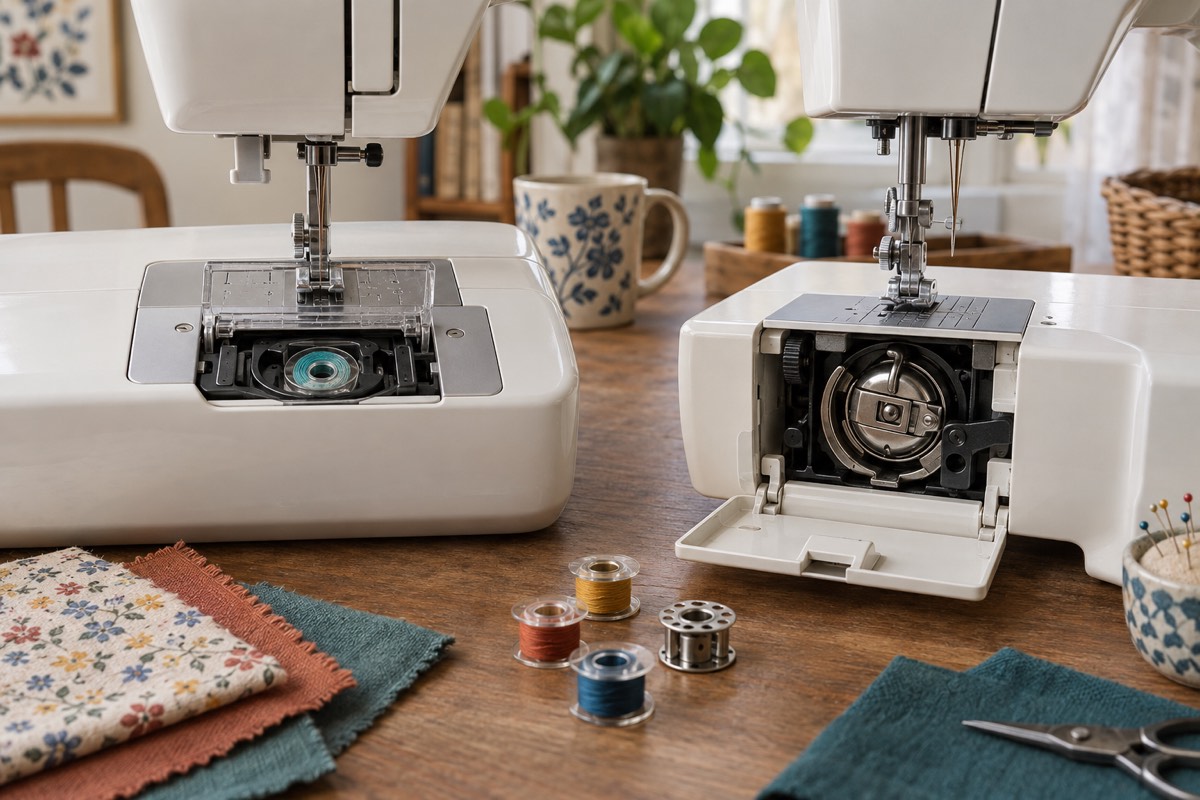
Every lockstitch sewing machine combines upper thread with bobbin thread below the fabric. “Top loading” and “front loading” describe how that lower thread package is arranged and reached. They do not tell you whether a machine is powerful, precise or suitable for a particular fabric.
How the two bobbin systems differ
Most current domestic top-loading machines use a horizontal rotary hook. The bobbin lies flat beneath a clear plate and is dropped into a fixed holder. A marked thread path guides the tail into position.
A common front-loading machine uses a vertical hook and a removable metal bobbin case. The accessory compartment is removed, the case is released from the front of the free arm, and the wound bobbin is inserted into it before the assembly is returned.
There are variations, so the exact manual—not a generic video—should decide bobbin orientation, thread path, case insertion, oiling and cleaning.
Why beginners often prefer top loading
The practical advantages are visibility and fewer loose parts during ordinary setup:
- the remaining thread can often be seen through the cover;
- the bobbin is inserted where the sewist can look directly down on it;
- there is no separate case to hold while routing the thread;
- some systems pick up the lower thread automatically after the tail is placed in a cutter channel.
The Brother LX17 is a straightforward example. Its horizontal top-loading bobbin sits under a transparent cover, complementing the machine’s simple mechanical dials.
Brother LX17
Best for a new sewist who values an uncomplicated dial layout and wants to learn on a full-size machine without paying for electronic controls.
A straightforward mechanical machine with a top-loading bobbin, 17 stitches and the core feet needed for everyday repairs, simple garments and home projects.
Keep in mind
- Its four-step buttonhole takes more input than a one-step system.
- There is no speed-limiting slider or automatic needle threader.
Top loading is not foolproof. A bobbin placed in the wrong direction, thread outside the tension spring, an overfilled or unevenly wound bobbin, or lint under the holder can still cause loops and poor tension. Clear plastic covers can also become scratched, and the bobbin holder must not be forced or damaged by an incorrectly fitted needle plate.
Why front-loading bobbins remain useful
Front-loading cases are familiar to generations of sewists and remain common on capable mechanical machines. The removable case gives direct access for cleaning and lets an experienced user feel whether the bobbin thread is seated in its tension spring. A spare case can sometimes be prepared for a specialist thread or tension setup—but only when the manufacturer permits it.
The trade-off is a less visible, more hand-intensive change. You may need to remove the flat-bed compartment, open a cover, hold the case latch and align its locating finger correctly. Remaining thread cannot usually be checked at a glance.
The Janome 2200XT uses a front-loading bobbin as part of a conventional mechanical layout. It remains a credible beginner machine for someone who values simple controls, drop feed and a free arm more than top-down bobbin visibility.
Janome 2200XT
Best for a beginner who prefers simple controls but wants drop feed for free-motion work and a broader utility-stitch range than the most basic machines.
A six-kilogram mechanical all-rounder with 22 stitch options, adjustable stitch length, drop feed and a free arm, operated through two main dials.
Keep in mind
- The front-loading bobbin is less visible while sewing than a clear top-loading system.
- The buttonhole is a four-step design rather than a one-step automatic cycle.
Neither layout is inherently quieter or better tensioned across all machines. Hook design, manufacturing, timing, needle condition, thread path and maintenance all affect the stitch. Claims that one orientation always produces a stronger stitch should not drive a purchase.
Common bobbin faults—and what the layout changes
Tangled thread underneath the fabric
Large loops below the work often point to the upper thread not entering its tension path, especially if the presser foot was down during threading. Rethread the upper path with the presser foot raised, insert a fresh correct needle, then reinsert the bobbin according to the manual. Do not tighten the bobbin-case screw as a first response.
The machine will not pick up bobbin thread
Confirm bobbin orientation, case or holder seating, needle insertion and handwheel direction. Use the specified bobbin type: two bobbins that look similar can differ in height, curvature or material. A wrong bobbin can move badly or damage the holder.
Uneven winding
Wind at the machine’s specified speed with thread correctly routed through the winding tension guide. Stop if the thread piles to one side. Never wind a bobbin while the needle mechanism is engaged unless the manual explicitly describes that setup.
Lint and broken thread
Switch off and unplug before removing covers or placing fingers near the needle area. Brush lint as the manual directs. Avoid blowing debris deeper into the mechanism and do not add oil unless the model instructions specify where and what to use.
Which bobbin style should you choose?
Choose top loading if you are a new sewist, want to monitor thread without removing the work, have dexterity concerns, or expect frequent colour changes. The Janome Sewist 725S combines that convenience with mechanical controls and adjustable presser-foot pressure for garment sewing.
Janome Sewist 725S
Best for a dressmaker who wants tactile mechanical controls but also needs foot-pressure adjustment and a more convenient top-loading bobbin.
A 25-stitch mechanical machine with a top-loading bobbin, adjustable presser-foot pressure, one-step buttonhole and hard cover.
Keep in mind
- It has no speed limiter or needle up/down control.
- At 6.7 kg plus its hard cover it is portable, but not the lightest machine for weekly travel.
Choose front loading if you already know the system, prefer a machine whose other controls and support better suit you, or want a specific mechanical model that uses it. Do not reject an otherwise suitable machine solely because the bobbin is vertical.
At a dealer, ask to wind, remove and reinsert the bobbin yourself. Check whether the symbols are visible, the cover is easy to open and the correct spare bobbins are readily available. Then evaluate the more consequential features: speed control, buttonhole system, feeding, workspace, warranty and service route. Our guide to features worth paying for puts those priorities in order.
Frequently asked questions
Are plastic bobbins worse than metal bobbins?
No general rule applies. Use the exact type and material specified for the machine. Substituting a metal bobbin in a system designed for plastic—or vice versa—can alter fit and interfere with sensors or the holder.
Can I adjust bobbin tension myself?
Routine problems should first be addressed through correct threading, a suitable fresh needle, correct bobbin and cleaning. Some manuals describe bobbin-tension adjustment; many users are better served by a technician because small changes are hard to reverse accurately.
Does a top-loading bobbin jam less?
Not by definition. “Jam-proof” is a product claim about a particular system, not a guarantee against incorrect threading, damaged needles, lint or unsuitable thread. Correct setup matters on both layouts.
Sources
The comparison is based on current model documentation for the Brother LX17, Janome 2200XT and Janome Sewist 725S, alongside the Brother sewing-machine buyer’s guide.