
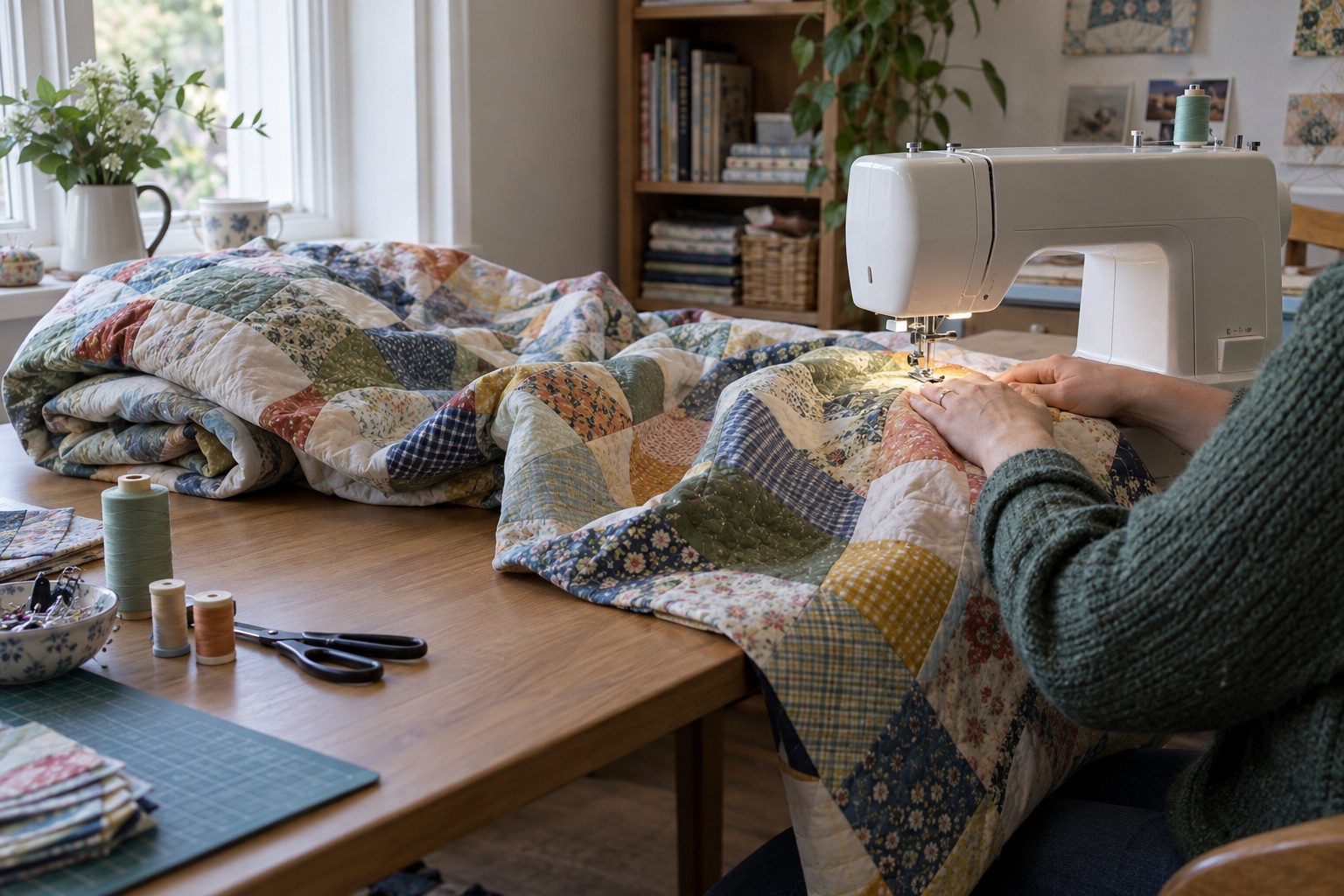
A domestic machine can quilt more than a small cushion, but the challenge is the fabric's mass and the number of times it must turn, not merely the number of stitches the machine offers. A large quilt that hangs off the table tugs against the needle and can distort even a well-basted line. Set up the room and choose a manoeuvrable design before starting.
Choose a design the machine can execute
Straight or gently curving lines with a walking foot are usually easier to manage than a dense all-over free-motion pattern on a first bed-size quilt. Sketch the intended lines on a scale drawing of the top. Mark where the quilt must turn and which sections will be inside the throat. A line running from one edge to another may sound simple but can require a large turn at the centre; shorter planned sections may be easier.
Use a sample sandwich of the same top, wadding and backing to set stitch length and inspect tension. Choose a needle and thread suited to the materials; change the needle if it begins to deflect or skip. Check the wadding maker's quilting-distance guidance so the stitched pattern is sufficiently close to keep layers stable after washing.
Baste for the whole journey, not only the first line
Lay the backing, wadding and top flat, smoothing without stretching. Secure all three layers using a basting method compatible with the fabrics and machine—pins, hand basting or a temporary adhesive used according to its instructions. If pin basting, remove pins well before they reach the foot and needle. Sewing over them can break a needle or damage the machine.
Look for ripples before moving to the machine. A wrinkle trapped under the first line rarely improves later. Mark the quilting lines with a tool tested on an offcut for full removability. If the marking or basting method needs washing, ensure every fabric and thread in the quilt tolerates that treatment.
Support the weight on both sides
Clear a stable table to the left and behind the machine, and position the machine so fabric can pass away from the needle without meeting a wall. An extension table keeps the quilt level at the needle. The Janome 5060QDC includes that table and an even-feed foot, a useful pairing for a home straight-line setup. The table does not enlarge the arm opening; it reduces the unsupported weight pulling down on the seam.
Janome 5060QDC
Best for a home quilter who wants the useful feet and table in the standard UK package while retaining a versatile dressmaking machine.
A 60-stitch computerised machine supplied with an extension table, quarter-inch foot, open-toe even-feed foot and free-motion foot.
Keep in mind
- The extension table supports fabric but does not enlarge the opening to the right of the needle.
- Large quilts still demand a supported table and careful handling of the bulk.
Roll or accordion-fold the portion going into the throat loosely enough to move. Keep the active stitching area flat. Shift the excess fabric with both hands well away from the needle and stop sewing whenever it starts dragging. A second table, cleared dining surface or temporary support can help more than a more expensive machine placed on a narrow desk.
The Brother F580 lists 190 mm of sewing workspace and includes a walking foot. That extra opening can ease a mixed sewing-and-embroidery household's quilt handling, but its benefit depends on a level supported table and the size of the sandwich.
Brother Innov-is F580
Best for a sewist who will use both functions regularly and needs more design room and sewing workspace than a compact combination machine provides.
A combined machine with a 180 × 130 mm embroidery field, 190 mm sewing workspace, wireless transfer, adjustable foot pressure and an included walking foot.
Keep in mind
- It is a substantial investment and takes more permanent table space than the M380D.
- One machine still cannot sew while embroidery is running; changing modes remains part of the workflow.
Work in manageable sections
Start with the route suited to your design and basting method, often near the centre of the top so the remaining bulk can be redistributed. Sew one planned section, stop with the needle safely positioned, lift and rearrange the quilt, then continue. Avoid pulling from behind or forcing a tight roll through the arm. If you must rotate the quilt, stop, support its weight and turn deliberately rather than twisting it while the needle is moving.
For straight-line quilting, install a compatible walking/even-feed foot by the manual and test that the needle clears its opening by turning the handwheel before sewing. For free motion, use the correct foot and feed-dog arrangement, and practise moving a small sandwich at a speed that gives balanced stitches. These methods need different setups; walking foot vs dual feed explains one of the choices.
When the quilt bunches or stitches vary
If the top layer creeps, check basting and upper-feed setup. If stitches shorten or vary, see whether the quilt is dragging off the table or whether you are moving it inconsistently. If the needle strikes heavily at seam intersections, stop and check the needle, foot level and layer thickness rather than using more pedal pressure. For persistent underside loops, rethread and test on the same layered sample before altering tension.
There is no failure in outsourcing one large top. If your machine's opening will not pass the prepared sandwich freely, or the design requires repeated tight turns that you cannot control, long-arm quilting or a simpler design may be the more sensible choice. Keep the domestic machine for piecing and smaller projects where it is comfortable.
Frequently asked questions
Should I start quilting in the centre?
For many designs it helps distribute potential movement outward, but the exact route depends on basting, pattern and machine setup. Plan the whole sequence before stitching rather than applying one rule blindly.
Should I make the quilt roll as tight as possible?
No. Compact enough to pass is useful; crushing the sandwich makes it harder to move and can distort layers. Rearrange or divide the work if it jams.
Can an extension table solve all large-quilt problems?
It provides level support but cannot increase throat width or height. You still need space behind and to the side, secure basting and a suitable quilting plan.
Sources
Machine package details use Janome 5060QDC and Brother F580. Foot and guide use follows Brother's quilting guide and walking-foot instructions.