
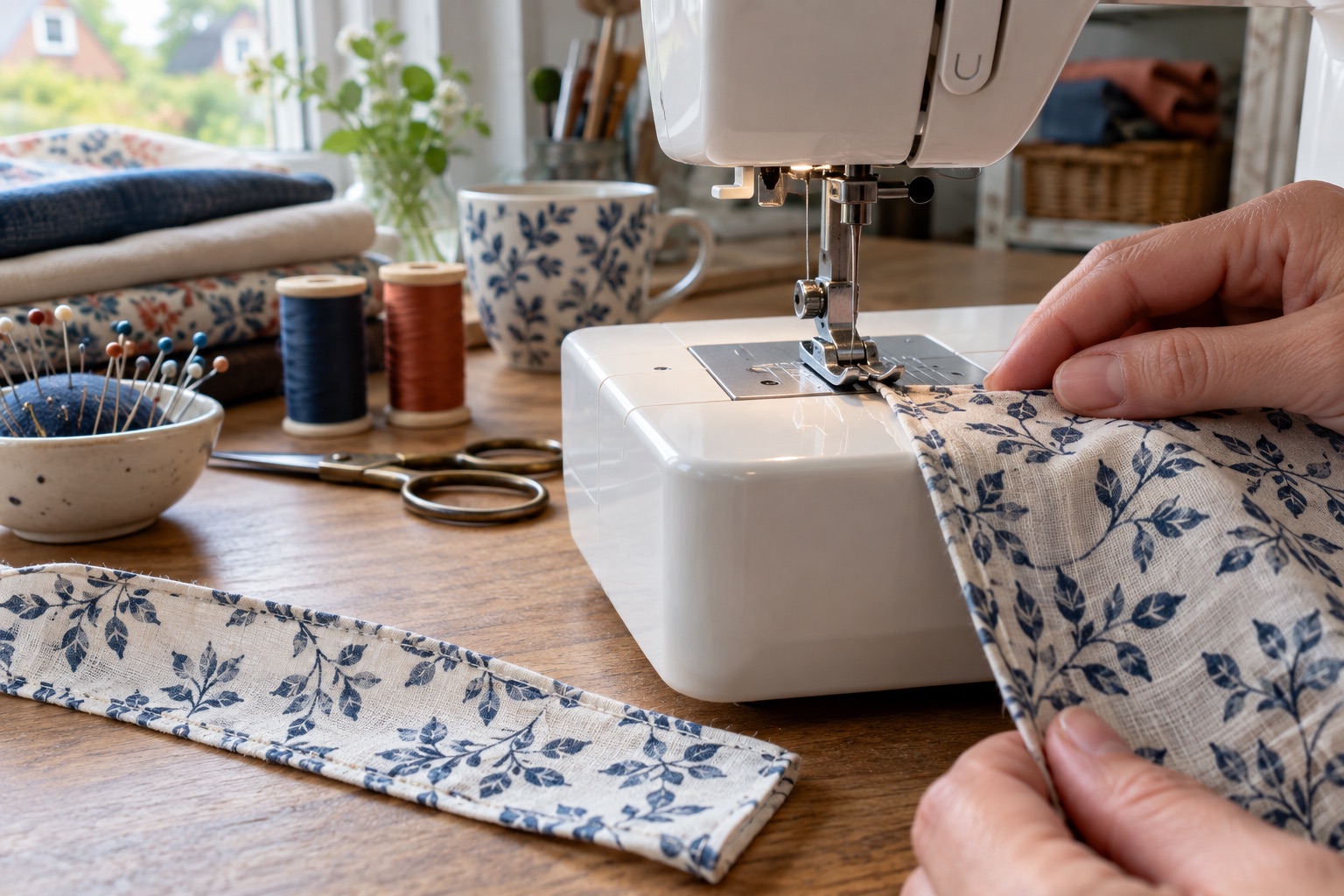
“Rolled hem” covers more than one finish. On an ordinary sewing machine, a narrow hemmer foot turns the cut edge through its scroll and holds a slim double fold as a straight stitch secures it. On an overlocker, a rolled hem is formed by loopers around an edge, often after changing stitch settings and sometimes knife position. The two may look similar from a distance, but they are not the same construction.
When is the domestic foot useful?
Light, reasonably stable woven cotton, voile or a similar fine fabric is the natural starting point. A long scarf edge, frill or sheer curtain may reward the consistent width once you can feed it. Heavy denim, thick seam intersections and stretchy jersey fight the scroll. A soft bias edge may stretch while entering; a highly fraying cloth can lose fibres before the second turn catches them. In those situations, press-and-stitch a double hem, use a suitable stabilising technique or choose another finish instead of forcing fabric into a tiny channel.
The foot's advertised “7 mm” can describe the machine's stitch-width family rather than a guaranteed finished hem width. Check the maker's actual foot specification and make a measured sample. The Brother F002N page describes a flat narrow hem on lightweight fabric, not a universal width for every project.
Start the hem before the scroll takes over
Square the beginning of the edge and trim stray threads. At the first few centimetres, turn the fabric edge twice by hand to roughly the intended depth and press or finger-crease it. With the machine off, attach the compatible foot and choose the maker-approved straight stitch and needle position. Check clearance by turning the handwheel. Sew a few stitches on the pre-folded start, stopping with the needle down. Raise the foot if your instructions permit, then guide the unsewn edge into the scroll, keeping the turned beginning behind the needle.
Resume slowly. Hold the incoming edge at a gentle angle so it enters the curl, but let the feed dogs move it. Too much fabric entering creates a broad, rope-like hem; too little leaves a raw whisker. Practise on a long scrap before attempting a garment edge. At corners or bulky seams, stop, trim or grade the allowance where appropriate and consider finishing that short section by hand rather than pulling a thick junction through the foot.
Correct the feed, not just the stitch length
If the raw edge escapes, more fabric needs to enter the curl or the cloth may be too slippery. If the hem varies in width, look at your incoming angle and whether the cloth is held under even tension. If it puckers, test a finer suitable needle, ordinary thread and a different stitch length on the same fabric. The puckering guide separates feeding and tension causes. For a one-off hem, a carefully pressed double turn sewn with the all-purpose foot is a perfectly sound result; the foot is a productivity aid, not a badge of quality.
Buy for a repeated fabric and an exact machine
Brother's F002N is a maker-documented example for compatible machines. The Amazon UK Brother 7 mm narrow-hemmer listing below does not display “F002N” in its title, so confirm that code with the retailer and Brother's model list before ordering; do not rely on our card as proof of a specific part code. If the match cannot be established, use the maker's authorised dealer instead. This caution matters more than saving a few pounds on a six-foot generic pack.
Brother 7 mm narrow hemmer foot
Worth considering for repeated light-fabric hems only after the seller confirms the exact F002N part code for the buyer's compatible machine.
A narrow hemmer foot for compatible Brother machines, designed to form a flat small hem on lightweight woven fabric.
Keep in mind
- The 7 mm listing label refers to the machine/foot family; do not assume it promises a 7 mm finished hem.
- Not a substitute for an overlocker's rolled hem on knit or for heavy fabric hemming.
Frequently asked questions
Is a rolled-hem foot good for jersey?
Usually not the best first choice. The scroll can stretch the knit and a straight stitch may snap. Test an appropriate stretch hem method instead.
Can I make the same hem without the foot?
Yes. Press two narrow turns and sew slowly with an all-purpose foot, or use a temporary guide for a long straight edge.
Why does fabric bunch in the scroll?
Too much fabric may be entering, the edge may be fraying or a seam crossing may be too thick. Stop and restart on a flat, stable sample.
Sources
Brother's F002N narrow-hemmer specification identifies the intended lightweight-fabric finish. Janome's sewing videos show a hemmer-foot approach, and its maintenance guidance describes standard-foot alternatives. Confirm the foot, stitch and machine pairing before fitting.