
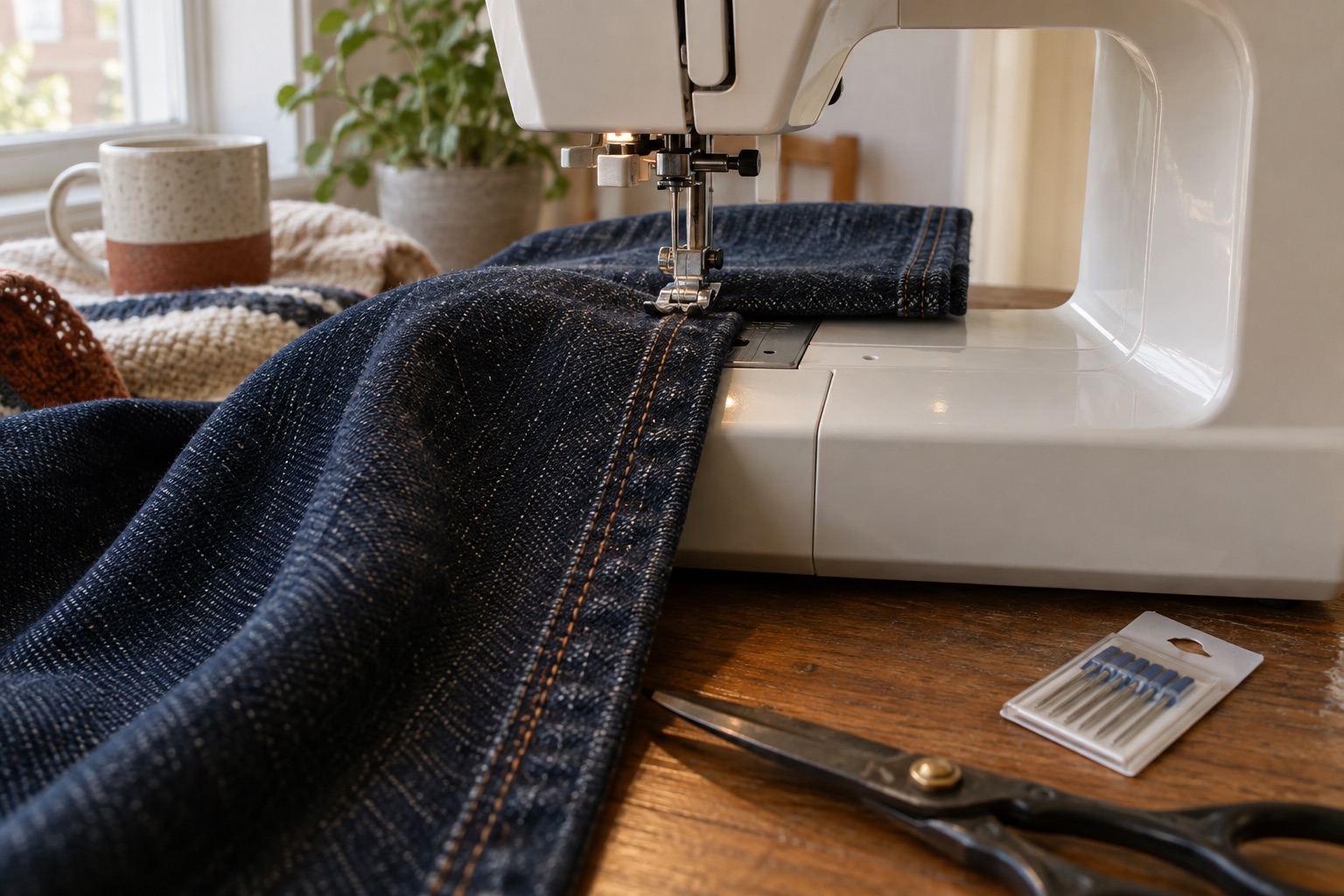
“Sewing denim” can mean one layer of light chambray, a jeans side seam, or a hem crossing a factory flat-felled seam. Those are different loads. Before choosing a heavier machine, test the exact number of layers you must cross. If a repair is beyond your machine's clearance, a local alterations service is safer than forcing it.
Map the thickest point before cutting
Inspect the garment for seam architecture, rivets and bulky folded allowances. Never aim to sew through a metal rivet. For a new project, follow the pattern's cutting and seam allowances, press seams in the stated direction and grade allowances only where construction permits. A jeans hem often becomes much thicker where the original side seam folds into the hem; the flat sections are not a valid machine test.
Build a sample from the same denim and thread, folded to the true layer count. Slowly turn the handwheel towards you through the stack with the presser foot down, checking that the needle clears the foot and plate. If it does not penetrate freely, reduce bulk or stop.
Choose a Jeans needle and sensible thread
SCHMETZ's Jeans needle is a 130/705 H-J domestic needle with a reinforced design intended for denim and similar firm fabrics. Its assortment spans 90/14–110/18. Begin with the smallest size that forms reliable stitches with your thread through the actual layers. A 110/18 on light denim can make unwanted holes; a 90/14 at a thick hem may deflect. Change a bent needle immediately.
SCHMETZ Jeans needles, assorted sizes
Choose the smallest size that forms a clean stitch through the actual denim layers without deflection, starting with a fresh needle.
A five-needle 130/705 H-J assortment in 90/14–110/18 for testing denim, twill and canvas of differing weights.
Keep in mind
- A larger needle cannot give a domestic machine unlimited piercing or presser-foot clearance.
- 110/18 may leave excessive holes in lighter denim.
For structural seams, ordinary quality all-purpose polyester thread is a sensible first test. The Gütermann Sew-All card illustrates that category; the Amazon listing is white, so match the colour to your garment. Decorative jeans topstitching may use a heavier top thread, but that can need a larger eye and different tension. Do not put thick thread in both needle and bobbin without consulting the machine manual and sampling first.
Gütermann Sew-All polyester thread, white
A reliable general-purpose thread family for mixed garment fabrics; choose the shade that blends with your project rather than buying white by default.
A 100 m spool of 100% polyester Sew-All thread for everyday construction seams, repairs and machine sewing.
Keep in mind
- The linked listing is white; match colour locally if needed.
- It is not the same as a deliberately heavy decorative topstitch thread.
Keep the presser foot level at the step
As the front of the foot climbs a folded seam, the foot can tilt and the feed dogs lose contact. Pause with the needle up, position a purpose-made height-compensation tool or a firm folded scrap behind the foot at roughly the same height, then stitch slowly. Remove it when the foot has crossed. Some feet have a levelling button: use it only as described for that model. Do not pull the garment from behind or force the handwheel when it resists.
The Brother HF37 includes a J foot with a levelling button and a non-stick foot. That is a meaningful feature if denim crossings and bags are regular projects, but it does not give unlimited material capacity. The needle, thread and seam geometry still decide the result. If you are comparing machines rather than solving one repair, read our denim-machine guide.
Brother HF37
Best for bags, jeans alterations and mixed dressmaking where a mechanical control layout and help over bulky seam steps matter.
A 37-stitch mechanical machine with a top-loading bobbin, levelling-button foot, non-stick foot, adjustable stitch dimensions and a hard case.
Keep in mind
- There is no maximum-speed slider.
- Its domestic heavy-duty positioning does not make it an industrial or walking-foot machine.
Make topstitching look deliberate
Press the seam flat first. Work from the visible side with a consistent seam guide or a measured offset from the edge. Use a longer stitch only after comparing samples; very short stitches can crowd heavy denim and make unpicking damaging. If using contrasting thread, test its appearance on both sides and at a crossing. Two separate rows are easier to control than a twin needle when the seam height changes sharply.
At a jeans hem, check the required finished length while wearing the intended shoes. Fold evenly and baste or clip the allowance so it cannot creep. Sew slowly around the tube with the free arm if the garment fits; never force a narrow leg around a machine bed.
Stop before the machine is damaged
Stop if the needle visibly bends, strikes the plate, repeatedly breaks, or if the motor slows markedly. Check for a blunt needle, wrong insertion, incorrect threading, an uneven foot and too many layers. Reducing bulk or using a different seam construction is often the fix. A “heavy-duty” domestic label is not an industrial rating.
Frequently asked questions
What needle size should I use for denim?
There is no one size for all denim. Test a compatible Jeans 90/14 for moderate layers, then 100/16 if the stack and thread need it. Reserve 110/18 for genuinely dense work that your machine can handle.
Can I use normal sewing thread on jeans?
Yes, especially for construction and repairs. Decorative topstitch thread is a separate choice and may require needle and tension changes.
Do I need a heavy-duty machine?
Not for every denim task. A well-set domestic machine may handle ordinary seams. Repeated multi-layer crossings and large bags justify closer attention to foot levelling, clearance and motor behaviour.
Sources
Needle construction and size range use SCHMETZ's Jeans needle specification. The levelling-foot example uses Brother's HF37 specification. For the actual machine's allowable needle sizes and threading, consult its manual.