
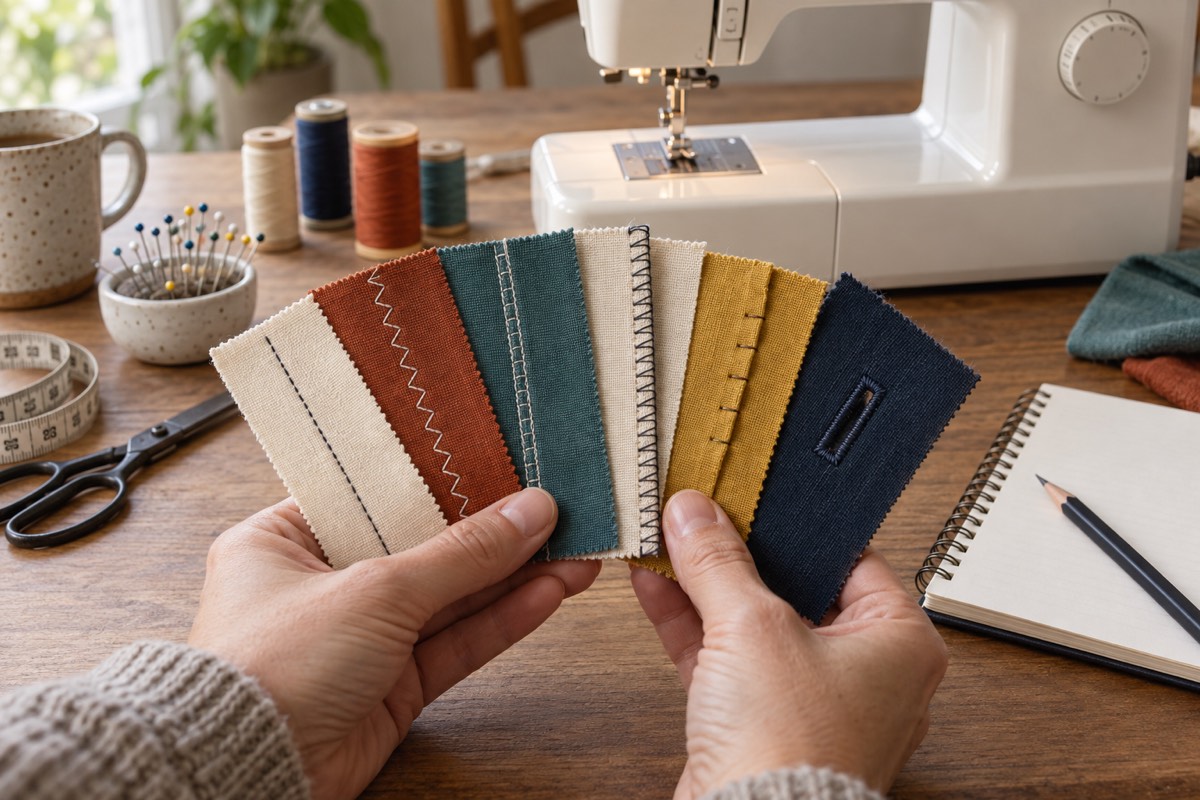
Stitch count is one of the easiest sewing-machine specifications to compare and one of the easiest to overvalue. A machine with 100 patterns is not automatically more capable at an ordinary seam than a machine with 17. What matters is whether it has the stitch families your projects require, whether their length and width can be adjusted, and whether the machine feeds your fabric consistently.
The two stitches almost everyone needs
Straight stitch
Straight stitch constructs most woven-fabric seams, topstitches edges, understitches facings, inserts some zips and gathers fabric when used with suitable settings. Look for adjustable length. Shorter stitches can suit fine or curved work; longer stitches can be useful for basting and topstitching. The right choice depends on fabric and purpose, so start with the pattern and manual, then sample.
Needle-position options can make straight stitch more versatile. Moving the needle helps control a narrow edge stitch or align a zipper foot, but confirm which presser feet and widths the manual permits.
Zigzag
Zigzag finishes some raw edges, attaches elastic, makes bar tacks, appliqués and provides controlled give for certain fabrics. Adjustable width and length make one zigzag setting perform many jobs. A dense, short zigzag behaves differently from a wide, open one.
The Brother LX17 demonstrates how far a modest specification can go: 17 stitches, straight and zigzag utility work, a four-step buttonhole and a top-loading bobbin. It suits basic woven projects without asking a beginner to navigate a large menu.
Brother LX17
Best for a new sewist who values an uncomplicated dial layout and wants to learn on a full-size machine without paying for electronic controls.
A straightforward mechanical machine with a top-loading bobbin, 17 stitches and the core feet needed for everyday repairs, simple garments and home projects.
Keep in mind
- Its four-step buttonhole takes more input than a one-step system.
- There is no speed-limiting slider or automatic needle threader.
Stretch and overcasting stitches
Stretch-seam options
Knits need a seam that can tolerate the garment stretching in wear. Depending on the fabric and machine, that may be a narrow zigzag, a lightning-style stretch stitch, a triple stretch stitch or another manual-approved pattern. No single icon is best for every jersey.
Sample the complete seam, then stretch it as the garment will be worn. Check whether stitches break, the fabric tunnels or the seam becomes wavy. Use a suitable ballpoint or stretch needle where the fabric and pattern call for it. Stitch choice cannot compensate for a damaged or incorrect needle.
Triple straight stretch stitch repeatedly moves backwards and forwards, producing a strong elastic seam but also placing more thread and needle penetrations into the fabric. It is slower to unpick, so it should be selected deliberately rather than used as a default.
Overcasting stitches
An overcasting or overedge stitch helps contain a raw edge using a normal sewing machine, often with a matching foot. It does not trim the edge and it does not form the same stitch as an overlocker. For occasional garments it may be entirely sufficient. Frequent knit sewing or a strong preference for fast, trimmed seam allowances can justify a separate overlocker.
If that distinction is the reason you are shopping, compare the workflows in overlocker versus sewing machine before assuming you need more stitches on the sewing machine.
Buttonholes, blind hems and specialist utility stitches
Buttonhole counts deserve more attention than decorative counts if you make garments. A four-step buttonhole asks you to select each stage. A one-step system uses a dedicated foot and completes the sequence in one cycle. Either can work well on prepared fabric, but the one-step route is easier to repeat.
The Brother Innov-is A16 has just 16 stitches but includes three one-step buttonholes, speed control and needle up/down. That is a good illustration of a compact stitch library paired with garment-focused controls.
Brother Innov-is A16
Best for garment sewing, careful learners and supervised teenagers who value slow-speed control more than a large decorative-stitch menu.
An electronic 16-stitch machine with a speed slider, needle up/down, three one-step buttonholes and a seven-point feed system.
Keep in mind
- It costs considerably more than a basic mechanical machine.
- At 6.6 kg it is class-portable rather than genuinely light.
A blind-hem stitch alternates straight stitches with an occasional sideways bite into a folded hem. It can create a discreet finish, but success depends on accurate folding, foot alignment and a thread colour that blends. It is useful rather than essential because hems can also be sewn by hand, topstitched or finished by other methods.
Other useful utility patterns may include darning, reinforced seams, shell tucks or elastic-attaching stitches. Read what the manual says each symbol is for. An unfamiliar icon is not extra capability until you can connect it to a project.
Why stitch totals can be misleading
Manufacturers may count left, centre and right needle positions as separate stitches, include mirrored decorative designs, or count each buttonhole style. That is not dishonest, but it means totals are poor cross-brand shorthand.
When comparing two machines, list these instead:
- straight-stitch length range and useful needle positions;
- zigzag width and length adjustment;
- at least one manual-approved stretch-seam option;
- an edge-finishing option and compatible foot;
- buttonhole method and included foot;
- whether stitch settings are direct, suggested or buried in a menu.
Decorative stitches can be enjoyable for quilting, labels and surface design. Buy them because you want that creative function—not because a higher number sounds more future-proof. Machine embroidery is a separate process using a hoop, digitised files and an embroidery mechanism; an alphabet on a sewing machine does not turn it into an embroidery machine.
Choose a stitch range for your work
Repairs and simple home sewing
Straight stitch, zigzag, a buttonhole and a free arm will cover many repairs, hems and cushion covers. A clear control layout is more valuable than a decorative bank.
Regular dressmaking
Add a one-step buttonhole, useful stretch and overcasting patterns, adjustable stitch dimensions and controls that make curves and pivots easier. The Brother SH40 offers 40 stitches and five one-step buttonholes, but its speed slider and needle up/down are the more important reasons to consider it.
Brother SH40
Best for a beginner who wants slower, capped sewing speed and controls that can support dressmaking, light quilting and more varied projects as confidence grows.
A compact electronic machine that adds a speed slider, start/stop control, needle up/down, 40 stitches and five one-step buttonhole styles without moving into a large chassis.
Keep in mind
- The compact 10 × 16 cm workspace is not designed for managing large quilts.
- Its extra controls and numbered stitch selection are less immediate than two mechanical dials.
Quilting and decorative work
Decorative stitches may be useful, but feeding, workspace, presser feet and needle-position control remain central. Confirm whether a walking foot, quarter-inch foot and extension table are included or compatible.
Heavy fabrics
Stitch count tells you very little. Needle system, motor behaviour, foot clearance, feeding and the thickness of actual seam crossings matter. “Heavy duty” still describes a domestic machine with limits. Use our denim guide for that decision.
The practical minimum is therefore not a magic number. Four to six stitch families can support years of sewing when the machine controls them well. Choose the functions, then let the published count fall where it may.
Frequently asked questions
Are 20 stitches enough for a beginner?
Usually, yes. Check that the set includes the utility stitches your planned projects require and that you can alter the important settings. Twenty relevant patterns can be more useful than 100 mostly decorative ones.
Do I need a special stitch for jersey?
You need a seam that stretches enough for the garment and fabric. That might be a narrow zigzag or a named stretch stitch. Use a suitable needle and sample the seam under realistic stretch.
Does an overcast stitch replace an overlocker?
It can finish many raw edges, but it does not trim and encase the edge in one operation. An overlocker is faster and forms a different stitch; it also takes more space, thread and setup.
Sources
Stitch functions and model examples are grounded in the Brother buyer’s guide, official Brother LX17, Brother Innov-is A16 and Brother SH40 specifications.