
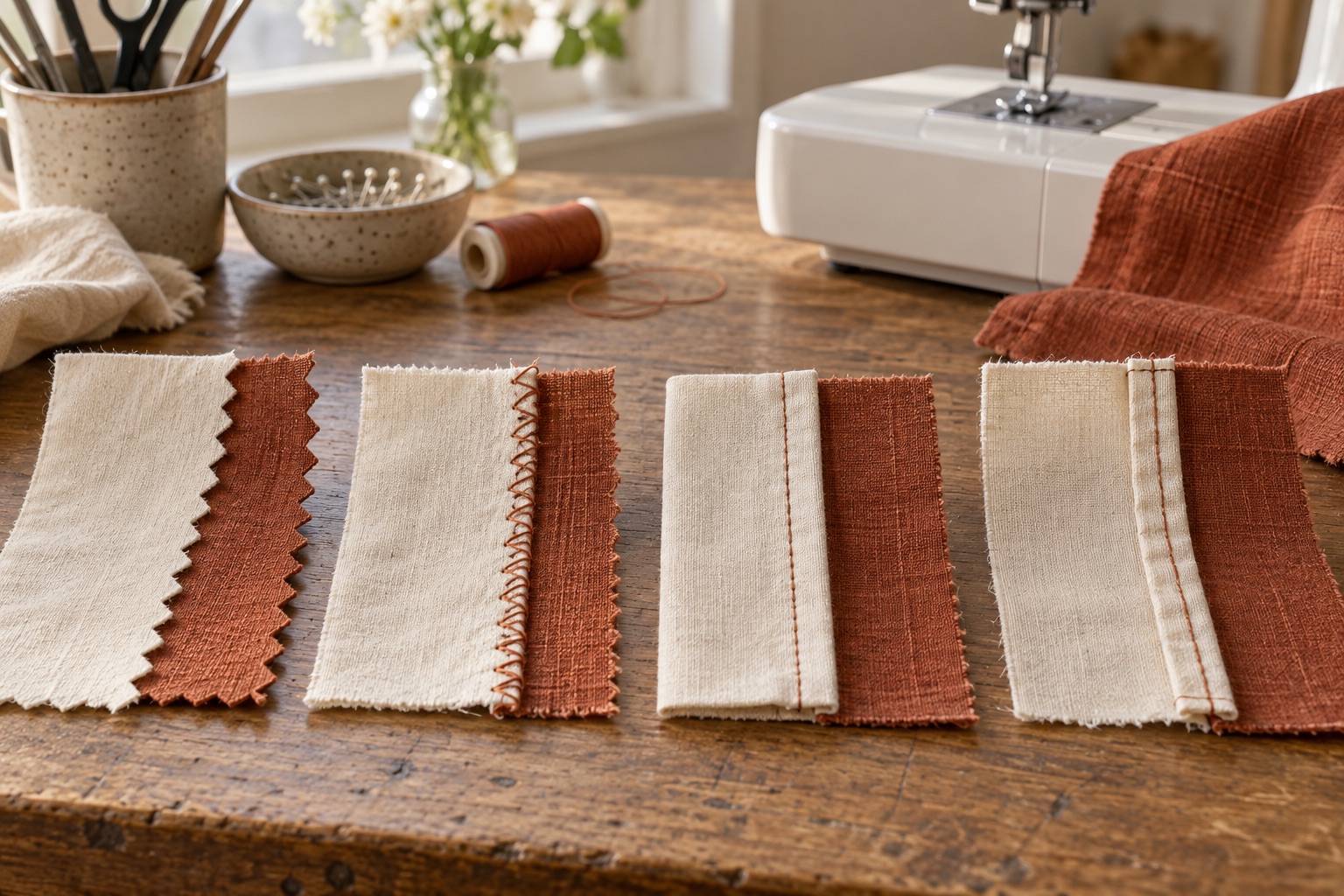
An overlocker is fast, but it is not the only way to keep a garment's inside durable and tidy. More importantly, a seam finish is not necessarily the seam that holds the garment together. Construct the seam at the pattern allowance first unless the pattern specifies a combined stitch, then finish the edge without trimming away the load-bearing stitches.
Let fraying and bulk decide
Woven linen and loosely woven cotton can shed threads quickly; firm quilting cotton often frays less in wear but still benefits from a finish on washable garments. Fine voile needs a finish that does not show harshly or add bulk. Thick denim may need graded allowances more than an elaborate bound edge. Jersey's cut edge usually does not unravel like a woven edge, though a visible inside may still be tidied.
On a folded offcut, sew the construction seam, press it open or to one side as the pattern requires, then try two finishes. Rub and wash the samples as the garment will be treated. Choose the one that remains flat, does not abrade and keeps loose fibres contained.
Zigzag or machine overcast: the workhorses
A medium-width zigzag placed near the raw edge can restrain fraying. Avoid sewing so close that the needle pulls the edge into a ridge; try a slightly wider allowance, then trim carefully outside the stitching if needed. If your machine has an overcasting stitch and compatible foot, its guide can help hold the edge. Brother's overcasting instructions specify checking by handwheel that the needle does not hit the foot after a width change. Never substitute a random foot because it looks similar.
For ordinary woven fabric, begin with a fresh compatible Universal needle of a size appropriate to fabric and thread. The assortment below covers common sizes for sampling. For a specialised fabric, use a more suitable point rather than forcing a larger universal needle.
SCHMETZ Universal needles, assorted sizes
A practical starting pack when the machine manual specifies the flat-shank 130/705 H system and your projects vary in fabric weight.
A ten-needle assortment spanning 70/10 to 100/16 for sampling fine-to-medium woven fabrics and ordinary sewing thread.
Keep in mind
- Universal point is not the first choice for very elastic knits.
- Check the needle system in your machine manual before buying.
Good all-purpose polyester thread suits many construction and edge finishes. The Gütermann Sew-All example is white; match the garment colour in practice. Keep the bobbin and upper threading correct before interpreting an untidy zigzag as a tension fault.
Gütermann Sew-All polyester thread, white
A reliable general-purpose thread family for mixed garment fabrics; choose the shade that blends with your project rather than buying white by default.
A 100 m spool of 100% polyester Sew-All thread for everyday construction seams, repairs and machine sewing.
Keep in mind
- The linked listing is white; match colour locally if needed.
- It is not the same as a deliberately heavy decorative topstitch thread.
French and bound seams
A French seam encloses both raw edges. It works especially well on sheer or light woven fabric where the inside will show, but it requires planning the allowance: sew wrong sides together first, trim that allowance, press, turn right sides together and sew a second seam that encloses the trimmed edge. Follow a pattern's stated allowance; do not add the two passes without accounting for the final seam position. Avoid it at bulky junctions or curved seams that resist being enclosed neatly.
A bound finish wraps a raw edge in bias binding. It is useful on unlined jackets or exposed allowances but adds layers and time. Hong Kong binding covers the visible face and wraps underneath with less bulk than a fully folded binding; practise the method before applying it to a costly garment. Pressing matters as much as stitching.
Cotton thread may suit a specific cotton garment or quilting aesthetic. The Gütermann Natural Cotton option below is not inherently a better seam finish than polyester; select it because the project calls for that thread and test strength and laundering. Its linked spool is black, so choose the correct colour for your garment.
Gütermann Natural Cotton thread, black
Consider when the project calls for a cotton thread and you have checked seam strength and colour match on a real sample.
A 100 m spool of mercerised cotton Natural Cotton C Ne 50 for cotton-fabric seams, patchwork and decorative stitching.
Keep in mind
- The linked listing is black; select an appropriate colour for the project.
- Cotton thread is not a universal substitute for polyester in high-stretch garment seams.
Pinking and knit edges
Pinking shears cut small zigzags that can slow fraying on a fairly stable woven cloth. They are quick and low-bulk, but loose cloth may still shed threads after repeated washing. A pinked edge is not a structural stitch. On jersey, edge finishing is often optional; focus on a construction seam that stretches. If you do zigzag a knit allowance, do not stretch the edge as it feeds.
Check the inside after real use
Examine the finish after pressing and laundering a sample. Are threads escaping? Is the allowance curling, shadowing through the outer fabric or scratching skin? Does the finish distort a stretch seam? The least elaborate finish that stays sound is usually the right one. An overlocker becomes attractive for repeat volume and speed, not because these finishes are invalid.
Frequently asked questions
Is a zigzag finish as strong as an overlocked seam?
Strength depends on the construction seam and fabric, not only the edge finish. A zigzag beside a sound straight seam can be entirely suitable for many woven garments.
Should I finish each allowance separately or together?
Finish separately when the seam must press open; finish together when the pattern directs the allowance to one side and bulk permits. Sample the result.
Can I leave jersey edges raw?
Often yes, because knitted edges commonly do not fray like woven cloth. Confirm the particular fabric's behaviour after wear and washing.
Sources
Machine overcasting and foot-clearance precautions follow Brother's overcasting-stitch guidance. Needle range uses SCHMETZ's Universal needle specification. Thread composition uses Gütermann's Sew-All and Natural Cotton C Ne 50 specifications.