
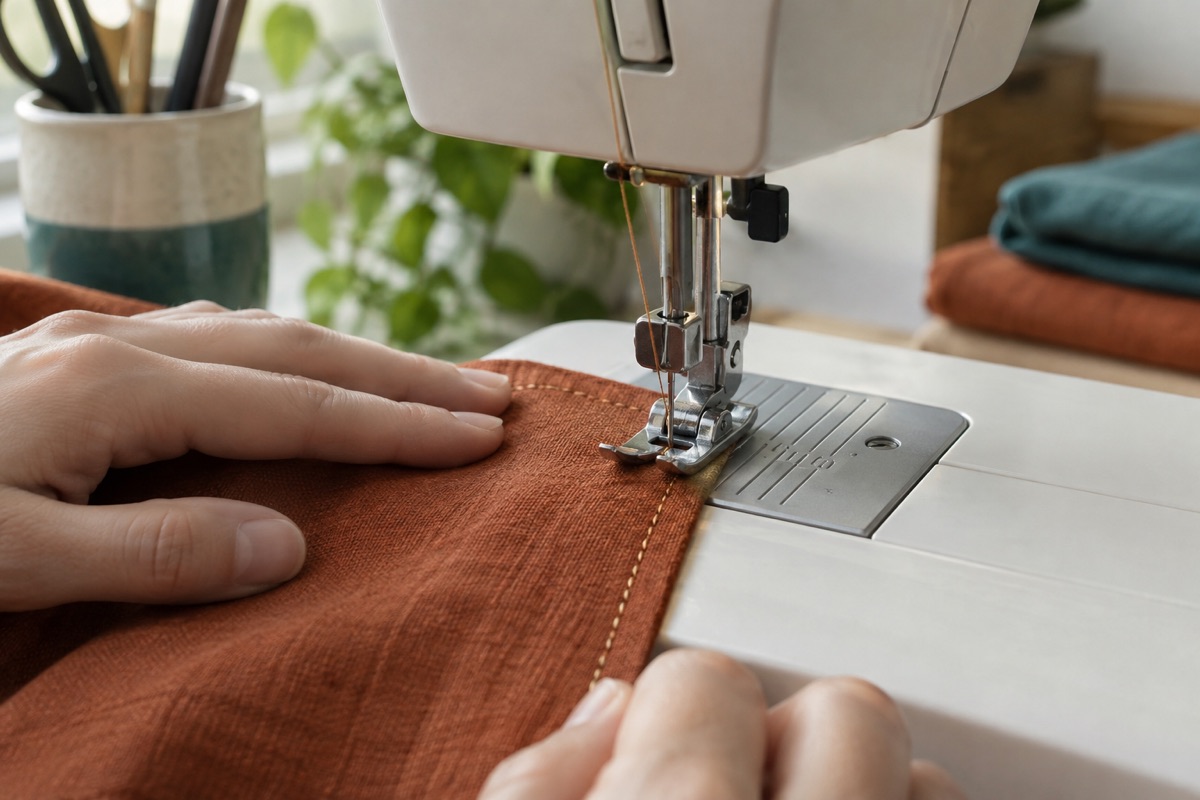
Topstitching sits on the outside of a project, so small variations show. The answer is rarely to sew faster or stare harder at the needle. Press the seam, choose a reference that stays the same distance from the edge, and test the complete fabric stack. A pocket edge, collar and jeans hem may need different needles and stitch lengths even when the desired line looks similar.
Give the machine a stable edge
Press the seam allowance in the direction the pattern specifies and let the fabric cool before stitching. Baste a slippery or thick edge if it wants to move. At a bulky join, trim or grade seam allowances only where the pattern and fabric allow it, then use a levelling aid behind the foot as it climbs. Mark the planned distance from the edge on a practice piece. If two parallel rows are needed, decide whether each will follow the fabric edge or the first line; an uneven first row makes a poor guide for the second.
Choose a reference, then the thread
An edge-stitch foot places a guide beside the seam; a marked standard foot or carefully placed seam guide can work too. Check the foot's required needle position and hand-turn once for clearance. Use a fresh needle suited to the fabric and thread. Ordinary polyester thread is a sensible start for lightweight or medium woven garments; heavier decorative topstitch thread may need a different needle, tension test and sometimes ordinary thread in the bobbin. Do not assume that thick thread belongs in every bobbin path.
The Gütermann Sew-All option below is a general-purpose thread, useful for a subtle matching line. It is not presented as a heavy jeans topstitch thread. If you want high-contrast thick stitching, sample the exact thread and needle combination first.
Gütermann Sew-All polyester thread, white
A reliable general-purpose thread family for mixed garment fabrics; choose the shade that blends with your project rather than buying white by default.
A 100 m spool of 100% polyester Sew-All thread for everyday construction seams, repairs and machine sewing.
Keep in mind
- The linked listing is white; match colour locally if needed.
- It is not the same as a deliberately heavy decorative topstitch thread.
Keep the line calm through straight sections and turns
Start with a moderate length, then compare slightly longer stitches on the final number of layers. Janome's garment guidance describes 3–4 mm as a common topstitching range for bottom-weight projects; a finer shirt fabric may look better shorter. Keep your eye on the edge against the guide, not on each needle puncture. Let the machine feed. Slow before corners; stop with the needle down if the machine and pattern allow, lift the foot, pivot and lower it again. Avoid turning while the needle is up, which can shift the corner. For a visible start and finish, draw thread tails to the wrong side and tie them where a backstitched lump would show, if suitable for the construction.
When the sample does not look tidy
Wobble: check the reference edge, pace and whether the fabric is pulling off the table. Skipped stitches: change the needle and check that the foot is level over a bulky join. Puckering: check presser pressure, seam bulk, needle and thread before changing tension. Uneven thread balance: rethread, then adjust tension in small steps on a sample. Unpick a visibly flawed line before pressing it flat; a second line beside the error seldom hides it.
Frequently asked questions
Must topstitching use special thread?
No. General-purpose thread gives a restrained visible line. Heavier thread is a design choice that may require a different needle and setup.
What stitch length is best?
There is no single value. A modestly longer straight stitch often flatters a visible line, but fabric weight and layers decide. Compare samples after pressing.
Sources
The practical length and pressure trade-offs follow Janome's topstitching guidance. Machine-specific needle position, foot and tension limits should come from the exact manual.