
Stop, unthread and look closely
Fix a sewing-machine problem
Work from the symptom to the simplest safe check, and know when the machine needs a technician.
Choose your route
Start with the question in front of you
Browse the collection
All guides in this section
Get set up
Sew your first seams
Thread and stitch faults
Movement, controls and repair
The useful context
Understand the choices
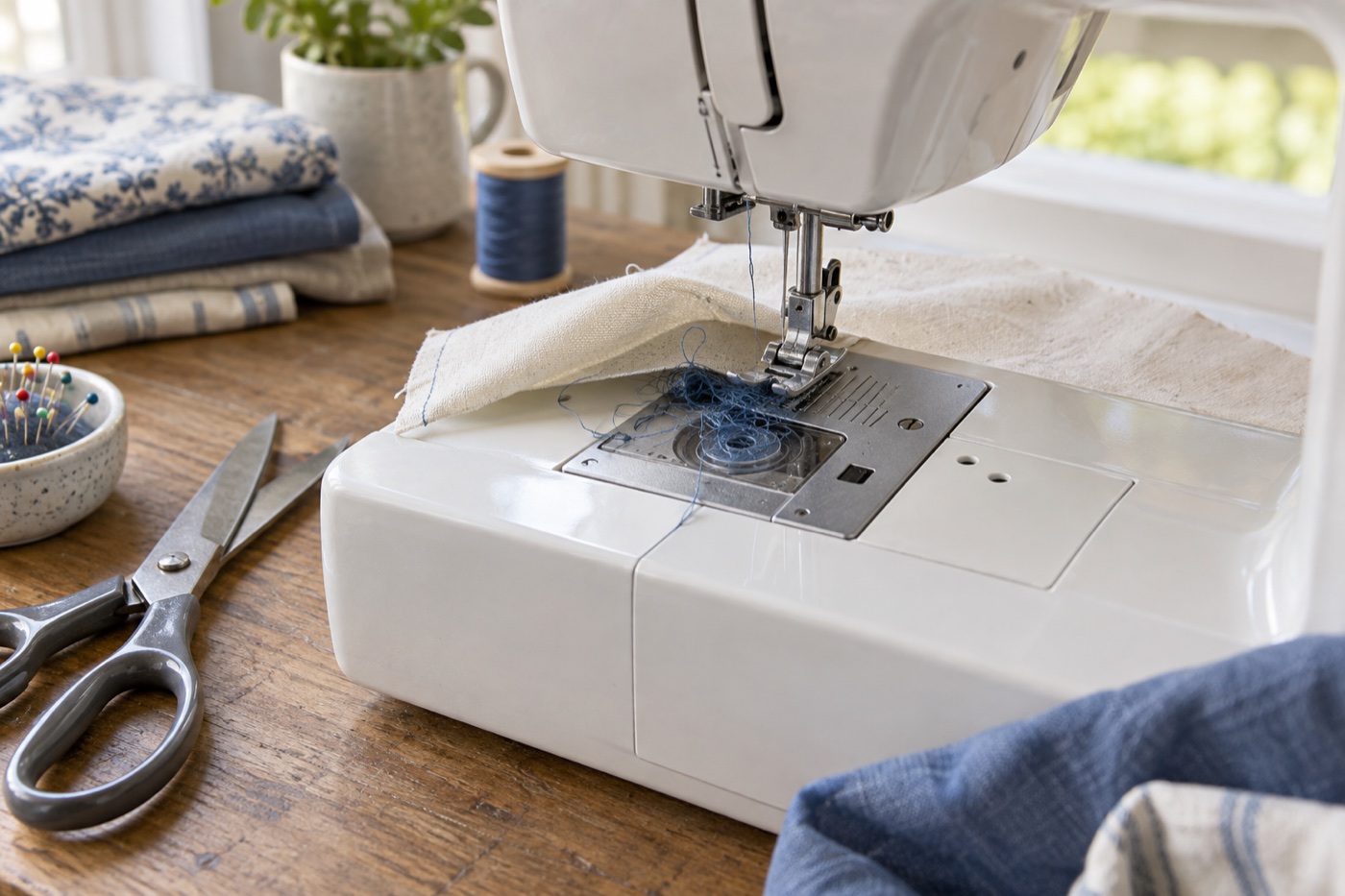
Thread nests underneath usually point back to the upper thread path. Skipped stitches often begin with the needle. Fabric that will not move may be sitting over lowered feed dogs or under too little presser-foot pressure. Start with the likely, reversible checks before touching internal adjustments.
A safe order for most faults
Switch off and unplug before changing a needle, clearing a jam or opening the bobbin area, following the exact manual for the model. Remove the upper thread completely, fit a fresh suitable needle correctly, clean accessible lint and rethread with the presser foot raised. Test on a folded scrap with the normal settings restored.
Do not turn every screw
Bobbin-case tension, hook timing, wiring and internal drive parts are not routine first checks. Stop if the machine smells hot, shows cable damage, repeatedly strikes the plate, remains locked after an accessible jam is cleared or makes a new mechanical knock. An authorised technician is the next useful step.
Start with the symptom you can see
If you are new to the machine, begin with your first hour at the sewing machine and the threading walkthrough. For an established setup, choose the closest problem: thread bunching underneath, skipped stitches, or a machine that jams. Change settings only after the simple checks; the tension guide shows how to make a controlled sample. Clean the accessible bobbin area with your model manual open, and check bobbin compatibility before buying a replacement.
If a thread has snapped, distinguish top-thread breakage from bobbin-thread breakage. Loose stitches on top call for a different lower-thread-path check, while puckered seams may involve fabric handling as well as tension. For movement faults, see fabric not feeding or a bobbin that will not wind. A needle threader that misses and a buttonhole that fails each have setup-specific checks. Stop using the machine if needles keep bending or breaking, and use the technician decision guide when the fault is no longer a safe owner adjustment.
A clear path from unboxing to a first project
Start by identifying the main machine controls and the small kit you actually need. Then wind a bobbin and insert it using either the top-loading or front-loading route shown by your manual. If the machine asks you to, bring up the lower thread before placing your cotton sample.
Next, practise one straight seam, starting and stopping at a controlled speed and securing the seam end. Once those steps feel repeatable, pick one of five first projects that uses the same skill on useful fabric.