
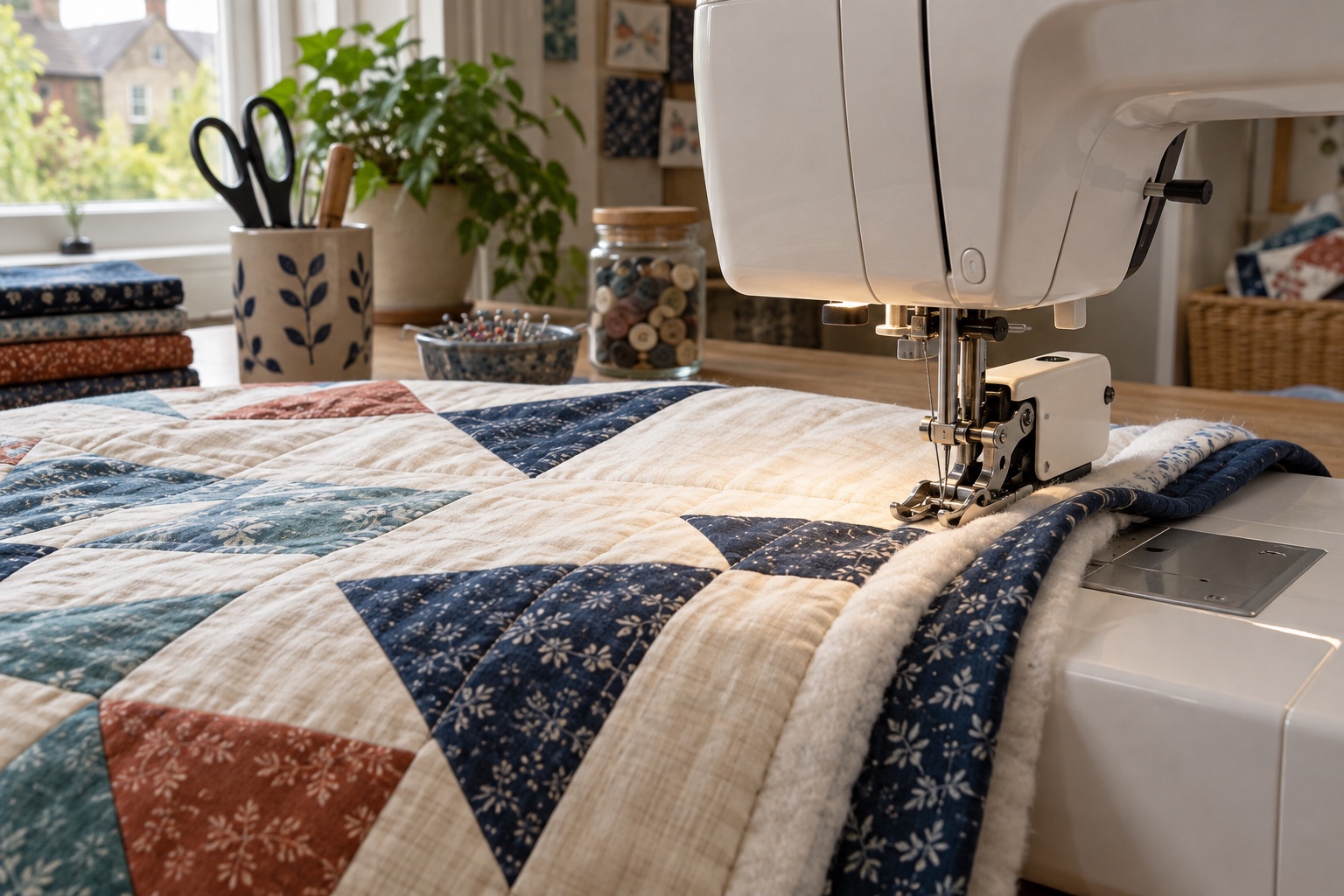
Ordinary feed dogs grip the underside of a quilt or garment. The upper layer is pressed down by the foot but is not driven in the same way, so it can creep forward, especially over wadding, checks or a slippery lining. A domestic walking foot, also called an even-feed foot, moves a set of teeth or pads above the fabric in time with the machine. Its purpose is alignment, not motor power.
What a walking foot changes—and what it cannot
On a quilt sandwich, upper feeding helps the top, wadding and backing advance together. On checked flannel or a striped furnishing fabric, it can keep matched intersections closer to their starting positions. On a long hem, it may reduce the differential creep that makes one layer appear longer. It still relies on correct basting, enough table support and a machine that can pierce the stack. If the needle deflects, the foot stalls or the fabric must be forced, reduce the bulk or use a more suitable machine instead.
This is not the same as a heavy industrial walking-foot mechanism. Nor is it always necessary for jersey: start with an appropriate stretch needle and machine settings, then test whether the knit actually shifts. A roller or non-stick foot solves a different top-surface friction problem.
When is the accessory worth fitting?
For straight-line quilting, a walking foot is often the first feed upgrade after sound basting. Work from the quilt centre outwards when the pattern allows, roll or support excess bulk on the table and avoid dragging the quilt to the needle. For matched checks, pin precisely at seam intersections, test one join and keep the seam allowance even. For soft layered homewares, try the supplied all-purpose foot first; a walking foot earns space in the box only if repeat tests show slipping.
It is usually the wrong tool for free-motion quilting, where the sewist intentionally controls fabric movement, or for a seam needing extensive side-to-side feeding. Brother's F033N guidance cautions against reverse and sideways sewing for that foot. Check the exact instructions of any other model before selecting a decorative or stretch stitch.
Mounting is more than clicking on a sole
Many walking feet replace the entire snap-on holder and fasten at the presser bar with a screw. The mechanism must sit correctly relative to the needle clamp or model-specific lever. Switch the machine off, remove the existing holder only as your manual permits, attach the correct foot securely and lower the presser bar. Before using the motor, rotate the handwheel through a full stitch cycle. Check needle clearance, feed motion and whether the foot lifts and lowers cleanly. Never force an arm into place.
The Brother-branded Amazon UK option below is described by its retailer as a “7 mm horizontal” walking foot. That title alone does not establish that it is F033N or that it fits every Brother 7 mm machine. Use the exact compatible-products list and part number for your model; if the listing cannot confirm them, do not order it. The low- versus high-shank guide explains why a matching width is only one part of the fit check.
Brother 7 mm horizontal walking foot
Consider only after confirming the exact Brother accessory code and machine model in Brother's compatible-products list.
An upper-feed walking foot for suitable Brother 7 mm horizontal-hook machines; useful for layered quilting and keeping matched fabrics aligned.
Keep in mind
- The Amazon listing's generic title does not itself prove fit for every Brother 7 mm machine.
- Do not use reverse or side-to-side feeding stitches unless the exact foot instructions expressly permit them.
Run a fair test before spending
Baste a sandwich of the same top, wadding and backing you plan to quilt. Mark a straight line and sew it with the machine's ordinary foot, without pulling. Note whether the layers move, the stitches vary or the seam tunnels. Try a longer appropriate stitch, better support and adjusted foot pressure if the manual offers it. If creeping remains the repeatable problem, a verified walking foot is a useful next tool. If the result is puckering or skipped stitches rather than drift, visit the puckered-seam or skipped-stitch guides first.
Frequently asked questions
Can I reverse stitch with a walking foot?
Not as a default. Brother explicitly excludes reverse with its F033N. Follow the instructions for your exact foot and secure thread tails by an approved method instead.
Is a walking foot necessary for quilting?
No. It is helpful for many straight-line quilt designs but not free-motion work, and some machines have integrated dual feed. Good basting and support remain essential.
Will it sew thick leather?
No such guarantee follows from upper feeding. Needle system, motor, clearance, material density and seam stack still limit a domestic machine.
Sources
Brother's F033N walking-foot specification explains upper feeding and stitch restrictions. Its dynamic walking-foot fitting guide shows why mounting varies. Confirm your exact machine and accessory pairing in the maker's current compatibility list.