
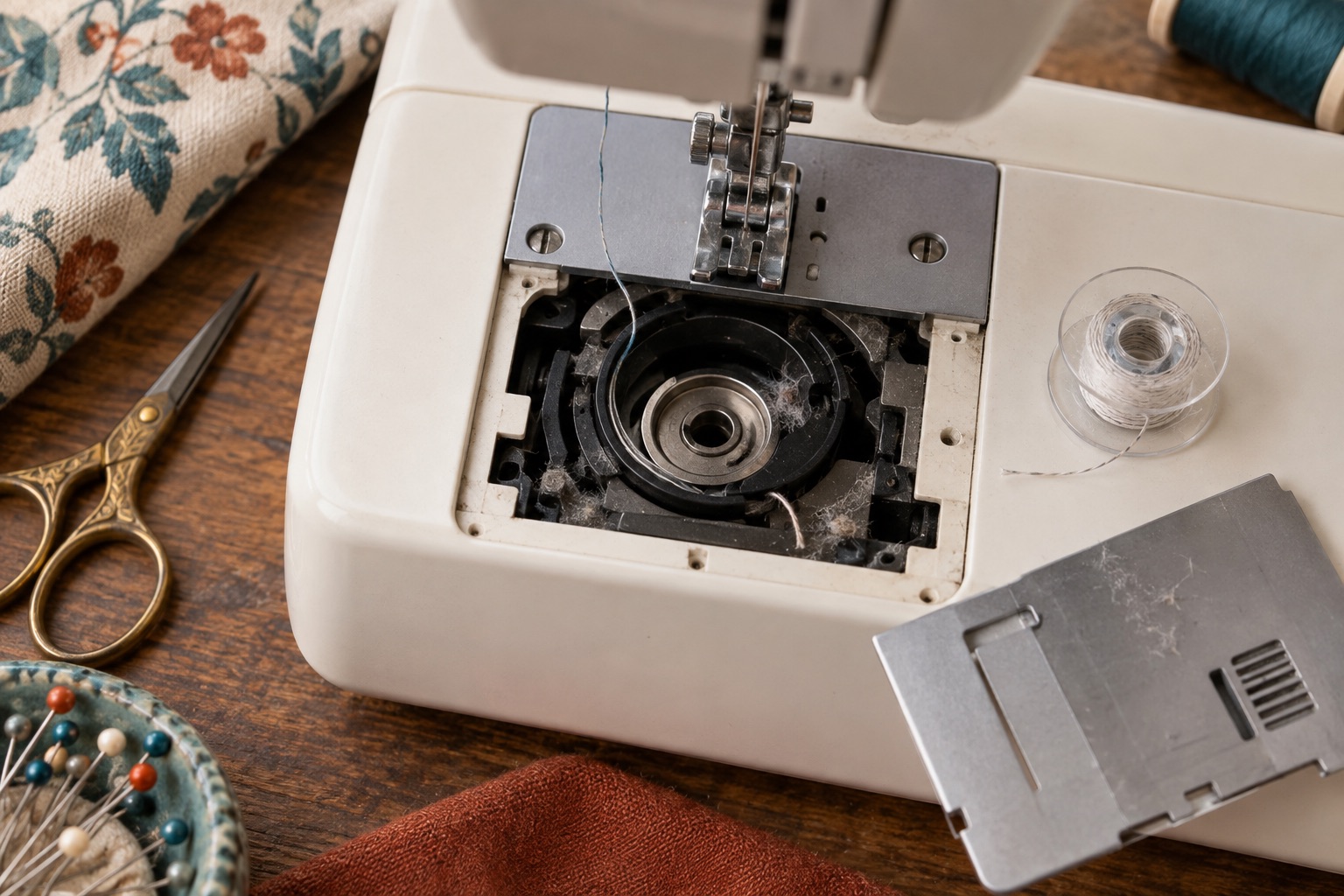
A break below the fabric is not automatically a call to tighten the bobbin case. The lower thread may be nearly empty, wound in loose loops, rubbing on a scratched bobbin or bypassing the small guide that gives it controlled tension. A wrong bobbin can fit into the opening yet still run badly. Begin by finding out whether the lower thread truly snapped or whether the upper thread has gathered underneath and made a nest.
Is the lower thread actually breaking?
Stop and lift the fabric only after bringing the needle clear as the manual directs. If the lower tail is cut short or has frayed, examine the bobbin path. If there is a ball of thread beneath the fabric but the bobbin strand remains intact, use our thread-bunching guide first: a missed upper take-up lever often creates that visual symptom. If the bobbin simply ran out, replace it; that is not a mechanical breakage.
Power off before opening the bobbin area. Use only the access steps permitted in your manual, and never run the machine with its bobbin cover or case loose.
Work from the bobbin outwards
Bobbin identity. Check the maker's part code, dimensions and material. A metal bobbin is not a substitute for a specified plastic bobbin merely because its diameter looks similar. Our compatibility guide explains the exact-match check.
Winding. Look for a firm, reasonably level wind that stays below the rim. Loose, cone-shaped or overfilled thread can snag. Rewind the bobbin through the dedicated pre-tension guide rather than pulling thread straight from spool to spindle. Replace a cracked, warped, rough-edged or scratched bobbin with the exact approved part.
Insertion. In a top loader, follow its cover arrow, slit and guide; in a front loader, thread the removable case and seat its latch as the manual describes. Do not borrow an anticlockwise rule from another model. The thread should draw from the installed bobbin with the feel and tail length specified by its maker.
Accessible case and race. With the machine unplugged, remove visible trapped thread and lint only where your manual allows. Do not use force, oil an unspecified area or loosen the case-tension screw. A deep scratch, broken spring or case that will not seat is a dealer question, not a cleaning job.
The Brother SFB/SA156 pack below is appropriate only if your Brother manual specifies that 11.5 mm plastic bobbin. It is not a universal replacement or a reason to buy spares when your supplied bobbin is sound.
Brother 11.5 mm sewing-machine bobbins, pack of 10
A useful spare set after confirming the exact Brother model's bobbin part code in its manual or support page.
Ten 11.5 mm plastic bobbins for Brother machines whose manual explicitly specifies SFB or SA156; not a universal bobbin replacement.
Keep in mind
- Do not use if your machine specifies another bobbin height, shape or material.
- The Amazon title alone does not prove compatibility with every Brother machine.
Make the smallest useful test
Rethread the upper path with the presser foot raised and restore normal settings. Sew slowly on two layers of plain woven cotton using a correctly installed, evenly wound bobbin. Inspect both faces and note whether the break occurs immediately, after several centimetres or only on a particular fabric. If the problem disappears with a known-good exact bobbin, keep the scratched or poorly wound one out of service. If it recurs with multiple correct bobbins, do not repeatedly turn the case screw; the case, hook or another mechanism may need attention.
When should you stop?
Unplug and seek help if a bobbin case falls out, the handwheel catches, a needle strikes the plate, the hook area has visible damage or the lower thread breaks repeatedly after correct insertion and accessible cleaning. A skilled technician can inspect the mechanism without risking timing or warranty. See when to call a technician.
Frequently asked questions
Can a badly wound bobbin break its thread?
Yes. Loose loops or an overfilled rim can catch. Rewind through the proper guide and retest before adjusting tension.
Why does the problem happen only with one bobbin?
Compare that bobbin with a confirmed original. Its shape, rim or winding may be wrong even if it sits in the cavity.
Should I adjust the bobbin-case screw?
Not as a first diagnosis. Confirm part fit, winding, insertion and accessible cleanliness first; case-tension adjustment is model-specific.
Sources
Brother's domestic bobbin-thread troubleshooting identifies incorrect setting, winding, scratches, tangles and unsuitable bobbins. Its model-specific SFB guidance supports the compatibility warning. Follow your own manual for insertion and permitted cleaning.