
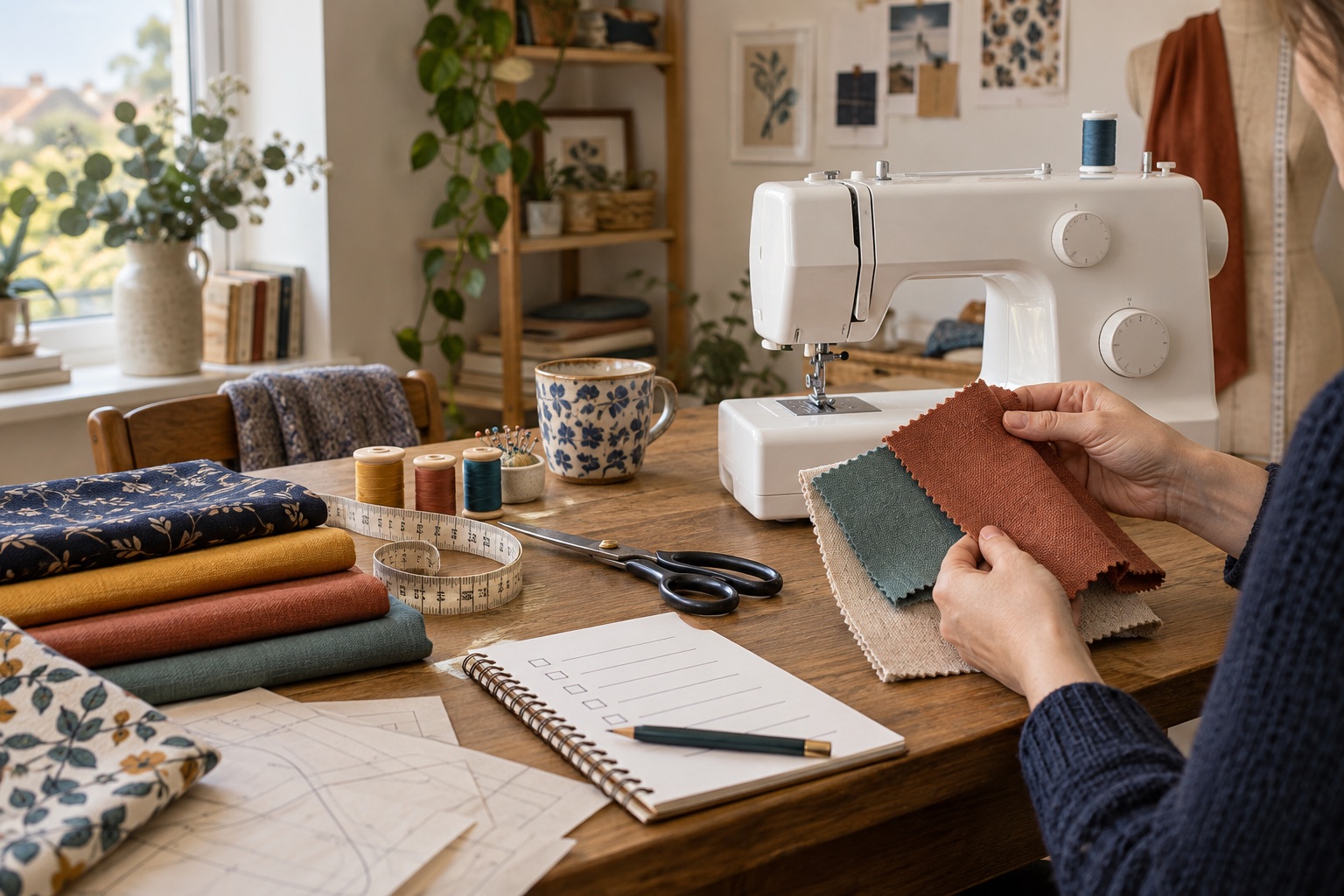
Choosing a first sewing machine becomes much easier when “beginner-friendly” is translated into specific jobs. A machine for trouser hems and cushion covers has a different brief from one for fitted shirts, jersey dresses or quilted bags. The best first purchase is not necessarily the cheapest or most automated; it is the machine whose controls you understand and whose limitations do not block the projects you are likely to attempt.
1. Write a three-project brief
Name three projects you genuinely expect to make in the next year. Beside each, note the fabric, the thickest crossing and any special operation: buttonholes, zips, stretch seams, free-motion work or long straight hems. This turns a vague shopping exercise into a practical specification.
- Repairs and alterations: prioritise a free arm, an ordinary zipper foot, clear straight and zigzag settings, and convenient bobbin access.
- Dressmaking: look for controllable stitch length and width, a good buttonhole system, useful stretch stitches and easy pivoting. Adjustable presser-foot pressure is valuable for varied fabrics.
- Bags, denim and furnishing fabrics: examine how the presser foot crosses bulky joins, whether the feed stays consistent and which needles the manual permits. “Heavy duty” on the casing is not an unlimited fabric rating.
- Quilting: support around the machine and space to the right of the needle matter. Drop feed, an available walking foot and an extension table can help, but they do not enlarge a compact throat.
If your list ranges from silk blouses to dense webbing, one domestic machine may not cover every extreme. Buy for the recurring middle of the workload, not the rarest ambition.
2. Decide how you want the machine to behave
A mechanical machine uses dials or sliders to select and adjust stitches. Its state is usually visible at a glance and the controls are direct. This suits people who prefer tactile settings, expect mostly utility sewing and do not need the machine to manage speed or needle position.
Electronic and computerised machines can add a speed-limiting slider, start/stop sewing, needle up/down, suggested settings and one-step buttonholes. A speed cap can make curves and corners calmer for a nervous learner. Needle-down stopping helps hold the fabric while pivoting. These are practical control benefits; a display and 100 decorative stitches are not automatically better.
There is no universal winner. Our separate mechanical versus computerised guide explains the trade-offs without treating either system as more durable by definition.
Foot-pedal control versus a speed slider
The pedal starts the machine and varies its speed. A slider limits the maximum speed the machine can reach, even if the pedal is pressed further. If fine control is your main worry, try both systems. A well-positioned pedal on a non-slip floor can matter as much as the machine itself.
The Brother SH40 is a useful example of the electronic route: its speed slider, needle up/down and quick-set bobbin directly address control and setup rather than simply adding more stitches.
Brother SH40
Best for a beginner who wants slower, capped sewing speed and controls that can support dressmaking, light quilting and more varied projects as confidence grows.
A compact electronic machine that adds a speed slider, start/stop control, needle up/down, 40 stitches and five one-step buttonhole styles without moving into a large chassis.
Keep in mind
- The compact 10 × 16 cm workspace is not designed for managing large quilts.
- Its extra controls and numbered stitch selection are less immediate than two mechanical dials.
3. Prioritise the features you will notice
Bobbin access
A clear top-loading bobbin lets you see the remaining thread and removes the separate front bobbin case. A front-loading system can work perfectly well, but its insertion path is less visible. Ask to remove, wind and reinsert the bobbin yourself; familiarity is more useful than a label.
Buttonholes
A four-step buttonhole requires the sewist to move through the stages. A one-step system uses a dedicated foot to complete the sequence. Garment makers are more likely to value the latter. If you mainly mend seams, paying extra for several buttonhole styles may add little.
Presser-foot pressure and feeding
Adjustable pressure can help when fabric is unusually fine, stretchy or bulky. It is not a substitute for the correct needle, thread, stitch and handling. For thick seams, look for a foot-levelling feature and test a realistic folded sample rather than a single flat layer.
The Janome 230DC makes sense when dressmaking or quilting will be regular: it combines adjustable foot pressure with speed control, one-step buttonholes and an extension table. Those features are useful only if they match your planned work.
Janome 230DC
Best for a committed beginner who expects to make garments or quilts regularly and would use speed control, foot-pressure adjustment and the larger work surface.
A computerised machine with 30 stitches, three one-step buttonholes, a speed controller, top-loading bobbin, adjustable foot pressure and an included extension table.
Keep in mind
- It is a substantial step up in cost from an entry mechanical model.
- Thirty stitches are useful only if the core controls and included table match the projects you will actually make.
Lighting, threading and markings
Good LED lighting, readable seam guides and a needle threader can reduce friction every time you sew. Check them in person if eyesight or hand dexterity is a concern. Marketing photographs do not show whether a lever is comfortable for your hands.
Included feet and future accessories
Check the UK box contents for the exact model. A zipper foot and buttonhole foot are core equipment. A walking foot, overcasting foot, non-stick foot or quarter-inch foot has value only when it matches a planned project and the machine’s attachment category.
4. Budget for the first complete setup
Keep money aside for fresh needles in suitable sizes and points, good thread, extra correct bobbins, fabric scissors, measuring tools and a stable table. A discounted machine with the wrong plug, unclear warranty or no service route is not necessarily good value.
The current UK market places basic full-size mechanical machines around the lower end, with speed control and more refined feeding generally appearing higher up. Promotions move. Our under-£200 guide explains the compromises and directs readers to the live retailer price rather than hard-coding a changing offer.
For straightforward repairs and woven-fabric projects, the Brother LX17 is the simplest suggested starting point: a full-size mechanical machine with a visible top-loading bobbin and the core utility stitches.
Brother LX17
Best for a new sewist who values an uncomplicated dial layout and wants to learn on a full-size machine without paying for electronic controls.
A straightforward mechanical machine with a top-loading bobbin, 17 stitches and the core feet needed for everyday repairs, simple garments and home projects.
Keep in mind
- Its four-step buttonhole takes more input than a one-step system.
- There is no speed-limiting slider or automatic needle threader.
Consider ownership costs as well as purchase price. Confirm the domestic warranty, who handles a fault, whether a nearby dealer services the brand and how easily bobbins, feet and manuals can be found. A recognised UK model is usually a safer starting point than an anonymous mini machine with an impressive bundle.
5. Try the real tasks before buying
If a dealer demonstration is possible, take samples rather than relying on the shop’s easiest cotton. Bring an ordinary woven, the bulkiest folded seam from your project list and a stretch fabric if you plan to make clothes.
Ask to perform these actions yourself:
- Wind and insert the bobbin.
- Thread the upper path and needle.
- Select straight stitch and zigzag, then alter length and width.
- Start slowly, stop at a marked point and pivot a corner.
- Sew across a realistic seam hump.
- Make a buttonhole if garments are central to the brief.
- Remove the accessory tray and use the free arm.
- Lift the machine and its cover if it will be stored or carried.
The point is not to assess showroom-perfect stitch quality. It is to see whether the controls make sense, the machine stays stable, the work area is visible and the dealer can explain a support route.
Avoid these first-machine traps
- Buying the largest stitch number: utility stitches, control and feeding matter before decoration.
- Assuming smaller means easier: very small machines may be less stable and harder to support.
- Choosing for one aspirational fabric: occasional denim does not always require a heavy-duty model; repeated bulky crossings might.
- Ignoring storage: measure the shelf, doorway and table, including the case and cables.
- Treating a machine as a complete sewing setup: needles, thread, pressing and fabric preparation strongly affect the seam.
- Using reviews as specifications: manuals and current UK manufacturer pages should settle features, voltage and compatibility.
A final first-machine checklist
Before ordering, you should be able to answer yes to the following:
- The machine is a current, traceable UK model with a UK plug and documented warranty.
- Its manual covers the fabrics and needles you expect to use.
- The controls suit how you prefer to learn.
- Its workspace and stored dimensions fit your home.
- The included feet cover the first projects, or compatible extras are available.
- You know who will provide advice or service if setup does not solve a problem.
- The machine plus essential tools fits the real budget.
If you still have several plausible options, use our beginner sewing-machine shortlist or the machine finder on the home page. Both organise the choice by project and control preference rather than treating one model as best for everyone.
Frequently asked questions
How many stitches does a beginner need?
Straight stitch, zigzag, a buttonhole and a suitable stretch or overcasting option cover a great deal of early sewing. Ease of adjustment is usually more important than a large decorative library.
Is a computerised machine too complicated for a beginner?
Not necessarily. A clear display, speed limiter and automatic defaults can reduce coordination. Choose one only when those controls solve a real need, not because computerised sounds more advanced.
Should I buy a mini sewing machine?
A recognised compact full-size model is generally a more versatile first purchase. Mini machines can have a narrower fabric range, lighter construction and less accessible support. Check the exact model, seller, plug and manual rather than judging size alone.
Sources
The selection process draws on the Brother sewing-machine buyer’s guide, Janome UK machine range, Janome retailer guidance and HSE sewing-machine safety guidance.