
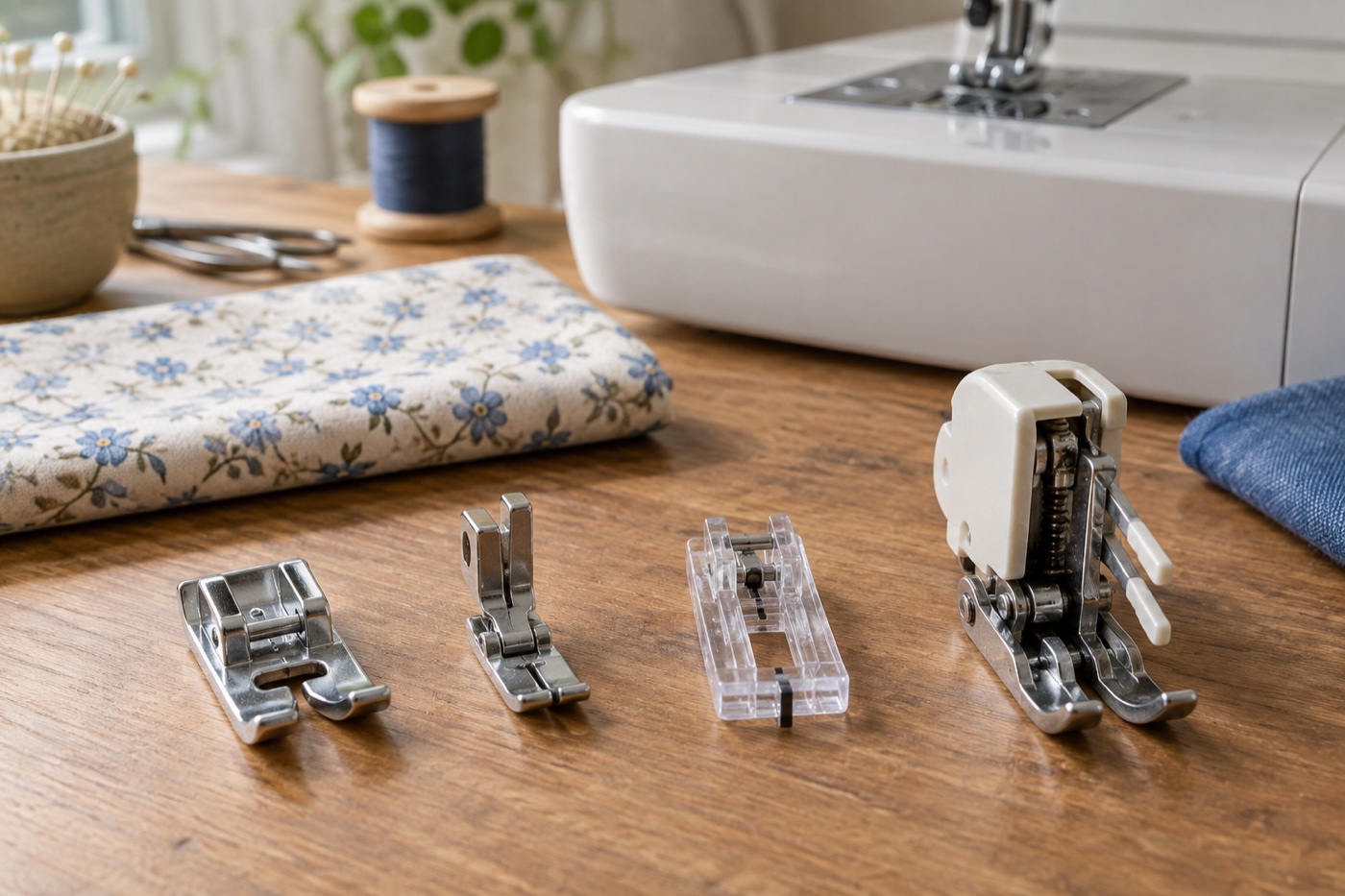
A presser foot holds the fabric against the feed dogs while the needle forms stitches. A specialist foot changes guidance, clearance or how layers travel—not the power of the motor. Many new sewists already have the useful basics in the accessory drawer, so identify the included feet before buying a large mixed set.
Know the feet that may already be in the box
The all-purpose or zigzag foot has a wide needle opening and is the default for straight stitches and ordinary utility zigzags within the machine's allowed range. A zipper foot lets the needle run close to a zip coil or piping; move the needle or attach the foot on the permitted side and check the clearance by turning the handwheel before powered sewing. A buttonhole foot either holds a button and sets the length automatically on compatible one-step machines, or provides a guide for a four-step sequence. Follow the machine's buttonhole method rather than assuming the foot decides it.
For a closure, our zipper-foot guide separates ordinary, narrow and concealed styles. If the foot has a guide for an edge, overcasting, blind hemming, narrow rolled hemming and edge stitching are four distinct jobs, not interchangeable names for the same accessory.
A blind-hem or overcasting foot may also be supplied. Its guide helps position an edge, but the selected stitch must be compatible with the foot and needle position. Sewing through a guide can break a needle and mark the plate. Make a slow handwheel clearance check whenever you change the foot or stitch width.
What specialist feet genuinely change
A quarter-inch piecing foot gives a narrow, repeatable reference for quilt seams. It is most useful when you repeatedly join patchwork pieces; it is not necessary for the first straight seam. The Brother SA125 shown below is one specific option for machines confirmed compatible with it. The named Brother foot is for centred straight stitching; a zigzag or offset needle can hit the metal. Before buying, check your exact model in Brother's accessory list and test the seam allowance on real fabric rather than assuming every foot's edge gives a perfect quarter inch.
Brother quarter-inch piecing foot SA125
Worth considering when quilt piecing is frequent and your exact model's accessory list confirms SA125 compatibility.
A Brother quarter-inch piecing foot for centred straight-stitch quilt seams and parallel topstitching on compatible machines.
Keep in mind
- Use only the permitted centred straight stitch; a zigzag or offset needle can strike the foot.
- Confirm shank, attachment and model compatibility before buying.
An even-feed or walking foot adds upper feeding action to help keep quilt layers, checks or slippery textiles aligned. It does not turn a domestic machine into an industrial walking-foot machine. A free-motion or darning foot allows the operator to move a quilt or embroidery fabric when feed dogs are lowered or covered, with setup varying by model. See our walking-foot versus dual-feed guide before paying for either.
The Janome 5060QDC already includes quarter-inch, even-feed and free-motion feet in its UK kit. If you are shopping for a machine rather than an accessory, that bundled equipment can be more valuable than buying separate generic feet later. Confirm the current package at the retailer.
Janome 5060QDC
Best for a home quilter who wants the useful feet and table in the standard UK package while retaining a versatile dressmaking machine.
A 60-stitch computerised machine supplied with an extension table, quarter-inch foot, open-toe even-feed foot and free-motion foot.
Keep in mind
- The extension table supports fabric but does not enlarge the opening to the right of the needle.
- Large quilts still demand a supported table and careful handling of the bulk.
The compatibility checklist that prevents needle strikes
First identify the machine model and its maximum stitch width. Then check whether the foot is snap-on, screw-on or requires removal of the holder; “low shank” and “high shank” describe mounting geometry, not a promise that every foot fits. Read the manufacturer compatibility list for the exact accessory code. Power off and unplug while changing a foot as directed by your manual. Attach it firmly, select the intended stitch and position, then rotate the handwheel towards you through a full cycle with no fabric to check that the needle clears the foot and plate. Repeat after changing stitch width or needle position.
If those terms are unfamiliar, compare low versus high shank with snap-on versus screw-on feet before ordering. The first describes height; the second describes which parts detach.
A levelling-button foot solves a different problem: it supports the foot when crossing a bulky seam step. The Brother HF37 includes one. It is relevant to denim and bags, not a reason to buy a 30-piece foot collection.
Brother HF37
Best for bags, jeans alterations and mixed dressmaking where a mechanical control layout and help over bulky seam steps matter.
A 37-stitch mechanical machine with a top-loading bobbin, levelling-button foot, non-stick foot, adjustable stitch dimensions and a hard case.
Keep in mind
- There is no maximum-speed slider.
- Its domestic heavy-duty positioning does not make it an industrial or walking-foot machine.
Choose the next foot by the task you repeat
If you are learning, keep the all-purpose foot fitted and master threading, stitch selection and seam allowances. If you insert zips regularly, use the compatible zipper foot already supplied or replace it with the exact maker part. If patchwork accuracy is the recurring frustration, test a quarter-inch foot. If layers creep, compare an even-feed foot with basting, fabric support and foot-pressure changes before buying. Specialist feet pay off when they address a repeatable result; they are poor cures for wrong needle, thread or tension.
Frequently asked questions
Do I need a walking foot to sew jersey?
Not necessarily. A suitable needle, stretch-compatible stitch, gentle feeding and appropriate foot pressure often matter first. Test on the actual knit before adding hardware.
Can a snap-on foot fit any low-shank machine?
No. Holder shape, needle width and accessory design vary. Check the exact machine and accessory combination.
Why did the needle hit my new foot?
The stitch width, needle position or foot opening may be incompatible, or the foot may be mounted incorrectly. Stop, replace a damaged needle and perform a handwheel clearance check before any powered test.
Sources
Brother's setup guidance explains basic foot changes. Its SA125 instructions specify a centred straight stitch for that exact foot, and the walking-foot tutorial explains mounting differences. The included Janome feet follow its 5060QDC specification. Check the exact manual and accessory code for your machine.