
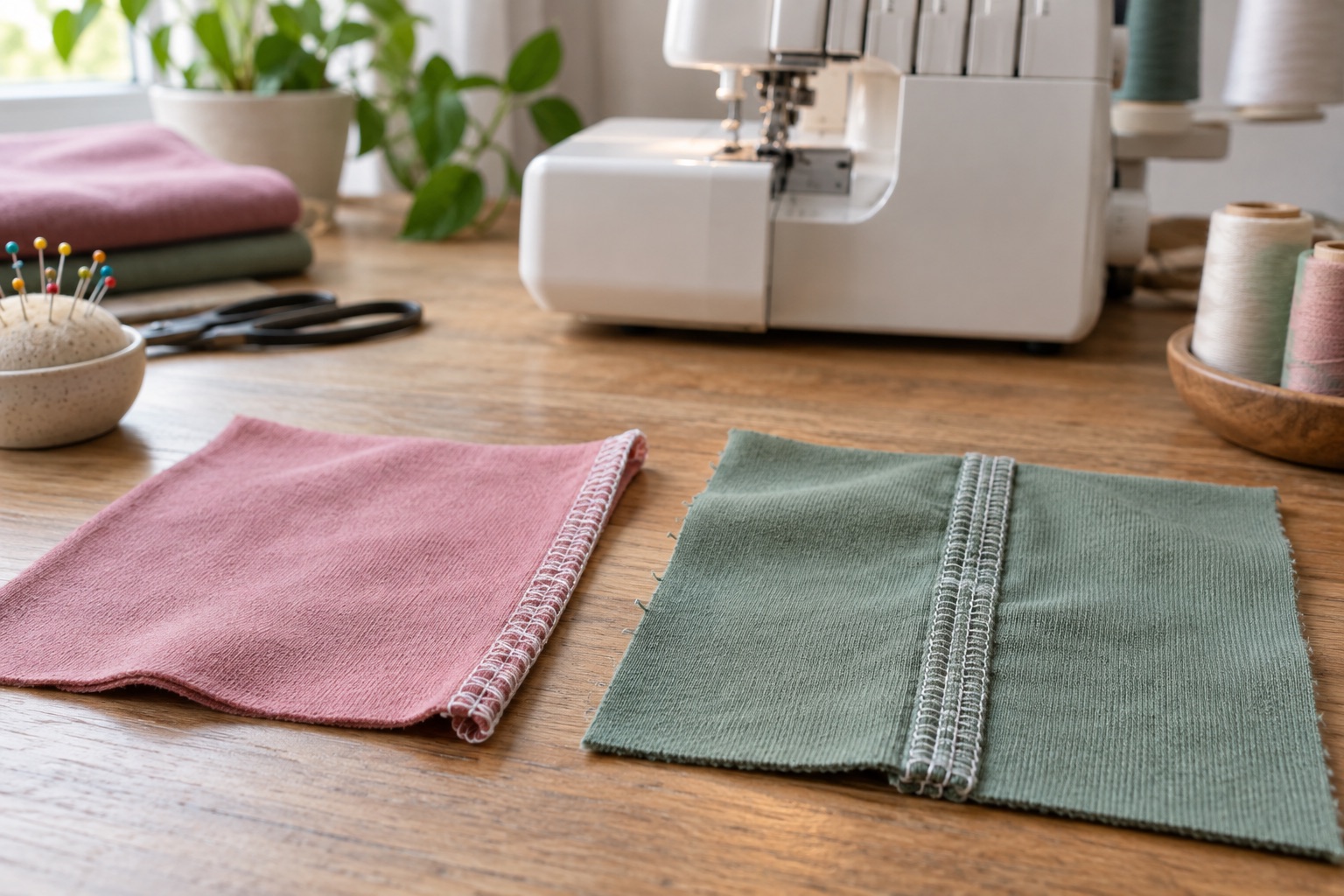
“Three versus four” is not a ranking of stitch quality. It describes different ways of using the needles and loopers. On a common domestic four-thread overlocker, four-thread stitching uses two needles and both loopers. A typical three-thread overlock uses one needle and both loopers. The exact setup, needle to remove and cutting width depend on the machine. Follow its manual, especially when a stitch finger or converter changes position.
A finished edge is not always a construction seam
Three-thread overlocking wraps a raw edge neatly. It is often used after an ordinary sewing-machine seam has already joined the fabric. It can also make decorative edges or rolled-hem variants, but “three-thread” by itself does not mean rolled hem. The needle position can change the seam width: one-needle left and right positions are not interchangeable on every model.
Four-thread overlocking puts a second needle line into the stitch. That is why it is commonly chosen to join two knit layers in one pass. The second line can improve security if the outer needle thread is stressed, though it does not make every fabric or seam indestructible. For areas subject to high stress, pattern instructions and garment design still matter.
When three threads are the sensible setting
Use a three-thread overlock when you have already sewn the structural seam on a domestic machine and simply need to neaten a woven seam allowance. It can also be useful for an exposed edge or lightweight fabric where the narrower result is appropriate. Compare a wide and narrow three-thread sample if your model permits both. The aim is enough coverage to hold the cut edge without a stiff, bulky ridge.
Do not assume it replaces a conventional seam on a zip opening, dart, pocket or heavily loaded woven join. The overlocker vs sewing machine guide maps those jobs more fully.
When four threads earn their place
For many jersey side seams, two-needle four-thread overlocking is a practical starting point: it joins, trims and finishes in one operation. It can be useful for woven seams too when the pattern and fabric suit the width and knife position. It also consumes more thread and makes a wider, denser edge than a light three-thread finish. On a very fine fabric, that can be more bulk than you want.
The Janome 9300DX is one verified 3/4-thread model with differential feed and adjustable cutting width. Its value here is flexibility: one machine can be set for either job. The card is not a claim that its factory settings are right for every fabric.
Janome 9300DX
Best for a learner who wants clearly labelled mechanical controls, adjustable seam width and a relatively compact eight-kilogram machine.
A compact 3/4-thread overlocker with colour-coded threading, differential feed, adjustable cutting width and a retractable upper knife.
Keep in mind
- It does not include the broad table-and-feet bundle supplied with some rivals.
- As with every overlocker, stitch quality depends on correct threading, needle choice, tension and a fabric test.
Make a decision sample, not a guess
- Cut two double-layer samples from the exact fabric, including a cross-grain knit direction if stretch matters.
- Start from the manual's three-thread and four-thread baseline in turn; record the needle position, stitch length, width, tension and differential feed.
- Sew the same length at a moderate speed without pulling either layer.
- Check the needle lines, looper wrap and whether the cut edge sits inside the threads.
- Stretch the knit seam gently to the degree the finished garment will experience. Do not tug hard enough to damage the sample.
- Wash a second swatch if the finished item will be laundered repeatedly.
If loops hang beyond the edge, revisit cutting width and tension rather than automatically adding the fourth thread. If the seam becomes wavy, check differential feed and handling; that fault has its own guide.
Frequently asked questions
Does four-thread overlocking stretch more?
It is a common construction stitch for knit seams, but stretch depends on stitch length, thread, fabric and setup. Test the seam rather than treating thread count as a guarantee.
Can I use three threads to sew a garment seam?
Sometimes, but decide by seam load, fabric and pattern instructions. A separate construction seam or four-thread configuration may be safer for a stressed join.
Does removing one needle automatically create a three-thread stitch?
No. Follow the machine's stitch chart for needle position, thread path, width and any other setting.
Sources
The stitch-role distinction is supported by baby lock's enspire seam guide, Janome's 9300DX specifications and the Janome overlocker guide.