
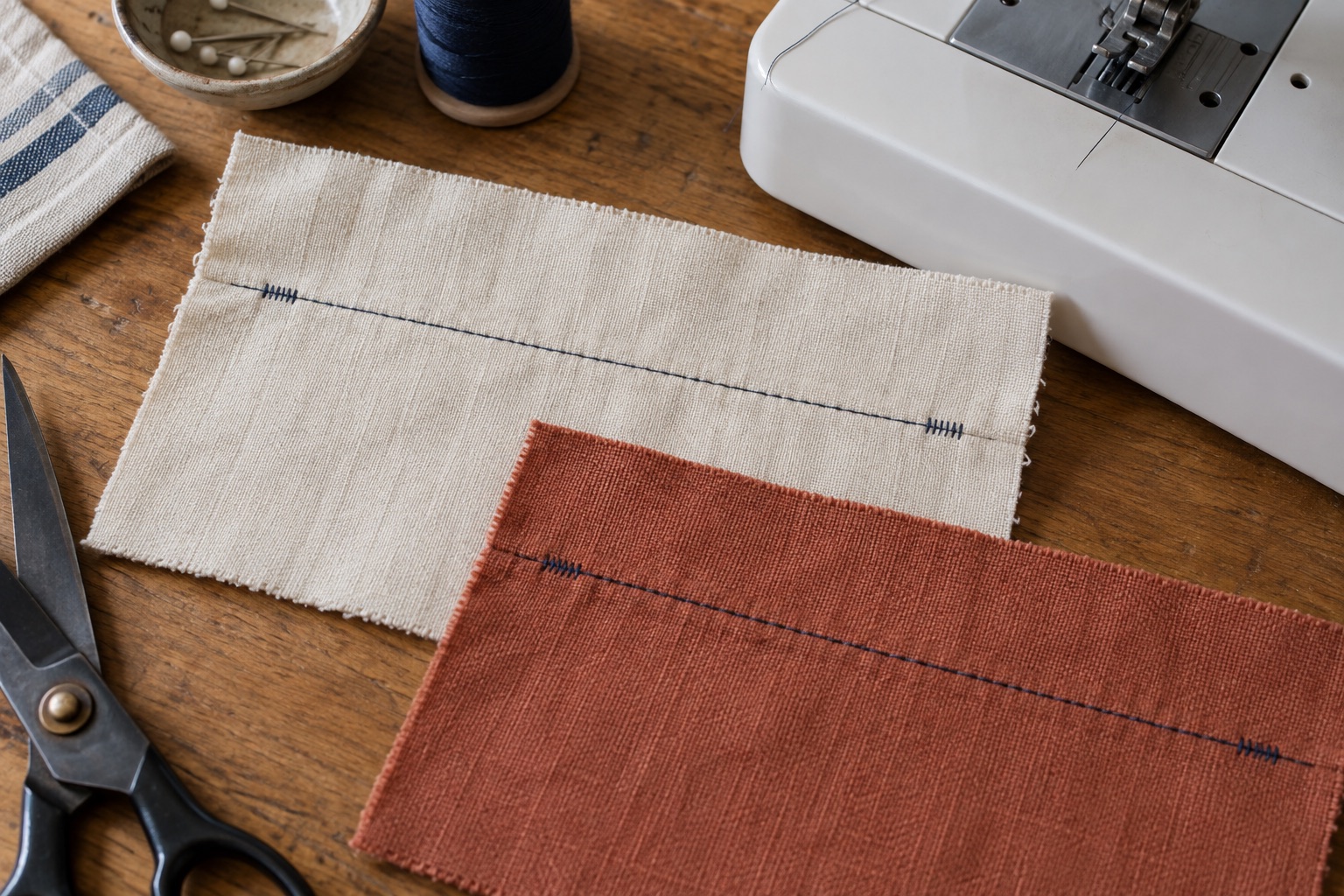
Reverse stitching is one common way to stop an ordinary straight seam from coming undone when its ends will be handled. It overlaps a short part of the seam, adding thread where it is needed. It is not the answer for every fabric or every stitch. First find whether your machine has a reverse lever, a button that must be held, or a programmed reinforcement/lock-stitch button. Those controls can look similar but behave differently.
What does reverse stitching do?
At the beginning or end of a plain construction seam, a few stitches sewn backwards over the existing line hold the free thread ends. Many makers call this a backstitch. A machine's reinforcement stitch may instead place several short stitches in one spot without travelling backwards. Both can secure a seam, but their appearance and operation differ by model and selected stitch. Check the manual's description rather than assuming any arrow-marked button is a continuous reverse control.
Keep the overlap short—usually a few stitches, as directed for your machine and project. Repeated long runs of forward and reverse can create a stiff knot of thread or pucker fine fabric. For a visible topstitch or a sheer fabric, an alternative finish may be neater.
How to practise a backstitch
- Thread the machine correctly and put two layers of stable cotton under the standard foot. Choose a plain straight stitch and use a slow speed. Keep the fabric edge on a seam guide.
- Begin a short distance into the seam allowance, sew forward a few stitches, then stop or slow as your model's reverse instructions require. Engage reverse and sew back towards the starting edge for a few stitches. Return to forward sewing and sew the main seam.
- Near the far end, slow down. Reverse a few stitches along the same line and stop with the needle in the position your manual specifies. Raise the foot, remove the fabric without pulling against a lowered needle, and trim the tails.
- Look at both sides. The reinforced end should be contained within the seam allowance and not form a dense, snarled lump. If it does, try fewer overlapping stitches on the next scrap, then check threading and tension if loops remain.
Some machines require you to keep the reverse lever pressed; others complete a programmed group of stitches when tapped. The selected stitch may affect that behaviour. When in doubt, sew the short test above on scrap rather than discovering it on a finished garment. Use speed-control drills if stopping precisely is the hardest part.
When should you avoid a visible backstitch?
On a dart point, repeated machine stitches can leave a bulky tip; sewing off the edge and tying thread tails may give a smoother result. On delicate or sheer fabric, a concentrated backstitch can pucker, so test a smaller reinforcement or hand-secured thread tails. A decorative stitch, buttonhole, stretch stitch or automated programme may have its own locking sequence. Follow the pattern and machine manual, not a universal three-stitch rule. For seams that will later be crossed by another seam, the pattern may specify a different start or finish.
Reverse stitching does not compensate for a structurally unsuitable seam. A torn knit may need a stretch-compatible stitch; an opening under strain needs the appropriate seam allowance and construction. The stretch-fabric settings guide covers that separate choice.
What if the machine will not reverse?
Check the selected stitch first. On some machines, the same button performs reinforcement rather than backward travel for particular stitches. Confirm the presser foot is lowered and that the button is being pressed as the manual specifies. If reverse works on a plain straight-stitch scrap but not another programme, that may be intended behaviour. If it never works, or the feed mechanism grinds or sticks, stop and consult the manual or service support; do not force the control.
Frequently asked questions
Do I need to reverse at both ends?
Usually for an exposed straight construction seam, unless the pattern provides another way to secure one or both ends. A test on scrap is useful for delicate fabric.
Is reverse stitching the same as a lock stitch?
No. Reverse moves the fabric backwards over a short distance. A lock or reinforcement function often makes stitches in place or follows a model-specific sequence.
How many reverse stitches should I use?
A few are usually sufficient for a plain seam. Follow the pattern or machine instructions and avoid creating a bulky stack of repeated passes.
Sources
Brother's reverse and reinforcement stitch instructions distinguish button behaviour by selected stitch. Its first-machine setup guide demonstrates short reverse stitching on a basic seam. Check your own model manual for the exact sequence.