
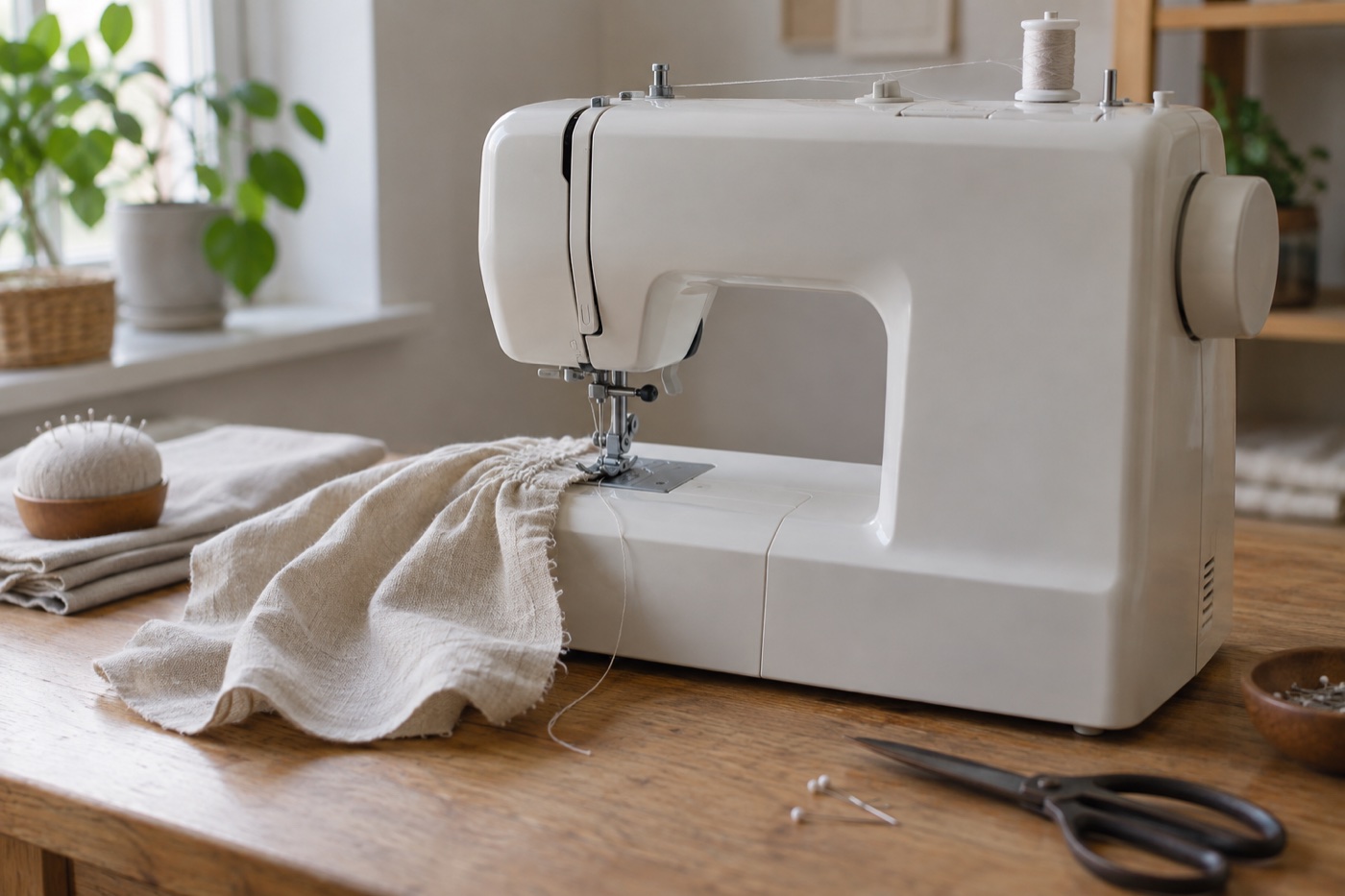
“Jamming” can describe fabric stuck beneath the foot, a hard handwheel, a bobbin-winder that has disabled sewing, or a motor that runs while cloth does not advance. Diagnose which one you have before opening anything. A true obstruction around the hook must be cleared gently; forcing the pedal can break a needle or score the bobbin case.
What stopped moving?
If the fabric is trapped and thread is piled beneath it, suspect a thread nest. If the handwheel turns freely but the machine will not stitch, check whether the bobbin-winder spindle is still engaged, the foot is down and the controls are in sewing mode. If the needle moves but fabric stays still, inspect the feed-dog position and foot pressure per the manual; that is a feeding issue, not necessarily a mechanical jam. If the handwheel will not move normally, stop immediately.
Clear only the accessible jam path
Switch off and unplug the machine. Raise the needle with the handwheel only if it turns freely in the manual's direction. Raise the presser foot and cut visible top and lower threads to free the fabric without pulling on the needle. If the needle has bent, remove it once the area is safe and replace it later. Open the bobbin cover or case as your manual permits. Use a small brush or tweezers only on accessible loose threads, keeping track of any parts and screws. Do not tug on internal wires or dismantle the hook beyond the manual's cleaning instructions.
Inspect the bobbin for damage, overfilling and incorrect shape. A replacement that merely “fits” can rub or tilt. Brother specifies SFB/SA156 11.5 mm bobbins for some models; the card below is relevant only where your machine's support page confirms that code. Do not alter bobbin-case tension to make an unsuitable bobbin run.
Brother 11.5 mm sewing-machine bobbins, pack of 10
A useful spare set after confirming the exact Brother model's bobbin part code in its manual or support page.
Ten 11.5 mm plastic bobbins for Brother machines whose manual explicitly specifies SFB or SA156; not a universal bobbin replacement.
Keep in mind
- Do not use if your machine specifies another bobbin height, shape or material.
- The Amazon title alone does not prove compatibility with every Brother machine.
Refit the bobbin case and cover exactly as the manual shows. Before powering on, slowly turn the handwheel one full cycle with the foot and plate clear. Any strike, scraping or hard point means stop and seek service rather than trying a powered stitch.
Prevent the same jam on the next seam
Rethread the upper path with the presser foot raised, making sure the take-up lever is included. Use the correct bobbin orientation and good-quality machine thread. Change a bent or dull needle while switched off; a SCHMETZ Universal assortment is an appropriate woven-cotton control for compatible 130/705 H machines. Begin on two layers of stable fabric, with the foot down and thread tails as the manual describes. Do not start right at a flimsy raw edge where fabric can be pushed through the plate. Clean accessible lint if the area is dusty. Our thread-nesting guide gives the detailed upper-path checks.
SCHMETZ Universal needles, assorted sizes
A practical starting pack when the machine manual specifies the flat-shank 130/705 H system and your projects vary in fabric weight.
A ten-needle assortment spanning 70/10 to 100/16 for sampling fine-to-medium woven fabrics and ordinary sewing thread.
Keep in mind
- Universal point is not the first choice for very elastic knits.
- Check the needle system in your machine manual before buying.
Do not force a damaged mechanism
Seek an authorised service centre if the wheel remains locked after accessible thread removal, the needle repeatedly hits the plate, the case is visibly scratched, a new knock appears, or there is heat, smoke or cable damage. Do not oil an unspecified point or open electrical covers. A simple jam should clear without force; persistent resistance is information, not a challenge.
Frequently asked questions
Why does the machine jam at the start of a seam?
Check whether the foot was lowered, tails were positioned as instructed and the fabric began far enough from the raw edge. A missed upper take-up lever is another common cause of nesting.
Can a wrong bobbin cause a jam?
Yes. An incorrect height or profile can feed badly even if the bobbin physically fits. Use the exact model-approved part.
Should I turn the wheel hard to release it?
No. Unplug, cut reachable threads and clear only the manual-approved accessible area. Stop if the wheel remains locked.
Sources
Brother's common-problems guidance covers threading, bobbin placement and bobbin-winder checks. Its bobbin-case cleaning instructions illustrate the power-off and careful reassembly principle for a named model; your own manual determines what may be removed.