
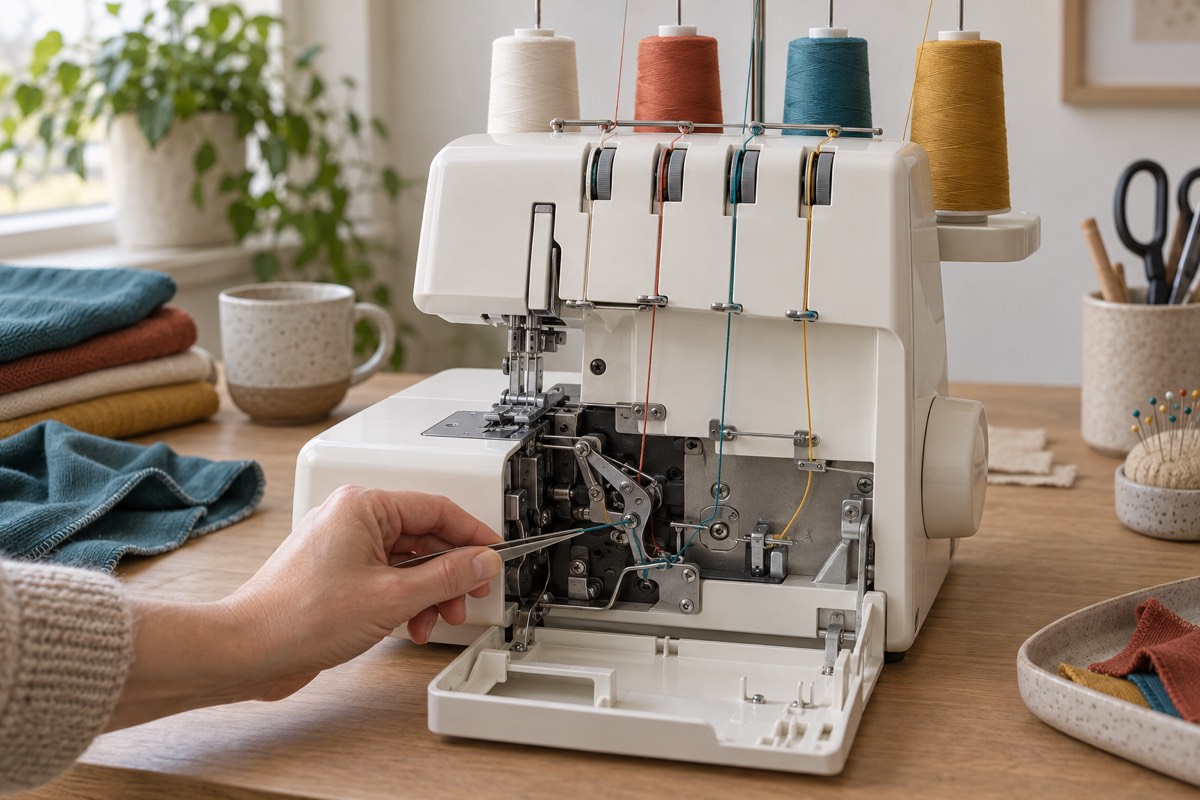
An overlocker—also called a serger in North American content—is a specialist edge machine. It uses several threads and loopers to form a flexible stitch around a raw edge while a knife trims the seam allowance. That combination is fast and useful, but it is not a prerequisite for making clothes.
What an overlocker does better
An overlocker excels at three related operations:
- joining many stretch fabrics with a seam that can flex;
- trimming and enclosing raw edges in a single pass;
- creating narrow rolled hems on suitable fabrics with the specified setup.
It is particularly satisfying on T-shirts, leggings, sweatshirts and knit childrenswear, where a four-thread seam can construct and finish together. On woven garments it can neaten seam allowances quickly after the main seam is sewn.
It cannot make an ordinary lockstitch, sew a standard buttonhole, topstitch in the middle of a panel or insert every zip. The knife also makes errors less reversible. This is why most owners use an overlocker alongside, not instead of, a sewing machine. Read the full overlocker versus sewing-machine comparison if you are choosing only one.
Signs an overlocker will earn its space
You sew knit garments repeatedly
If T-shirts, jersey dresses, base layers or activewear are monthly projects, the speed and elasticity of a correctly balanced overlocked seam can materially improve the workflow. Differential feed also provides a direct way to manage edge stretching on many knits.
Edge finishing is your bottleneck
You may already make successful garments on a sewing machine but dislike trimming seam allowances and overcasting each edge. An overlocker combines those steps. The benefit is time and consistency, not permission to call the garment “professional”.
You will practise threading and samples
An overlocker rewards methodical setup. If you are willing to thread from the manual, keep labelled samples and adjust differential feed for each fabric, the machine becomes predictable. If you expect one permanent setting, it may become frustrating.
The Brother 2104D is a sensible first model when those conditions apply. It provides 3/4-thread operation, differential feed, a lower-looper threading aid and a rolled-hem changeover without a large specialist bundle.
Brother 2104D
Best for a first-time overlocker owner who wants the core controls, useful threading assistance and a widely documented domestic model without paying for a large accessory bundle.
A compact 3/4-thread overlocker with colour-coded threading, a lower-looper threading aid, differential feed, a free arm and an instant rolled-hem changeover.
Keep in mind
- It is an overlocker, so it does not replace a sewing machine for buttonholes, topstitching or construction away from an edge.
- Threading is still a multi-step process and must follow the machine manual in the stated order.
Signs you should wait
You do not yet own a capable sewing machine
A normal sewing machine covers a broader range: straight seams, buttonholes, zips, basting, topstitching, understitching and many repairs. Unless your work is unusually specialised, it should be the first purchase.
You mostly mend or sew occasional woven projects
A zigzag or overcasting stitch can finish many raw edges adequately. Pinking, bias binding, French seams and enclosed construction are also valid techniques. For two skirts and a cushion cover a year, a second machine may not repay its space and setup.
You are buying for appearance alone
An overlocked edge is only one construction choice. Stitch balance, pressing, seam selection and fabric handling affect durability and appearance at least as much. A visible thread wrap is not automatic evidence of better workmanship.
Your space cannot support four cones and safe access
The machine needs a stable surface, clearance for its telescopic thread stand and room at the left for fabric and waste. Repeatedly packing it away increases setup friction. Measure the machine in working configuration, not just its body.
Budget for the full setup
The purchase price is only part of ownership. Allow for:
- four cones of suitable general-purpose overlocker thread;
- the exact needle system and sizes specified by the manual;
- tweezers, a lint brush and any model-specific waste tray;
- enough offcuts to sample tension, cutting width and differential feed;
- servicing or help from a dealer if threading and basic checks do not solve a fault.
Do not buy a broad foot kit until a project requires it. If you already know you will use a wide table, gathering foot, piping foot and blind-stitch foot, the Brother 3034DWT packages those with pressure adjustment and differential feed.
Brother 3034DWT
Best for a beginner who expects to sew garments regularly and will genuinely use the wider support surface and included specialist feet.
A 3/4-thread overlocker supplied with a wide table, trim trap and blind-stitch, gathering and piping feet, plus differential feed and adjustable presser-foot pressure.
Keep in mind
- The accessory bundle costs more and is poor value if you only need occasional seam finishing.
- Its maximum 1,300-stitch-per-minute speed is capacity, not a reason to rush while learning.
Decide by the projects you repeat
| Your recurring work | Buy now? | Why |
|---|---|---|
| Knit T-shirts, leggings and sweatshirts | Likely yes | Flexible construction and differential feed address a recurring need. |
| Woven dresses and shirts | Maybe | Fast seam finishing helps, but the sewing machine still performs most construction. |
| Repairs, curtains and cushion covers | Usually no | Straight stitch, zigzag and alternative edge finishes normally cover the work. |
| Dancewear or activewear | Often yes | Stretch seams are central, but specialist elastic techniques still require practice. |
| Cover hems on T-shirts | Not by itself | A normal overlocker trims edges; a coverstitch machine makes the familiar parallel hem. |
| One aspirational project | Wait | Learn the existing machine and see whether edge finishing truly becomes the constraint. |
If the answer is yes, compare our three beginner overlockers and prioritise a manual you understand, accessible support and controls that match your fabrics. If the answer is not yet, improve the finish from the machine you own and revisit the purchase after several real projects.
Frequently asked questions
Can an overlocker sew a complete garment?
Some simple knit garments can be largely assembled on one, but most wardrobes still need a sewing machine for operations such as topstitching, buttonholes, zips and precise construction away from an edge.
Does an overlocker stop jersey stretching?
Differential feed can counter edge stretching, but the correct setting depends on the fabric, stitch and handling. Test identical offcuts rather than assuming a universal number.
Is an overlocker the same as a coverstitch machine?
No. An overlocker trims and encloses raw edges. A coverstitch forms flexible surface hems and normally does not cut. See overlocker versus coverstitch before buying either.
Sources
Machine functions and decision boundaries draw on the Brother buyer’s guide, official Brother 2104D and Brother 3034DWT specifications, and the Janome overlocker guide.