
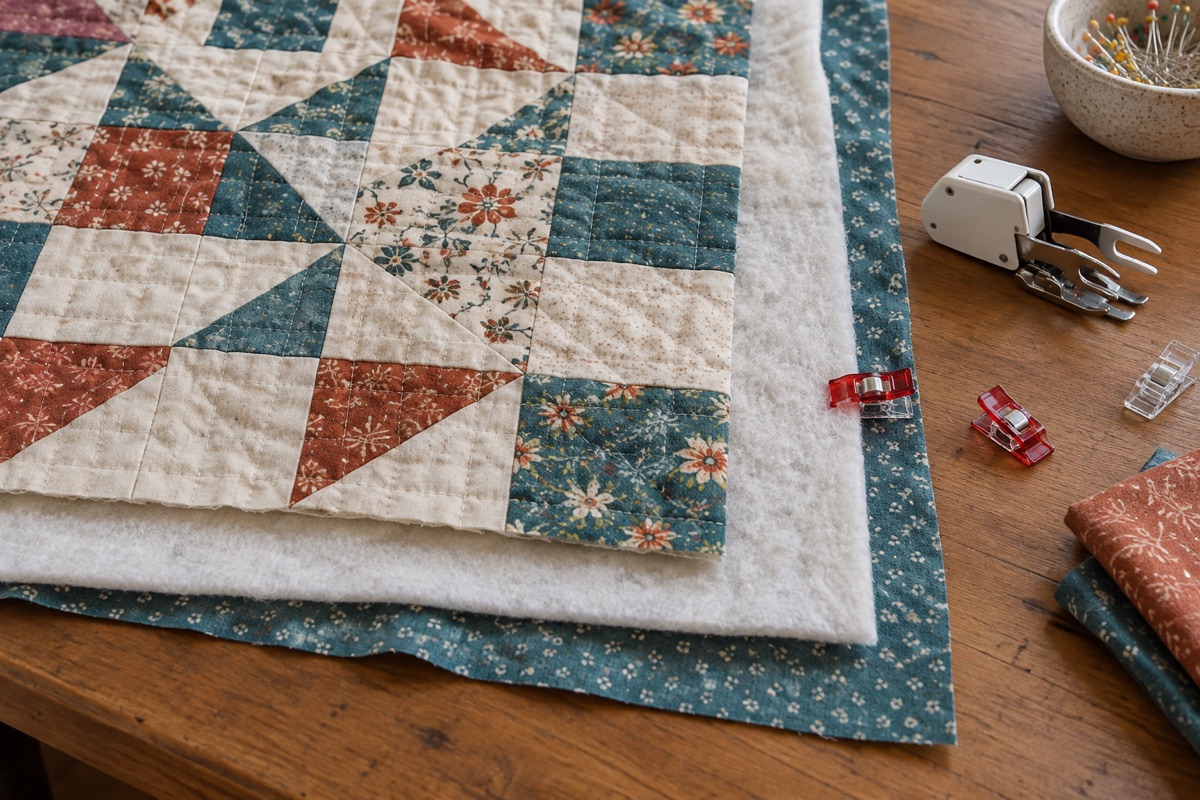
Three layers can travel at slightly different rates: feed dogs move the backing, the ordinary foot presses on the top, and wadding sits between them. A heavy quilt hanging off the table adds drag. The result may be a pucker at the far edge even when each fabric looked flat at the start. Solve the layer movement before altering thread tension, which controls the stitch rather than the sandwich.
Find out where the movement begins
Lay the quilt flat and look for ripples before the needle reaches them. If the layers already wrinkle when you smooth them, rebuild the sandwich. If the top creeps only as it goes under the foot, focus on feed method, basting and foot pressure. If a seam line veers because the whole quilt tugs to one side, improve table support. A small basted sample of the same three materials can isolate the machine setup from the weight of the full quilt.
Rebuild from the centre out
Press and flatten the backing, wadding and top as the materials allow. Smooth from the middle towards the edges without stretching one layer. Secure all three with your preferred method at spacing appropriate to the pattern, wadding and planned quilting density. Remove pins before the needle reaches them. Clips belong at outer edges, not under the presser foot. Keep excess backing and wadding beyond the top so small movement does not expose an edge. A large, loosely basted area has more opportunity to creep than a well-secured small one.
For straight lines, choose a route that does not repeatedly push a wave towards an unsecured edge. Follow the quilt pattern's direction guidance. If a pucker appears, stop, remove the affected stitches and smooth/rebaste; sewing across the fold will trap it permanently.
Use an even-feed method where it helps
A walking foot grips the upper layer in coordination with the machine's lower feed. Brother recommends it for quilting layers that slide or pucker. The exact foot must fit the machine's width and attachment system; install with power off and follow the maker's speed and stitch restrictions. A built-in dual-feed system is another solution on machines that support it. Neither replaces basting. For piecing two cotton layers, a quarter-inch foot is often more suitable than a bulky walking foot.
Brother 7 mm horizontal walking foot
Consider only after confirming the exact Brother accessory code and machine model in Brother's compatible-products list.
An upper-feed walking foot for suitable Brother 7 mm horizontal-hook machines; useful for layered quilting and keeping matched fabrics aligned.
Keep in mind
- The Amazon listing's generic title does not itself prove fit for every Brother 7 mm machine.
- Do not use reverse or side-to-side feeding stitches unless the exact foot instructions expressly permit them.
Support the quilt on a level surface to the left and behind the machine. Roll or fold the section passing through the throat without pulling it from the needle. Guide it gently; do not hold the fabric taut against the feed dogs. Sew a short sample and inspect both sides before committing to a long line.
If it still shifts
Check that the foot is fully lowered, the feed dogs are raised for straight-line quilting, the walking foot is correctly fitted and the quilt is not catching on the table edge. Test another needle and stitch length on the layered offcut. If ordinary two-layer cotton also fails to feed, use the fabric-not-feeding diagnosis rather than assuming every issue is quilting technique. If the needle strikes a foot or plate, stop and recheck compatibility; do not force the machine.
Frequently asked questions
Will more pins solve shifting?
They can help secure layers, but uneven smoothing or quilt weight can still create a wave. Rebuild flat and support the mass of the quilt as well.
Should I lower the feed dogs with a walking foot?
Usually no for ordinary straight-line quilting: the foot works with the lower feed. Lowered feed dogs belong to a different, free-motion arrangement when the exact manual specifies it.
Sources
Brother's quilted placemat tutorial describes basting and walking-foot control for layers that slide. The Brother dynamic-walking-foot guide explains the distinct foot functions. Apply the attachment and speed limits in your own machine manual.