
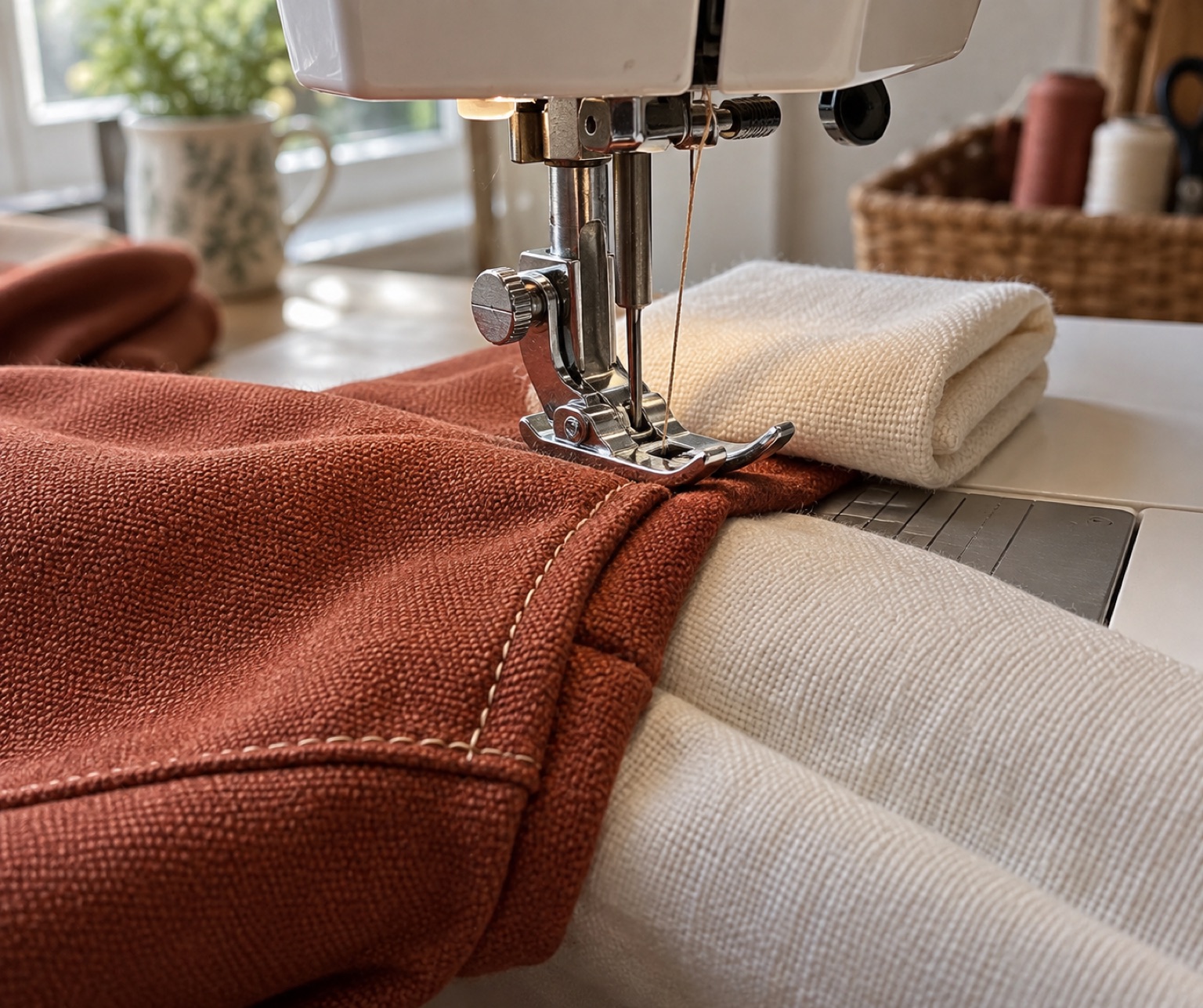
A seam can stitch perfectly for ten centimetres and skip the instant it crosses a waistband, jeans hem or bag handle. That pattern points to a change in thickness and feeding, not automatically a broken tension unit. Diagnose it on a sample with the same materials and folds before touching the finished garment again.
What changes at a bulky crossing?
The leading edge of the presser foot climbs while its rear remains lower. The fabric can stop advancing consistently, the needle may bend as it enters dense cloth, and thread may fail to form a stable loop below the plate. If the machine also skips on flat cloth, go back to basic threading, a correctly seated fresh needle and the right bobbin. If it skips only at the step, concentrate on height and density.
Look for needle holes that are enlarged or slanted, uneven stitch length, thread shredding and a foot that rocks. Do not keep sewing after a needle strike: a damaged point can compound the problem, and a broken tip may remain in the machine or fabric.
Keep the foot horizontal
Approach the seam slowly. With the needle up and machine stopped, put a firm scrap folded to approximately the same height behind the foot so the sole is supported as it climbs. A purpose-made hump jumper serves the same job. Remove the support once the foot is fully on the thick section; repeat in front of the foot as it descends if needed. Do not place loose material where it can enter the needle path.
Brother specifies a levelling button on the HF37's J foot for thicker fabrics. That can be useful if such crossings are routine, but use the foot's exact manual rather than assuming all J feet work identically.
Brother HF37
Best for bags, jeans alterations and mixed dressmaking where a mechanical control layout and help over bulky seam steps matter.
A 37-stitch mechanical machine with a top-loading bobbin, levelling-button foot, non-stick foot, adjustable stitch dimensions and a hard case.
Keep in mind
- There is no maximum-speed slider.
- Its domestic heavy-duty positioning does not make it an industrial or walking-foot machine.
Use the right needle, not merely the largest
For denim or firm twill, SCHMETZ's Jeans needle is designed for the material. Test 90/14 or 100/16 on the actual stack, then a larger size only if thread and machine permit it. The assortment below helps determine which size makes a clean hole and reliable stitch. Replace a needle that bent during the first attempt; straightening it by eye is not safe.
SCHMETZ Jeans needles, assorted sizes
Choose the smallest size that forms a clean stitch through the actual denim layers without deflection, starting with a fresh needle.
A five-needle 130/705 H-J assortment in 90/14–110/18 for testing denim, twill and canvas of differing weights.
Keep in mind
- A larger needle cannot give a domestic machine unlimited piercing or presser-foot clearance.
- 110/18 may leave excessive holes in lighter denim.
For a thick wool seam, the best needle may be a suitable universal rather than a Jeans type. For a stretch-fabric waistband, a Stretch needle may matter more than nominal strength. Fabric structure, thread and seam thickness all count; see needle types and needle sizes before bulk-buying.
Make the crossing easier where the pattern permits
Press allowances in opposite directions where the construction allows so they nest rather than stack. Grade enclosed allowances to different widths, or trim only those layers the pattern leaves inside a seam. For a jeans hem, press the original side-seam ridge flatter before folding the hem; do not hammer on the machine or strike rivets. Baste the crossing so layers cannot creep. Never cut into a load-bearing seam merely to make the machine pass.
Longer stitches can help topstitching look balanced on thick cloth, but a stitch-length dial cannot compensate for inadequate feed or needle clearance. Test one variable at a time. Handwheel the first few stitches of a difficult step and watch the foot's angle.
Recognise a true machine limit
Stop if the foot cannot be lowered, the needle strikes a foot or plate, the handwheel is hard to turn, the motor labours, or stitches remain unreliable after a level-foot and fresh-needle test. A machine rated for ordinary garments is not obligated to sew every combination of denim, batting, webbing or leather. Change the seam construction or seek an alterations specialist for a difficult repair.
Frequently asked questions
Why does my machine skip only at a jeans hem side seam?
That point stacks the hem fold on top of the existing side seam. The sudden step tilts the foot and can deflect the needle. A level foot and representative test stack are more useful first checks than a tension adjustment.
Should I pull the fabric through the machine?
No. Pulling can bend the needle and alter stitch length. Support the garment's weight, level the foot and let the feed dogs advance it.
Will a bigger motor solve it?
Not necessarily. Foot clearance, feed contact, needle choice and seam construction often decide whether the stitch forms. Stop if the mechanism resists.
Sources
The machine-feature example follows Brother's HF37 specification. Needle suitability and available sizes follow SCHMETZ's Jeans needle guidance. Your machine manual controls needle-size limits and foot operation.