
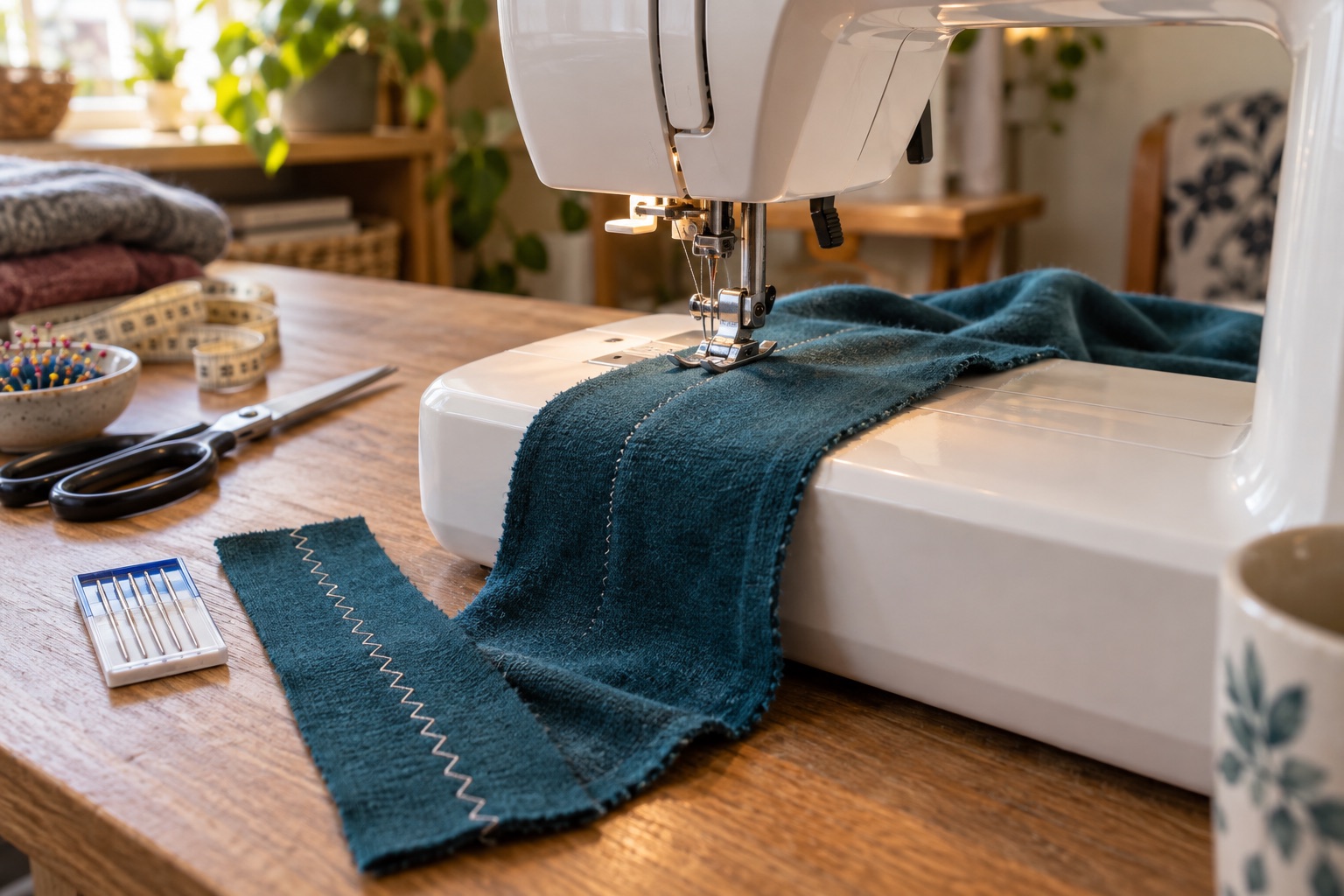
Stretch fabrics need a seam that can extend with the garment. A regular straight stitch may look tidy on a flat T-shirt sample and then snap when pulled over a shoulder. The solution is not one universal tension number. Needle, stitch geometry, foot pressure and how the cloth is supported all interact, so begin with a scrap that duplicates the actual seam layers.
Choose a needle for the knit structure
SCHMETZ distinguishes jersey needles for many knitted fabrics from stretch needles designed for more elastic knits or fabrics with elastane. A stretch needle's scarf and eye geometry are intended to help prevent skipped stitches. Choose a size appropriate to fabric weight and thread, and use the needle system required by the machine manual. A worn or bent needle can make a good setting appear wrong.
For a stable cotton jersey without much elastane, a jersey/ball-point needle is a reasonable first test. For highly elastic rib, swimwear or fabric that skips stitches, try a compatible stretch needle. Do not force a thicker needle through a fine knit simply because it feeds more easily; inspect the swatch for holes and damaged yarns after sewing.
Pick a seam that stretches without breaking
A narrow zigzag gives a seam some extension while retaining a relatively discreet appearance. SCHMETZ suggests a small zigzag around 1 mm wide with 1.5–2 mm length as an example starting point, not a rule for every machine and knit. Your machine may also have a lightning-bolt or triple-stretch stitch; consult its manual for purpose and stitch width. Test the seam by gently stretching it to the degree the garment will experience.
A triple-stretch stitch can be strong but is dense and awkward to unpick, so it is not automatically best for fine jersey. An overcasting stitch finishes an edge; its strength as the sole construction seam depends on the stitch and garment. Finish the seam only after the test demonstrates suitable recovery. For hems, a twin needle or coverstitch is a separate technique with its own threading and tension checks.
Stop the fabric growing under the foot
Let the feed dogs move the knit. Avoid pulling from the front or behind. Support the garment so its weight does not stretch the edge before it reaches the foot. If the seam emerges wavy, test a lower presser-foot pressure where your machine permits it, a walking/even-feed foot compatible with the model, or a light removable stabiliser. Change one variable at a time and compare rested samples.
The Janome Sewist 725S offers adjustable foot pressure in a mechanical machine. That control gives you a way to reduce excessive hold on certain knits while keeping a straightforward dial layout. It still needs a suitable needle and stitch; pressure is not a “stretch mode”.
Janome Sewist 725S
Best for a dressmaker who wants tactile mechanical controls but also needs foot-pressure adjustment and a more convenient top-loading bobbin.
A 25-stitch mechanical machine with a top-loading bobbin, adjustable presser-foot pressure, one-step buttonhole and hard cover.
Keep in mind
- It has no speed limiter or needle up/down control.
- At 6.7 kg plus its hard cover it is portable, but not the lightest machine for weekly travel.
The Brother F580 adds adjustable pressure and an included walking foot in a more advanced combination machine. Those are useful if difficult feeding recurs across garment and quilting projects, but it would be disproportionate to buy this machine solely for a first jersey T-shirt.
Brother Innov-is F580
Best for a sewist who will use both functions regularly and needs more design room and sewing workspace than a compact combination machine provides.
A combined machine with a 180 × 130 mm embroidery field, 190 mm sewing workspace, wireless transfer, adjustable foot pressure and an included walking foot.
Keep in mind
- It is a substantial investment and takes more permanent table space than the M380D.
- One machine still cannot sew while embroidery is running; changing modes remains part of the workflow.
A reliable five-strip test
Cut five offcuts on the same grain as the real seam and fold them to the actual layer count. Sew one with a fresh appropriate needle and narrow zigzag at the manual's normal pressure. Sew the next with a stretch stitch if available. Let the samples relax, then stretch each gently along the seam and inspect for popped thread, tunnelling, puckering and holes. If both wave, repeat one with a pressure or feeding change. Press the chosen sample as you will press the garment.
Record the fabric, needle type and size, stitch settings, pressure position, foot and thread. A setting that works on cotton jersey may be unsuitable for a slippery rayon knit or resilient activewear. Test again at a bulky crossing; flat single-layer success does not guarantee a good hem or waistband.
If you sew knits frequently, the Brother 2104D can create and finish many stretch seams in one pass, with differential feed for controlling edge distortion. It is an additional overlocker, not a replacement for the sewing machine's buttonholes, zips or topstitching. Compare its real job against whether you need an overlocker before adding a second machine.
Brother 2104D
Best for a first-time overlocker owner who wants the core controls, useful threading assistance and a widely documented domestic model without paying for a large accessory bundle.
A compact 3/4-thread overlocker with colour-coded threading, a lower-looper threading aid, differential feed, a free arm and an instant rolled-hem changeover.
Keep in mind
- It is an overlocker, so it does not replace a sewing machine for buttonholes, topstitching or construction away from an edge.
- Threading is still a multi-step process and must follow the machine manual in the stated order.
Diagnose the result, not only the dial
Skipped stitches: fit a fresh compatible stretch needle and rethread, then test another size if the fabric warrants it. Popped seams: choose a seam with more extension and avoid stretching the garment beyond its design fit. Wavy edges: stop pulling, support the fabric and adjust feed/pressure in small steps. Holes: check needle point and size, and whether repeated unpicking has already damaged the knit. Tunnelling in a hem: test narrower twin-needle spacing, suitable backing or a different hem method rather than blindly tightening tension.
Never sew over pins. Keep hands away from the needle and switch off before changing needles or feet. If the machine labours at a bulky crossing, stop and reduce or level the stack rather than increasing speed.
Frequently asked questions
Can I sew jersey without an overlocker?
Yes. A domestic machine with a suitable needle and stretchable stitch can construct many knit garments. An overlocker mainly adds faster edge trimming and a different seam finish.
What tension number should I use for stretch fabric?
There is no universal number. Start with the machine manual's normal setting and a correct needle, then adjust only after inspecting a representative seam with the right thread and layers.
Should I use a walking foot on all knits?
No. Try a normal foot and correct needle/stitch first. Add a compatible walking foot when layers are feeding unevenly, and compare it on the same fabric test.
Sources
Needle and stitch starting points use SCHMETZ's stretch-needle specification and four needles for jersey guidance. Machine-control examples use Janome Sewist 725S, Brother F580 and Brother 2104D.