
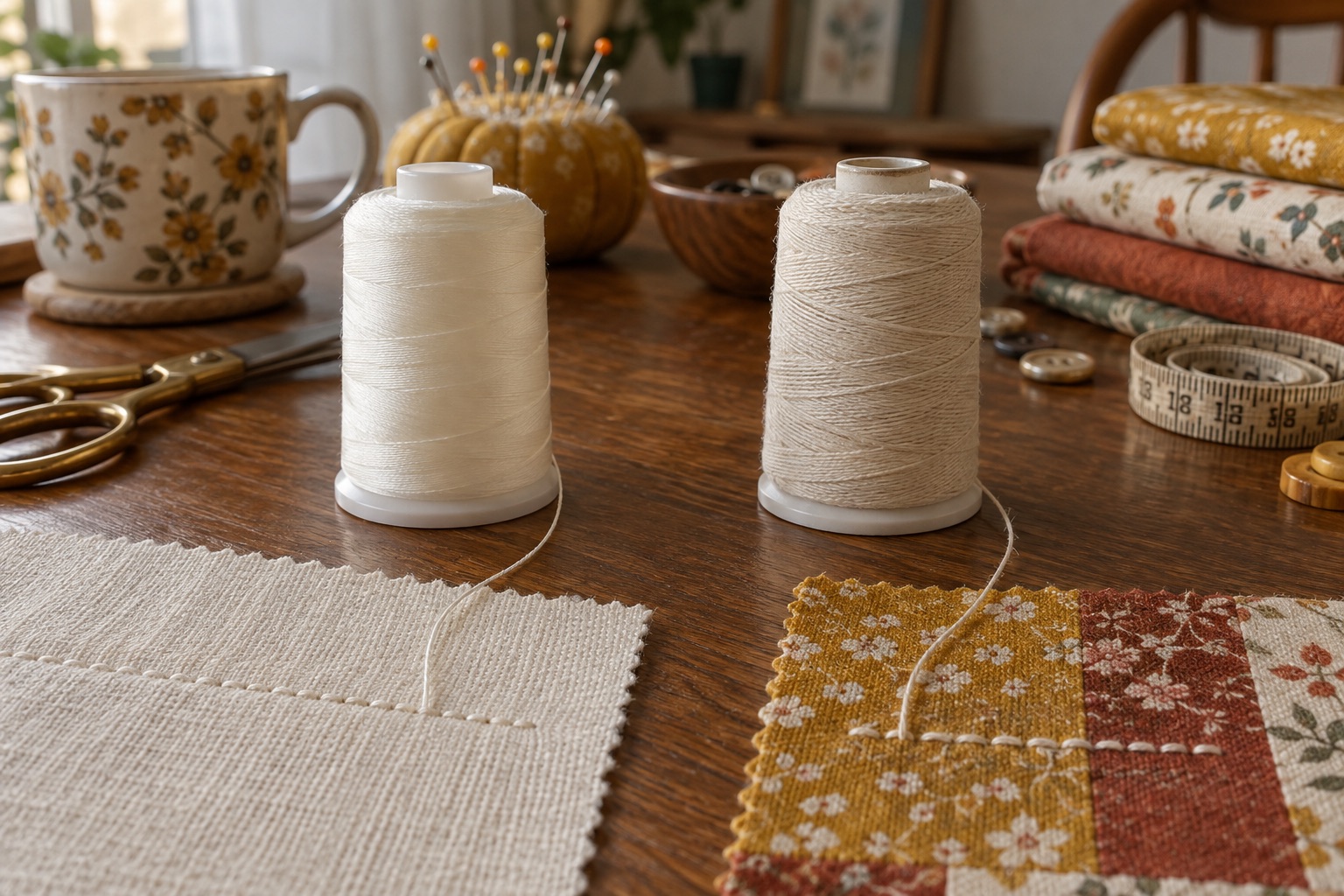
“Cotton fabric needs cotton thread” and “polyester is always stronger” are both too blunt to guide a real project. Choose thread for what the seam does: does it move, take abrasion, need a particular look or get washed often? Then compare actual thread families of similar intended weight rather than a fine construction thread with a heavy decorative one.
The practical differences
Gütermann Sew-All is a 100% polyester general-purpose thread. Its maker recommends Universal needles in the NM 70–90 range for typical use. Gütermann Natural Cotton C Ne 50 is 100% mercerised cotton and is marketed for quilting, patchwork, closing seams and topstitching; the maker likewise suggests Universal NM 70–90. This is a comparison of two named product families, not a claim that every cotton and polyester thread behaves identically.
Polyester generally has more give than cotton thread of comparable intended use, which can make it helpful for garments that move. Cotton can have a pleasing natural handle and appearance in cotton projects. Finish, twist, thickness and manufacturing quality still matter. Cheap fuzzy thread of either fibre can shed lint or fray through the needle eye.
Use all-purpose polyester for versatile garment sewing
For an everyday woven garment, alterations or a jersey seam, a quality all-purpose polyester is a sound first test. The Sew-All spool below is a specific 100 m white listing. White is not an all-purpose colour: choose a close shade or a deliberate contrast for the actual garment. The fibre does not make an ordinary straight stitch elastic enough for a tight knit—stitch construction still matters.
Gütermann Sew-All polyester thread, white
A reliable general-purpose thread family for mixed garment fabrics; choose the shade that blends with your project rather than buying white by default.
A 100 m spool of 100% polyester Sew-All thread for everyday construction seams, repairs and machine sewing.
Keep in mind
- The linked listing is white; match colour locally if needed.
- It is not the same as a deliberately heavy decorative topstitch thread.
For a high-visibility jeans topstitch, a heavier decorative thread may be desirable, but it is a different product category from Sew-All. Test the needle eye and bobbin arrangement before switching. For a structural seam, ordinary thread may feed more predictably through a thick crossing than a showy heavy top thread.
Use cotton when the fibre or look is part of the brief
Natural Cotton C Ne 50 is mercerised, which gives a smoother, subtly glossy cotton surface. It suits many cotton patchwork and quilting applications and can be used for seams or decorative stitching where its look is wanted. Some quilters prefer cotton thread alongside cotton fabric, but that preference is not a universal performance law. Test the same seam and washing conditions before choosing it for a hard-wearing garment.
The linked Gütermann Natural Cotton spool is black. It is a useful example of the fibre and thread family, not a colour recommendation for every project. Verify the desired shade and spool length on the retailer listing.
Gütermann Natural Cotton thread, black
Consider when the project calls for a cotton thread and you have checked seam strength and colour match on a real sample.
A 100 m spool of mercerised cotton Natural Cotton C Ne 50 for cotton-fabric seams, patchwork and decorative stitching.
Keep in mind
- The linked listing is black; select an appropriate colour for the project.
- Cotton thread is not a universal substitute for polyester in high-stretch garment seams.
A quick project-led choice
For a fitted knit garment, begin with quality all-purpose polyester and a seam that stretches; a cotton thread is not the automatic match simply because the jersey contains cotton. For piecing cotton quilt blocks, either thread may work if its weight permits an accurate seam allowance and the finished quilt's care. For a decorative visible line, choose the desired appearance and then make a sample; for thick jeans topstitching, consider a purpose-made heavier thread and suitable needle eye. For repairs, match the original fabric, expected strain and colour before fibre ideology.
The same Universal needle assortment can carry either of the two featured thread families when the fabric and machine suit it. The manufacturer's 70–90 guidance is a starting range; do not use a Universal point on highly elastic jersey simply because the thread maker says “Universal”. Fabric structure still governs the point choice.
SCHMETZ Universal needles, assorted sizes
A practical starting pack when the machine manual specifies the flat-shank 130/705 H system and your projects vary in fabric weight.
A ten-needle assortment spanning 70/10 to 100/16 for sampling fine-to-medium woven fabrics and ordinary sewing thread.
Keep in mind
- Universal point is not the first choice for very elastic knits.
- Check the needle system in your machine manual before buying.
If a thread shreds, loops or puckers
Rethread with the presser foot raised so the thread seats correctly in the tension discs. Check spool orientation, a correctly inserted bobbin and a fresh needle of appropriate type and eye size. Compare a sample with ordinary thread from a known maker. If the machine sews the control sample well, the issue may be the new thread's thickness, texture or spool feed rather than the machine timing. Adjust tension only after those checks and only in small, documented steps.
Frequently asked questions
Is polyester thread bad for cotton fabric?
No. A quality all-purpose polyester can sew many cotton fabrics. Choose by seam use, appearance and care rather than assuming fibre matching is mandatory.
Is cotton thread always best for quilting?
No. It is a common aesthetic and material choice, but weight, stitch consistency, laundering and the desired quilt finish matter more than a blanket rule.
Can I mix polyester top thread and cotton bobbin thread?
It may work, but first test a matching thread pair so differences in weight and tension are easier to diagnose. Mixed fibres are not a shortcut for a feeding or needle fault.
Sources
Composition, intended use and needle recommendations use Gütermann's Sew-All and Natural Cotton C Ne 50 specifications. Needle-system and size advice uses SCHMETZ's Universal needle specification.