
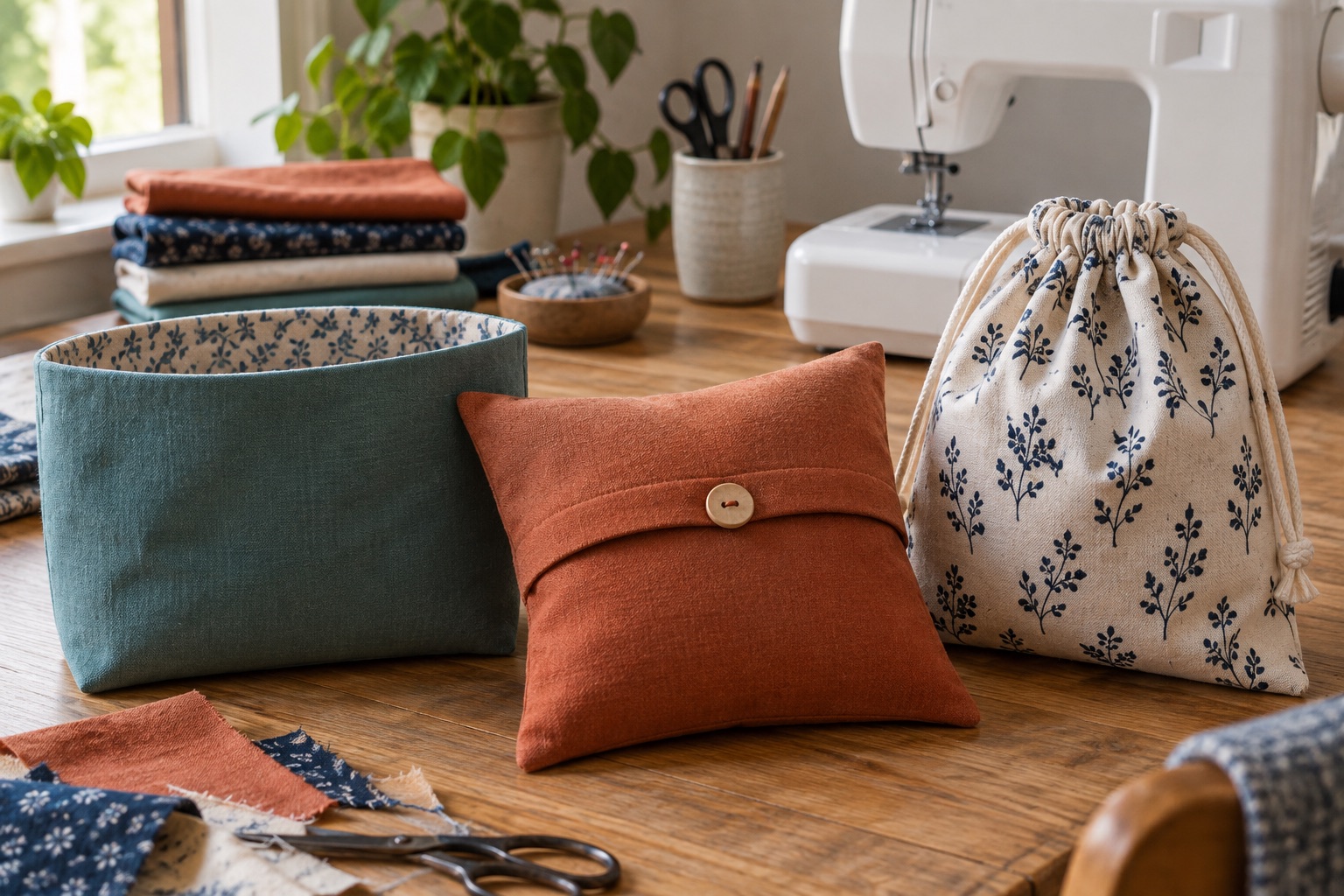
A first project should be useful, small enough to finish and forgiving of a slightly uneven seam. Stable woven cotton or cotton-linen is easier to guide than jersey or slippery satin. Wash and press the fabric as appropriate to its care instructions before cutting, so a later wash does not surprise you with shrinkage. Choose a simple written pattern if dimensions matter, and read it all the way through before cutting.
Before you cut the good fabric
Thread the machine, wind a compatible bobbin and test the stitch on a folded offcut from the same fabric. Use the correct needle for that fabric, a standard straight stitch and the seam allowance specified by the pattern. Measure that allowance from the needle to the guide—not from the presser-foot edge unless they happen to match. Practise a straight line and a short reverse stitch on the offcut. Press the test seam open or to one side as the project requires.
You do not need a feature-heavy machine for these woven-cotton projects. The Brother LX17 is an example of a basic full-size mechanical machine with the straight stitch, zigzag and standard foot needed for many first makes. It is a buying option only if you still need a machine; use the one you own if it sews a sound sample.
Brother LX17
Best for a new sewist who values an uncomplicated dial layout and wants to learn on a full-size machine without paying for electronic controls.
A straightforward mechanical machine with a top-loading bobbin, 17 stitches and the core feet needed for everyday repairs, simple garments and home projects.
Keep in mind
- Its four-step buttonhole takes more input than a one-step system.
- There is no speed-limiting slider or automatic needle threader.
Projects 1 and 2: stay flat and small
1. Hemmed cotton napkin. Cut a square of medium-weight woven cotton. Press a narrow double-fold hem around each edge to enclose raw edges, pin or clip it, then sew a straight line close to the inner fold. Stop at each corner, arrange a neat fold and continue; use the handwheel to position the needle if your manual permits. The lesson is keeping a consistent distance from an edge. You can make one napkin without committing to a full set.
2. Fabric bookmark. Cut two matching long rectangles of cotton. Place their right sides together, sew around the sides and one end using the chosen seam allowance, and leave the other short end open. Trim bulky corners without cutting stitches, turn right side out, press and topstitch the open end closed. This introduces sewing two layers, turning a corner and making visible topstitching. Use a sturdy enough fabric or a suitable insert if the bookmark feels too floppy, and keep any insert away from the needle unless it is made to be sewn.
For these first woven projects, choose a fresh needle in the size recommended for your fabric and machine. The SCHMETZ universal assortment below is a way to keep suitable spares, not a reason to pick a heavy needle for thin cotton; confirm the machine's needle system first.
SCHMETZ Universal needles, assorted sizes
A practical starting pack when the machine manual specifies the flat-shank 130/705 H system and your projects vary in fabric weight.
A ten-needle assortment spanning 70/10 to 100/16 for sampling fine-to-medium woven fabrics and ordinary sewing thread.
Keep in mind
- Universal point is not the first choice for very elastic knits.
- Check the needle system in your machine manual before buying.
Projects 3 and 4: enclose and turn
3. Two-panel drawstring bag. Cut two equal rectangles of woven cotton and follow a simple bag pattern for the top casing allowance. Join the side and bottom seams but leave the pattern's openings for the cord channel. Finish the raw seam edges with the method your machine allows, press the top casing down and stitch its lower edge. Thread a cord through using a safe blunt tool. The key lesson is planning an opening before you sew the side seam shut. Keep drawstrings away from babies and young children; this is a general storage bag, not a child's sleep item.
4. Envelope cushion cover. Use one front panel and two overlapping back panels cut for an existing cushion insert, allowing for seams and the overlap. Hem the inner edges of the back panels first. Place backs and front right sides together with the back panels overlapping, sew the outside edge, finish and turn through the envelope opening. This repeats straight seams and teaches construction order. Measure the insert rather than guessing a universal cut size; different fabrics and preferred fullness change the result.
All-purpose thread is suitable for many ordinary woven-cotton seams. The linked Gütermann Sew-All spool is white; choose a coordinating colour for visible hems or darker fabric. If you already have sound thread in a suitable shade, use it.
Gütermann Sew-All polyester thread, white
A reliable general-purpose thread family for mixed garment fabrics; choose the shade that blends with your project rather than buying white by default.
A 100 m spool of 100% polyester Sew-All thread for everyday construction seams, repairs and machine sewing.
Keep in mind
- The linked listing is white; match colour locally if needed.
- It is not the same as a deliberately heavy decorative topstitch thread.
Project 5: a simple open-top tote
Choose a pattern that specifies both fabric weight and handle construction. Sew the two main panels together, finish the raw side and bottom edges, then prepare and attach handles exactly where the pattern indicates. Make a neat top hem and reinforce handle attachment as instructed. The new lesson is that a useful bag needs more than a straight seam: fabric strength, handle placement and secure attachment matter. Start with light everyday use, not heavy shopping, until you know the pattern and fabric are appropriate.
If any project stalls because the machine bunches thread or skips stitches, stop on an offcut. Recheck threading, needle insertion and bobbin fit before continuing through finished fabric. Press between construction steps; it is part of making a neat seam, not merely a final touch.
Frequently asked questions
What is the easiest actual thing to sew?
A hemmed woven-cotton napkin has no fitting, zip or curved seam. A bookmark is similarly small but adds a turn and topstitching.
Do I need an overlocker for these projects?
No. A standard sewing machine can construct them. Use an appropriate seam finish where raw edges will be exposed or fray.
Should I buy fabric before choosing a pattern?
Choose the pattern and its recommended fabric weight first, especially for a tote or cushion cover. Then buy enough fabric to include a test offcut and account for the pattern's cutting layout.
Sources
Brother's first-machine setup guide supports the basic test-seam sequence, while Janome UK's project library provides maker-published examples of machine-sewn beginner makes. The Brother LX17 specifications support the machine example. Follow the chosen project's full pattern for cut sizes, seam allowances, handle strength and finishing.