
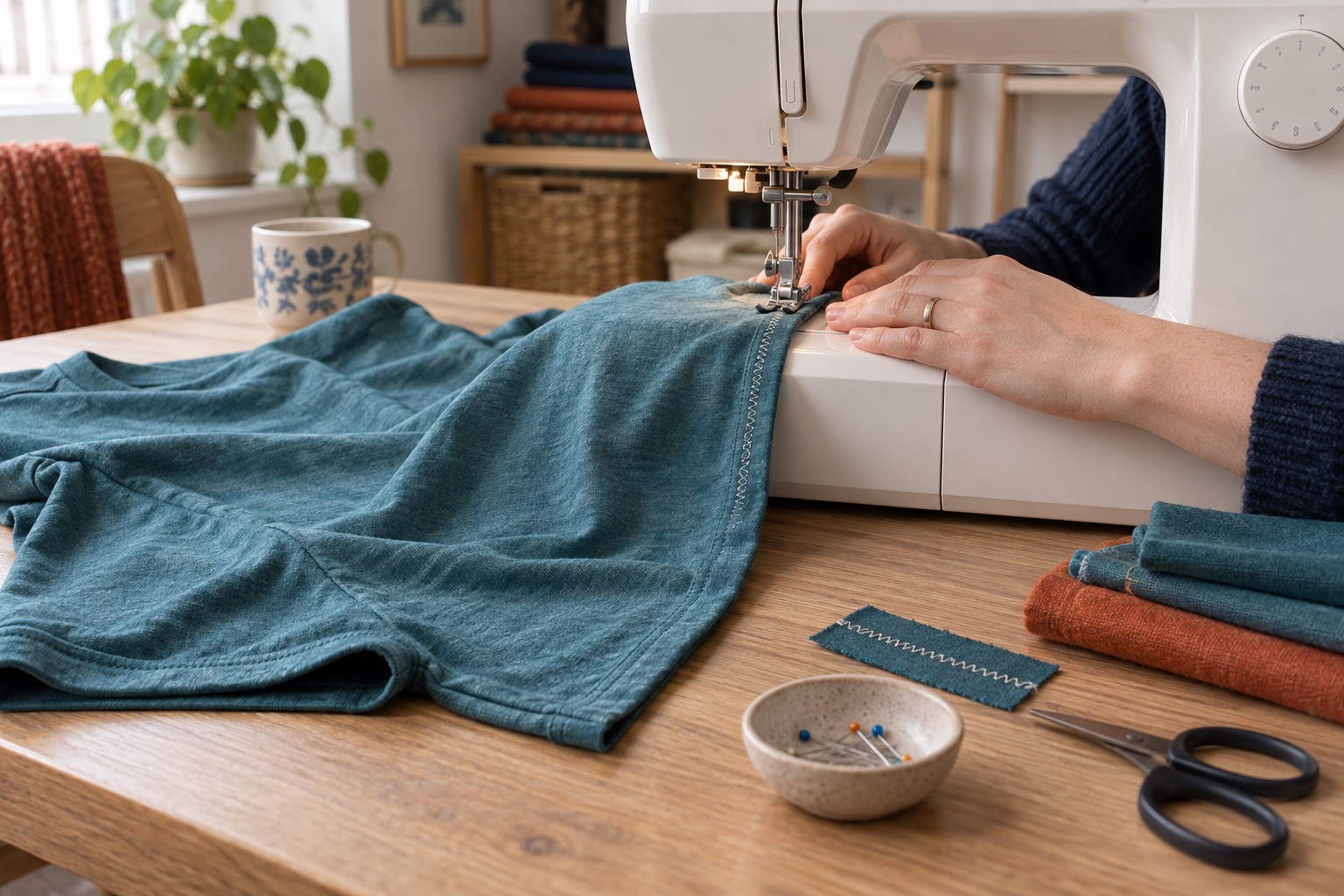
A first jersey T-shirt does not require a second machine. The challenge is to preserve the fabric's stretch while keeping the seam flat and intact. This guide follows the garment workflow; if you already have a wavy or skipped seam and want a diagnostic settings sequence, use our stretch-fabric settings guide.
Prepare the real fabric, not an idealised sample
Wash and dry washable jersey as you intend to care for the garment, following its label. Identify the direction of greatest stretch and cut pattern pieces on the intended grain. Use weights or fine pins within the seam allowance; avoid stretching the fabric while cutting. Keep a generous offcut from the same section for tests, because a stable body panel and a highly elastic neckband may need different setups.
Thread the machine correctly, use the bobbin type specified in its manual and begin with ordinary good-quality sewing thread. Do not solve a feeding problem by yanking the fabric through. Support the weight of the garment on the table both in front of and behind the foot.
Match the needle to the knit
SCHMETZ describes its Jersey needle as a medium-ballpoint choice for knitted fabric. For cotton jersey with little elastane, start with an appropriate size from that family. The assorted pack below lets you compare 70/10, 80/12 and 90/14 on the actual cloth; a thicker needle is not automatically better. Inspect holes and damaged knit loops after sewing.
SCHMETZ Jersey needles, assorted sizes
Useful for cotton T-shirts and other stable jersey when a universal needle snags knit yarns or gives an untidy seam.
A medium-ballpoint 130/705 H SUK assortment for ordinary knitted fabrics, with sizes 70/10 to 90/14 to test against jersey weight.
Keep in mind
- For highly elastic fabric with skipped stitches, a Stretch needle may be better.
- A compatible machine and correct size still need checking.
For rib, swimwear or elastane-rich jersey that skips despite correct threading, SCHMETZ's Stretch needle has a different scarf and eye arrangement. It is a reasoned next test, not a promise to cure every skip. Fit a fresh needle of the system prescribed by your machine and change only one variable at a time.
SCHMETZ Stretch needles, assorted sizes
A targeted alternative when elastane-rich jersey, rib or activewear skips despite correct threading and a fresh Jersey needle.
A five-needle 130/705 H-S pack with stretch-needle scarf and eye geometry intended to reduce skipped stitches in elastic fabrics.
Keep in mind
- It does not replace a stitch that can stretch with the garment.
- Test size against the fabric and thread rather than assuming 90/14 is always safer.
Construct with a seam that survives movement
Fold an offcut to the actual number of layers. Try a narrow zigzag—SCHMETZ gives roughly 1 mm width and 1.5–2 mm length as an example starting point—or the machine manual's stretch stitch. Sew a strip, let it relax, then gently stretch it as the garment will be stretched. If the thread pops, the stitch has too little extension for that position. If the knit puckers, check feeding and pressure before turning every tension control.
A dense triple-stretch stitch can be hard to unpick, so it is not the default for every T-shirt. A plain straight stitch may be fine for a stable seam that sees little movement, but it is a poor assumption for a neckline or fitted side seam. Sew shoulder seams, side seams and sleeves using the pattern's seam allowance; do not trim that allowance merely to imitate an overlocker. Press gently according to the fibre and use a press cloth where needed.
Keep the edge from waving
Let the feed dogs transport the layers. If one layer grows, pin or baste more closely, use a compatible walking foot if you own one, or test lower presser-foot pressure if the machine provides adjustment. Lightweight removable stabiliser can help a reluctant edge, but sample how it washes out or tears away first. Compare finished samples after resting; a freshly sewn knit can appear more stretched than it remains.
At a neckband, quarter-mark the band and neckline, then distribute the intended band stretch evenly between marks. Do not stretch the neckline itself. If the pattern gives no band ratio, test a small section rather than assuming one percentage works across every rib and neckline curve.
Choose a hem you can reproduce
A narrow zigzag or suitable stretch stitch can hem a T-shirt effectively. Fold and press the allowance without stretching it; check that the seam still extends enough to get the garment on. A twin needle gives two parallel rows above and a zigzag of bobbin thread below. It needs twin-needle compatibility and careful threading; see the step-by-step twin-needle guide.
The SCHMETZ Stretch Twin 4.0/75 is an option only if your zigzag foot and needle plate have enough clearance. Rotate the handwheel through the intended straight-stitch setting before pressing the pedal. Try a narrower spacing if the hem tunnels.
SCHMETZ Stretch Twin needle 4.0/75
For a compatible zigzag-capable domestic machine with sufficient needle-plate and presser-foot clearance, after a handwheel collision check.
A 4 mm-spaced twin needle with Stretch-needle geometry for two parallel rows on knit hems and a zigzag bobbin thread beneath.
Keep in mind
- A 4 mm gap will not fit every foot or stitch-width setting.
- Tunnelling may still require stabilisation, tension or spacing tests.
Frequently asked questions
Must I finish jersey seam allowances?
Many jersey edges do not fray like woven edges. Trim neatly only if the pattern and seam strength permit; an optional zigzag finish can tidy the inside. Do not cut into the construction seam.
Why does my jersey seam break when I put the garment on?
The construction stitch may not extend enough, or the garment may be stretched beyond its intended fit. Test a narrower zigzag or suitable stretch stitch on the same fabric and seam layers.
Should I buy an overlocker for one T-shirt?
No. Learn the fabric and your domestic machine first. An overlocker becomes more compelling when you repeatedly make knit garments and value fast edge finishing.
Sources
Needle differences and stitch examples follow SCHMETZ's four needles for jersey, Jersey needle and Stretch needle guidance. Always use your own machine and garment-pattern instructions for threading, stitch choice and seam allowances.