
| Question | Mechanical | Computerised |
|---|---|---|
| Stitch selection | Dial or lever | Buttons or jog dial with display |
| Maximum-speed limiter | Uncommon | Common on mid-range models |
| Needle up/down | Uncommon | Often available |
| Buttonholes | Often four-step or one-step | Usually one-step with several styles |
| Starting price | Usually lower | Usually higher |
| Repair assumption | Model-specific | Model-specific |
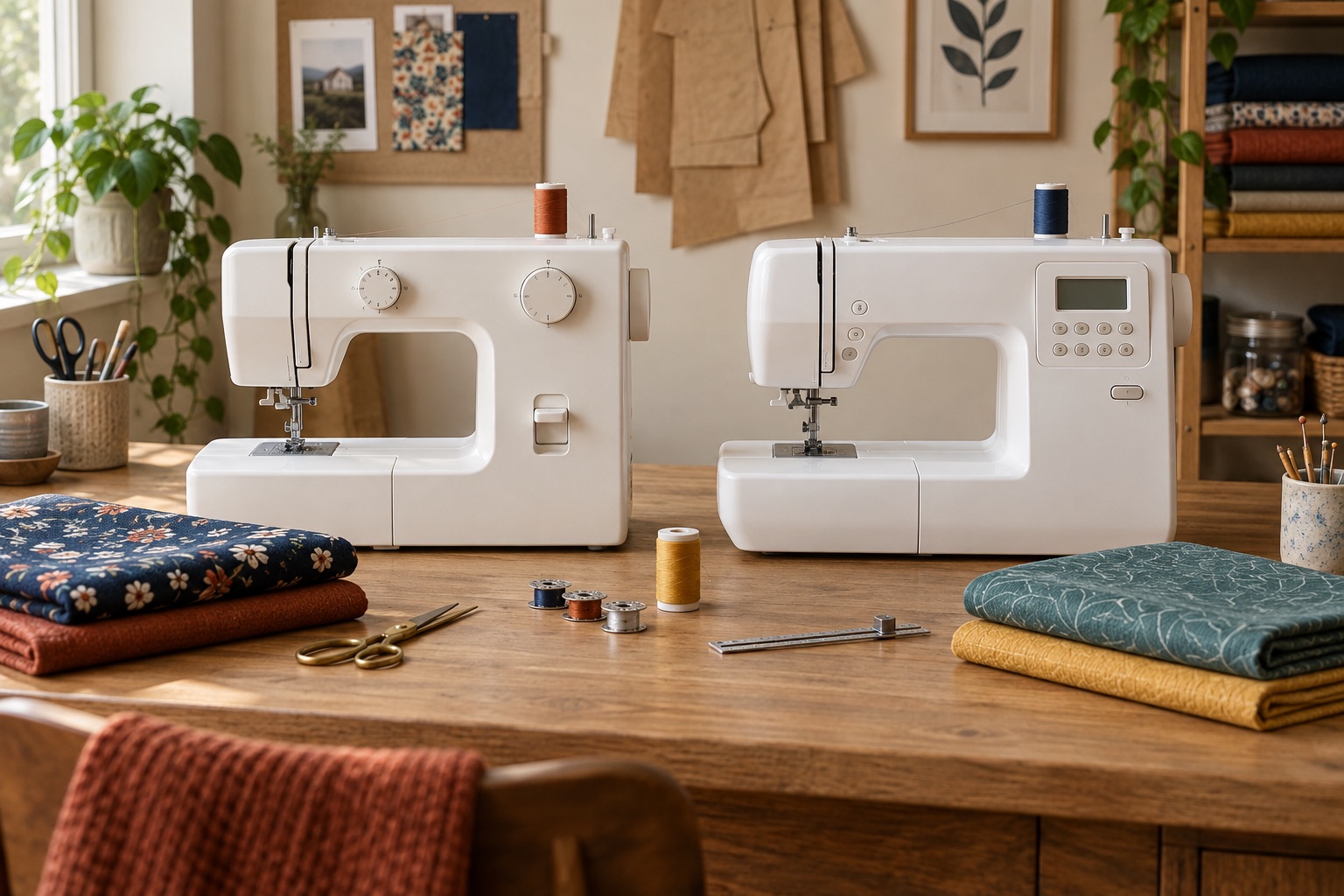
Mechanical and computerised sewing machines form two control systems, not two levels of sewing ability. Both use an electric motor, foot control, needle, hook and feed dogs. The difference is mainly how the sewist selects settings and how much control the machine’s electronics can automate.
What is actually different?
A mechanical model normally uses dials, sliders and internal cams to select stitches. You set length, width and tension directly where the model allows. The machine runs when the foot pedal is pressed, and the needle usually stops wherever it happens to be in its cycle.
A computerised or electronic model uses buttons, a jog dial or touch controls. It may set a default length and width for the chosen stitch, show the recommended presser foot and add controls such as maximum speed, needle up/down, start/stop and locking stitches. “Computerised” does not mean the machine sews the project for you; fabric still has to be prepared, supported and guided.
The number of stitches is an unreliable way to choose between them. A focused 16-stitch electronic model can offer more useful control than a 100-stitch machine bought only for its menu.
Choose mechanical for direct, tactile sewing
Mechanical machines suit sewists who like settings that remain visibly fixed, mainly use straight and zigzag stitches and prefer to control speed through the pedal. They also tend to offer the lowest route into a current full-size machine.
The Janome Sewist 725S shows what a well-equipped mechanical model can include: a one-step buttonhole, top-loading bobbin, needle threader, drop feed and adjustable presser-foot pressure. Those garment-friendly features matter more than its lack of a screen. The Brother LX17 is a simpler example with 17 stitches, a top-loading bobbin and a four-step buttonhole.
Janome Sewist 725S
Best for a dressmaker who wants tactile mechanical controls but also needs foot-pressure adjustment and a more convenient top-loading bobbin.
A 25-stitch mechanical machine with a top-loading bobbin, adjustable presser-foot pressure, one-step buttonhole and hard cover.
Keep in mind
- It has no speed limiter or needle up/down control.
- At 6.7 kg plus its hard cover it is portable, but not the lightest machine for weekly travel.
Mechanical does not always mean basic or cheap. A robust metal-bodied model can cost more than an entry computerised one, and a mechanical machine can still have complex internal timing and plastic components. Judge the exact construction and support, not a nostalgic idea of simplicity.
Mechanical advantages
- Settings are direct and easy to see.
- Entry models usually cost less.
- Utility sewing rarely requires navigating a menu.
- A sewist who dislikes screens may find the workflow calmer.
Mechanical compromises
- Maximum-speed limiting is uncommon.
- Needle up/down and start/stop are rarely present.
- Four-step buttonholes are more common at the low end.
- The foot pedal carries more of the low-speed control task.
Choose computerised for repeatable control
A computerised machine makes sense when its controls solve specific coordination or accuracy problems. A speed slider can keep the machine slow around curves. Needle-down stopping holds the work for a pivot. A one-step buttonhole can make repeated shirt or dress buttonholes more consistent. Default stitch settings can give a useful starting point, provided you still adjust them for the fabric.
The Brother Innov-is A16 is a useful example because it has only 16 stitches. Its value lies in a speed slider, needle up/down, quick-set bobbin, three one-step buttonholes and seven-point feeding rather than a huge stitch count. It is a stronger fit for precise dressmaking or a careful learner than for someone who wants the lowest-cost repair machine.
Brother Innov-is A16
Best for garment sewing, careful learners and supervised teenagers who value slow-speed control more than a large decorative-stitch menu.
An electronic 16-stitch machine with a speed slider, needle up/down, three one-step buttonholes and a seven-point feed system.
Keep in mind
- It costs considerably more than a basic mechanical machine.
- At 6.6 kg it is class-portable rather than genuinely light.
Computerised advantages
- Speed can often be capped independently of pedal pressure.
- Needle position and lock stitch can be controlled by button.
- One-step buttonholes and remembered defaults reduce repeated setup.
- Displays can identify settings and the suggested foot.
Computerised compromises
- The purchase price is usually higher.
- More controls can distract a sewist who needs only straight stitch and zigzag.
- Electronic faults require appropriate diagnosis; they are not a home-repair invitation.
- A large stitch library does not improve feeding, workspace or build quality.
Is a mechanical machine more reliable?
There is no sound basis for treating every mechanical machine as more durable than every computerised one. Reliability depends on the specific design, manufacturing, use, maintenance, storage and access to competent service. Both types contain moving mechanical parts; both can be damaged by forcing fabric, using a bent needle or pulling a jammed seam.
Ask practical ownership questions instead:
- Is the exact UK model supported by the manufacturer?
- Is the manual available and are compatible bobbins and feet identifiable?
- Who handles warranty work and paid servicing locally?
- Does the brand specify a domestic warranty for this machine?
- Can the retailer demonstrate the controls and diagnose setup errors?
Routine user care is similar: clean only as the manual instructs, change needles regularly, use the correct bobbin, avoid unapproved oiling and switch off before needle or presser-foot changes. Do not open electronic housings or attempt internal electrical repairs.
Which type is better for a beginner?
The better beginner machine is the one whose controls reduce friction for that learner. A confident pedal user making simple woven projects may learn fastest on two mechanical dials. A nervous learner, supervised teenager or dressmaker working around curves may benefit from a speed limiter and needle-down stopping.
Brother LX17
Best for a new sewist who values an uncomplicated dial layout and wants to learn on a full-size machine without paying for electronic controls.
A straightforward mechanical machine with a top-loading bobbin, 17 stitches and the core feet needed for everyday repairs, simple garments and home projects.
Keep in mind
- Its four-step buttonhole takes more input than a one-step system.
- There is no speed-limiting slider or automatic needle threader.
Which type is better for dressmaking?
Either can be excellent. Prioritise controllable stitch dimensions, useful stretch stitches, buttonholes, presser-foot pressure where possible, free-arm access and suitable feet. A mechanical Janome 725S meets much of that brief; an electronic Brother A16 adds slower capped sewing and needle position. Our dressmaking machine guide compares the project fit directly.
Which type handles denim better?
The control system does not determine fabric capacity. Feeding, foot clearance, levelling over seam humps, needle choice and the number and density of layers matter more. See our separate sewing machines for denim guide for domestic-machine limits.
A five-question decision
Choose a mechanical machine if most of these are true:
- you prefer dials and want to see every setting;
- the first projects rely on utility stitches;
- the foot pedal feels easy to control;
- lower initial cost matters;
- automated needle position would rarely be used.
Choose a computerised machine if most of these are true:
- you want to cap maximum speed;
- you pivot often or value needle up/down;
- garment buttonholes are a regular job;
- a display and suggested settings feel reassuring;
- you are willing to pay for those controls and a clear service route.
Try both with your own fabric before deciding. The right feel is not visible on a specification sheet, and the wrong control style can make a technically capable machine stay in its cupboard.
Frequently asked questions
Can a computerised sewing machine be used without the foot pedal?
Some models have a start/stop button, but its permitted use depends on the machine and selected operation. Follow the exact manual. Many sewists still prefer the pedal while using a speed slider as the upper limit.
Are mechanical machines always cheaper to repair?
No. The fault, parts supply, labour and model all matter. Ask a local service provider about the models you are considering rather than assuming a repair price from the control label.
Do computerised machines choose tension automatically?
Some advanced models do; many entry and mid-range machines retain manual upper-thread tension. Check the exact specification and manual.
Sources
Feature comparisons use the manufacturer specifications for the Brother Innov-is A16, Brother LX17 and Janome Sewist 725S, with general selection context from the Brother buyer’s guide.