
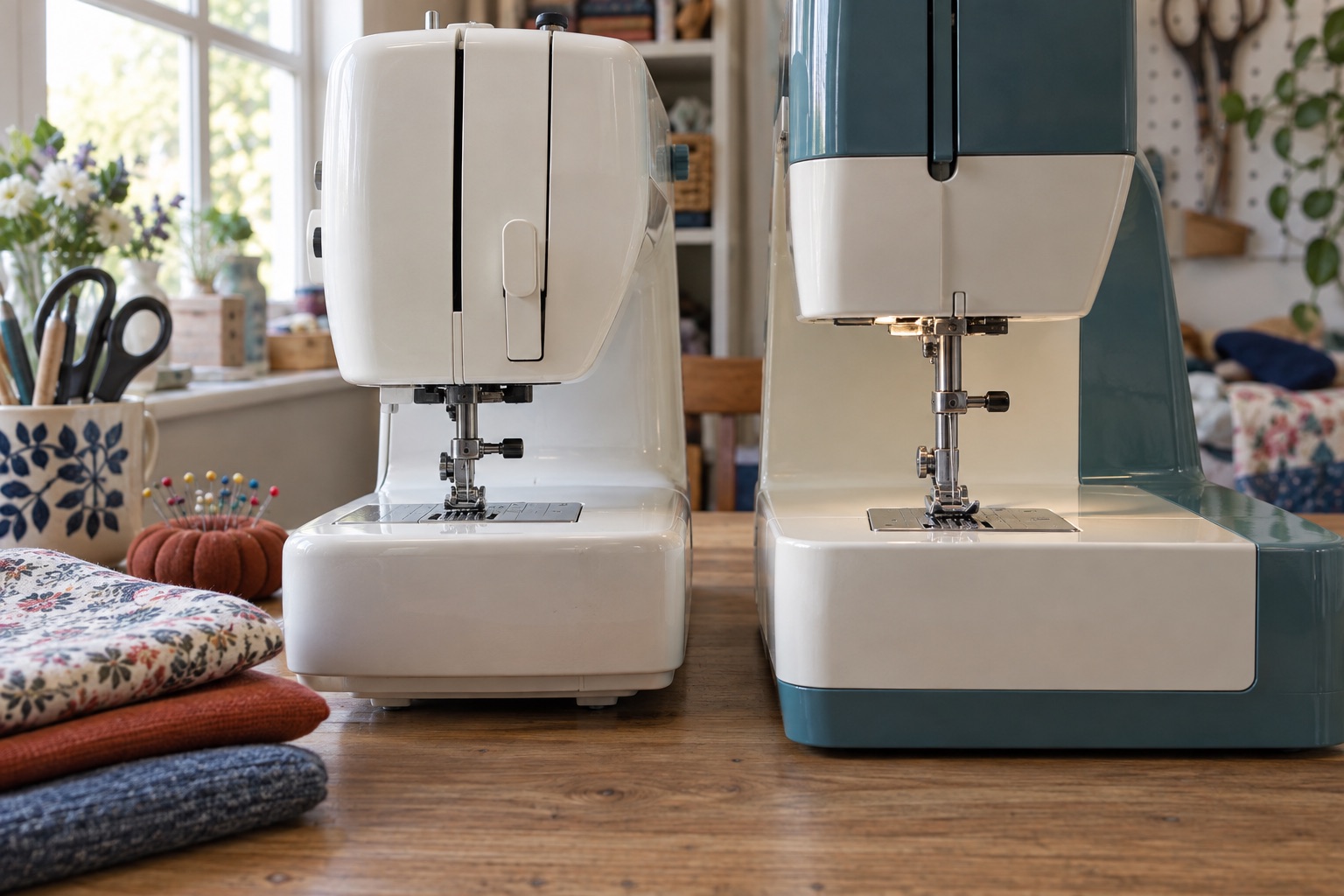
“Low shank” is not a quality grade, and “high shank” does not mean the machine is stronger. It describes the geometry of the mounting point on the presser bar. This matters when buying a screw-on walking or darning foot, or a replacement holder, because an accessory made for one height may sit too high or low on another machine.
Where is the shank measured?
The relevant relationship is between the presser-foot mounting screw and the needle plate with the presser bar lowered. Makers sometimes publish indicative measurements, but there are different foot systems, adapters and machine families, so an internet-wide millimetre rule is a poor substitute for a model-specific compatibility table. Brother's ruler-foot guidance describes the mounting distinction in the context of its own accessories. Use that as an explanation, not as a guarantee about every brand.
The foot sole may attach by a horizontal snap bar to a holder, while the holder itself screws to the presser bar. Thus a machine with snap-on everyday soles can still require a screw-on walking foot. Shank height and attachment method answer different questions; see snap-on versus screw-on feet.
A reliable sequence for identifying your setup
Start with the full model number on the machine label or manual, not just the brand. Look for the maker's accessory list and the exact code of the foot you want. Check whether the foot is sold for your model directly, for a stitch-width family or with a specific adapter. If the instructions use terms such as low shank, high shank, vertical or horizontal, read them as part of that model's system. Photograph the existing foot and holder only for comparison after you have the maker part code; two similar-looking holders can still position the needle differently.
If the manual is missing, seek the maker's support page or a dealer with the model number. Avoid assuming that a generic “fits most low-shank machines” listing accounts for your needle swing or plate. This is especially important with a metal guide near the needle, a walking foot that replaces the holder, or a straight-stitch foot with a small needle hole.
Other dimensions can still make a matching shank unsafe
Needle width is one. A foot for a 5 mm machine may not clear a 7 mm zigzag even if the shank attaches. The needle's default centre can differ; some accessories require a centred straight stitch. The holder's snap bar and the distance from bar to needle can vary. Some feet need a lever around the needle clamp. An embroidery or industrial machine can use an entirely different fitting despite a familiar shank phrase. These are reasons to reject broad brand lists without a maker compatibility code.
Brother's F091 high-shank adjustable zipper-foot guide is a clear example: that foot is specifically high-shank and screw-on. It should not be treated as a low-shank substitute because it appears to have an adjustable guide. Likewise, a Brother-branded 7 mm walking foot is not automatically right for every Brother 7 mm machine; the exact model list governs.
The final check happens without power
Switch off and unplug as the manual directs. Mount the correct holder or foot securely, lower it and turn the handwheel through the full intended stitch cycle. Check that the needle clears the foot, guide and plate at the actual selected stitch width and position. Verify that the foot lifts, lowers and feeds as described. Repeat after changing needle position. If anything binds or touches, stop and obtain the correct part rather than filing a foot or forcing an adapter.
Frequently asked questions
Is every snap-on foot low shank?
No. Snap-on describes the sole-to-holder connection; low shank describes the holder-to-machine mounting height.
Can I use an adapter to fit a high-shank foot?
Only if the machine or accessory maker specifies that combination. An improvised adapter may put the needle into the foot or change feeding geometry.
Is a high-shank machine more powerful?
Not by definition. Power and fabric capacity depend on the whole machine design, not the position of a mounting screw.
Sources
Brother's ruler-foot mounting guide explains the height distinction. Its high-shank F091 guide shows a model-specific screw-on example. Use your exact machine's accessory list for the final match.