
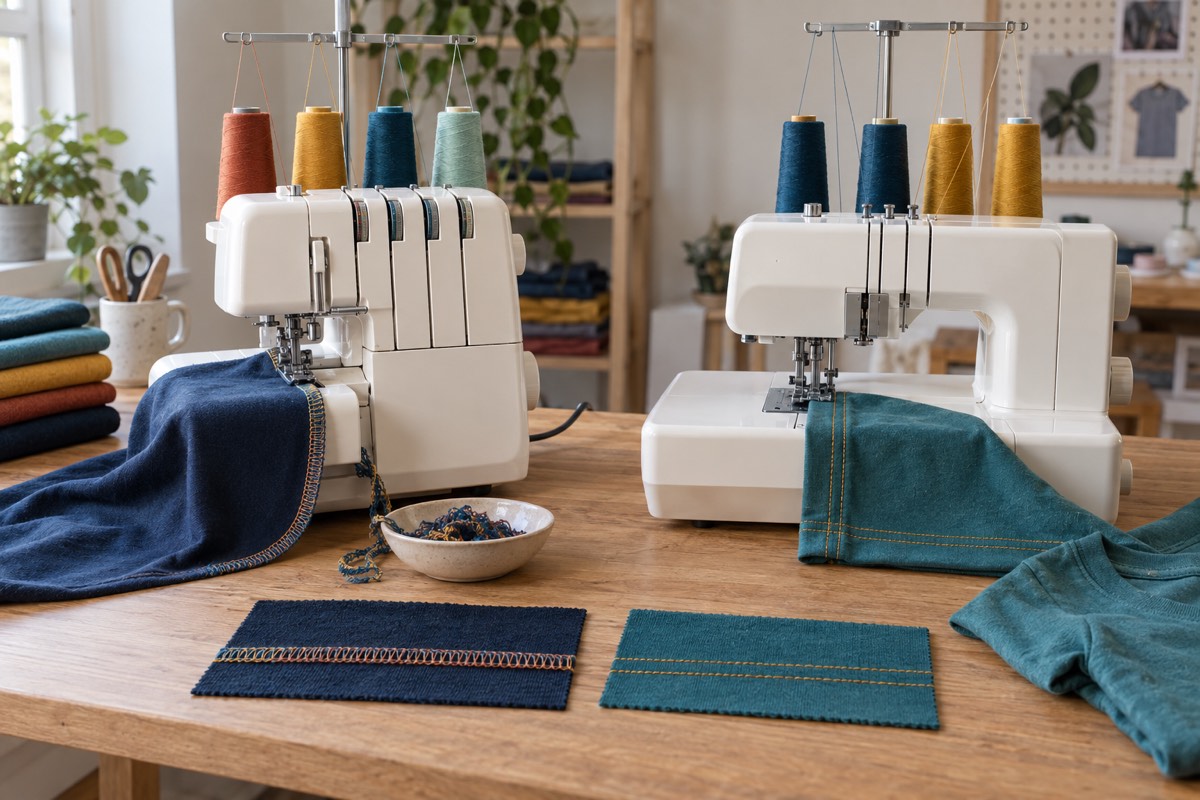
| Question | Overlocker | Coverstitch |
|---|---|---|
| Where does it sew? | At a raw edge | Across a folded or flat surface |
| Does it trim? | Yes | No |
| Typical garment job | Construct and finish knit seams | Hem T-shirts and leggings |
| Visible right side | Edge wrap or seam line | One or more parallel needle lines |
| Buy order | Usually first | Usually after sewing machine and overlocker |
The easiest way to separate these machines is to look at where the stitch is formed. An overlocker works on a raw edge and cuts immediately before sewing. A coverstitch works on the surface of a folded or flat piece and leaves the fabric width intact.
What each machine produces
Overlocker: joined and enclosed edges
An overlocker uses needles and loopers to wrap thread around an edge. On a four-thread setup, two needle lines can contribute to a flexible construction seam while the loopers cover the cut allowance. Three-thread arrangements are commonly used for edge finishing, subject to the manual.
The Brother 3034DWT is an example of the general-purpose specialist: 3/4-thread operation, differential feed, a knife, pressure adjustment and a garment-oriented table-and-feet bundle.
Brother 3034DWT
Best for a beginner who expects to sew garments regularly and will genuinely use the wider support surface and included specialist feet.
A 3/4-thread overlocker supplied with a wide table, trim trap and blind-stitch, gathering and piping feet, plus differential feed and adjustable presser-foot pressure.
Keep in mind
- The accessory bundle costs more and is poor value if you only need occasional seam finishing.
- Its maximum 1,300-stitch-per-minute speed is capacity, not a reason to rush while learning.
Coverstitch: flexible surface hems
A coverstitch machine uses one or more needle threads on top and a looper thread beneath. On a typical T-shirt hem, the right side shows two parallel straight-looking rows while the underside has a flexible chain-like cover. Because there is no trimming knife, the stitch can be placed across a folded hem or used decoratively within a panel.
The Brother CV3550 supports several thread configurations, including top-cover stitches, and provides 155 mm of working space. It is a dedicated coverstitch machine, not an overlocker with the knife switched off.
Brother CV3550
Best for a garment maker who already owns a sewing machine and needs shop-style knit hems often enough to justify a specialist second or third machine.
A dedicated coverstitch machine for flexible hems and decorative surface stitching, with two-sided top-cover capability and a 155 mm work area.
Keep in mind
- It does not trim raw edges, so it is not an overlocker substitute.
- It is specialised and hard to justify for occasional woven garments or simple repairs.
Choose by the operation you repeat
T-shirts and sweatshirts
An overlocker can assemble shoulder, side and sleeve seams quickly. A coverstitch can finish the lower hem and sleeve hems with flexible parallel rows. A sewing machine may still be used for stabilising, topstitching, attaching some neckbands or completing details.
Leggings and activewear
The overlocker handles long flexible construction seams. Coverstitch can hem legs and create flat decorative or elastic-covering applications where the machine and pattern permit. Neither machine is a substitute for testing recovery and stretch on the exact fabric.
Woven garments
An overlocker remains useful for neatening seam allowances. Coverstitch has a narrower role because ordinary lockstitch hems, blind hems and hand finishes often suit woven garments. If woven dresses and shirts dominate, an overlocker is more likely to earn its space.
Children’s clothes and batch sewing
Both machines can save time when the same operations recur, but each colour change may mean multiple threads and a test. Batch similar colours and fabrics to reduce setup. Speed only helps after stitch formation and handling are controlled.
What about combination overlocker-coverstitch machines?
Some machines convert between overlock and coverstitch setups. They save table space and may cost less than two separate machines, but conversion can involve rethreading, needle changes, moving the knife or changing the presser-foot setup. That is acceptable for sewists who switch occasionally; it can interrupt a workflow that alternates between seam construction and hemming.
A dedicated pair lets both machines remain threaded and ready. It consumes more money and space. There is no universal best arrangement: count how often you would switch modes during one garment and decide whether physical space or setup time is the tighter constraint.
Which should you buy first?
For most garment sewists the order is:
- Sewing machine for broad construction, topstitching, zips and buttonholes.
- Overlocker for frequent knit seams and fast edge finishing.
- Coverstitch when flexible hems are frequent enough to justify a specialist setup.
Reverse steps two and three only when your existing workflow already handles construction well and the specific bottleneck is repeated knit hemming. If you are trying to improve one occasional T-shirt, a twin needle on a compatible sewing machine may be a more proportionate experiment, though it forms a different stitch and needs careful tension and fabric testing.
Budget for thread, needles, workspace and learning. A coverstitch can tunnel, skip stitches or struggle at bulky seam crossings if setup is wrong. An overlocker can wave or pucker an edge if differential feed and handling are wrong. Specialist machines narrow the job; they do not eliminate technique.
Frequently asked questions
Can an overlocker make a cover hem?
A normal overlocker can make overlocked and rolled edges, but it does not produce the familiar parallel cover-hem stitch. Some combination machines can convert to coverstitch mode.
Does a coverstitch machine cut fabric?
No. It retains the fabric width and works over a folded or flat surface. That is central to its hemming role.
Can I use a twin needle instead of coverstitch?
For occasional hems, a compatible sewing machine and twin needle can create parallel top lines with a zigzagging bobbin thread beneath. It is not the same stitch, and sampling is essential, but it may postpone a specialist purchase.
Sources
The distinction and examples use the Brother buyer’s guide, official Brother 3034DWT specifications and Brother CV3550 specifications.