
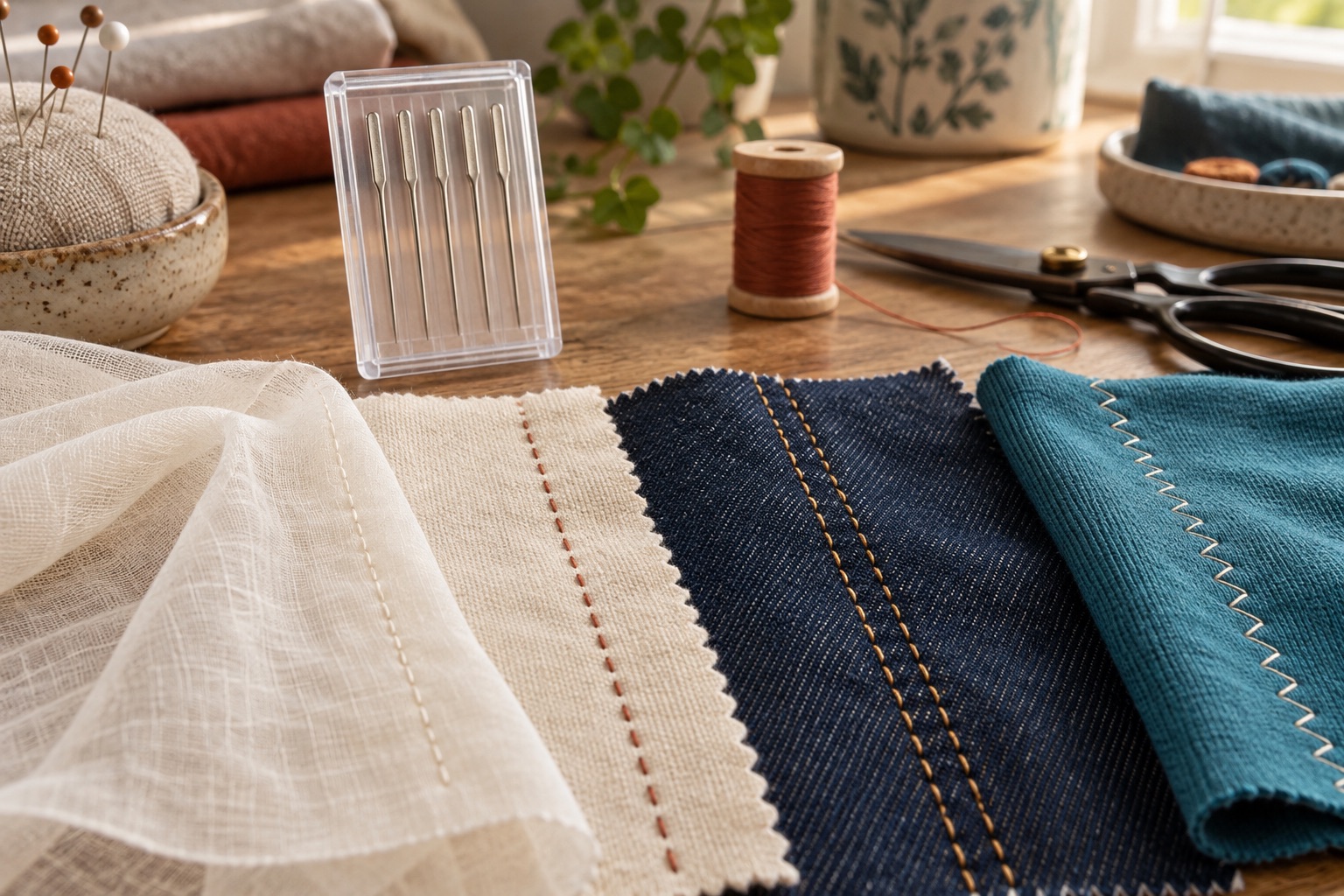
Needle packets can appear to offer a type for every fabric. You do not need them all. Begin with the fabric's construction and the problem you are trying to solve, then select a size and a compatible needle system. This guide covers the type decision; our needle-size guide explains 70/10, 80/12 and the other numbers.
Universal versus Microtex for woven cloth
The SCHMETZ Universal needle has a slightly rounded point and suits a wide range of everyday woven fabrics. It is an economical first test for cotton, poplin or linen when you are not seeing damaged yarns or missed stitches. The assortment below gives several sizes, but it does not make one point ideal for every textile.
SCHMETZ Universal needles, assorted sizes
A practical starting pack when the machine manual specifies the flat-shank 130/705 H system and your projects vary in fabric weight.
A ten-needle assortment spanning 70/10 to 100/16 for sampling fine-to-medium woven fabrics and ordinary sewing thread.
Keep in mind
- Universal point is not the first choice for very elastic knits.
- Check the needle system in your machine manual before buying.
Microtex is a specialised choice with a very slim, acute point for some dense, fine or tightly woven materials. It may give cleaner penetration on a fabric that resists a Universal needle, but it can mark or damage a fabric that needs a rounded point. Sample it on the actual layers and inspect both sides. Do not buy it solely because the fabric feels “difficult”; identify the symptom first.
Jersey and Stretch are related, not identical
A Jersey needle has a medium ballpoint intended to move between many knit yarns rather than pierce them as a sharp point might. For a stable cotton T-shirt knit, it is a good first test. SCHMETZ notes that more elastic fabrics may be better served by Stretch or Super Stretch needles. The Jersey assortment below spans sizes that let you avoid excess holes in fine knit.
SCHMETZ Jersey needles, assorted sizes
Useful for cotton T-shirts and other stable jersey when a universal needle snags knit yarns or gives an untidy seam.
A medium-ballpoint 130/705 H SUK assortment for ordinary knitted fabrics, with sizes 70/10 to 90/14 to test against jersey weight.
Keep in mind
- For highly elastic fabric with skipped stitches, a Stretch needle may be better.
- A compatible machine and correct size still need checking.
The Stretch needle combines a medium ballpoint with scarf and eye-area geometry designed to help form stitches on highly elastic material. Choose it if elastane-rich jersey, rib or activewear skips with a fresh Jersey needle and correct threading. It will not make a straight construction stitch stretch enough for a fitted garment; stitch selection is a separate decision.
SCHMETZ Stretch needles, assorted sizes
A targeted alternative when elastane-rich jersey, rib or activewear skips despite correct threading and a fresh Jersey needle.
A five-needle 130/705 H-S pack with stretch-needle scarf and eye geometry intended to reduce skipped stitches in elastic fabrics.
Keep in mind
- It does not replace a stitch that can stretch with the garment.
- Test size against the fabric and thread rather than assuming 90/14 is always safer.
Jeans for firm cloth; Topstitch for thick thread
SCHMETZ's Jeans needle is a reinforced 130/705 H-J design for denim, canvas and similar firm cloth. Despite a common shorthand that calls every denim needle “sharp”, SCHMETZ describes its Jeans point as medium ballpoint; rely on the manufacturer's actual specification. A 90/14 or 100/16 is a sensible starting comparison on a real denim seam, but more layers may exceed the machine's capacity.
SCHMETZ Jeans needles, assorted sizes
Choose the smallest size that forms a clean stitch through the actual denim layers without deflection, starting with a fresh needle.
A five-needle 130/705 H-J assortment in 90/14–110/18 for testing denim, twill and canvas of differing weights.
Keep in mind
- A larger needle cannot give a domestic machine unlimited piercing or presser-foot clearance.
- 110/18 may leave excessive holes in lighter denim.
A Topstitch needle solves a different problem: a longer or larger eye and thread path help some heavier decorative threads pass without shredding. It may be useful for conspicuous jeans topstitching or embroidery-like thread, but it does not replace the structural Jeans needle automatically. Match thread, fabric and eye, and test on the garment's thickest crossing.
Leather needles are another separate category with a cutting point. Do not use one on ordinary woven or knitted fabric because it can cut yarns; follow the material and machine manufacturer's restrictions. Overlocker needles may use an entirely different system, so never assume a domestic 130/705 H needle fits just because it can enter a clamp.
A three-check selection method
First, read the machine manual for its needle system (often 130/705 H on domestic sewing machines). Second, choose type from the fabric structure and the fault: ordinary woven, stable knit, elastic knit or firm woven. Third, choose size for fabric weight and thread, then sew a sample with the actual seam layers. Change the needle after a strike, obvious bending or deteriorating stitch formation. An identical-looking industrial round-shank needle is not automatically compatible.
Frequently asked questions
Can I sew jersey with a Universal needle?
It may form a seam on some stable knits, but a Jersey or Stretch point is a more targeted first choice when you want to avoid damaged loops or skipped stitches.
Is a Jeans needle just a large Universal needle?
No. Its construction is intended for denim-like materials. Size still matters independently; a Jeans 90/14 and Jeans 110/18 are different diameters.
Should I keep using a needle until it breaks?
No. A worn or damaged needle can spoil fabric and stitches before it breaks. Replace it when performance deteriorates, after a strike or at the start of a demanding project.
Sources
Type distinctions use SCHMETZ's Universal, Jersey, Stretch and Jeans specifications and its Needle ABC. Confirm your machine's exact system and permitted size in its manual.