
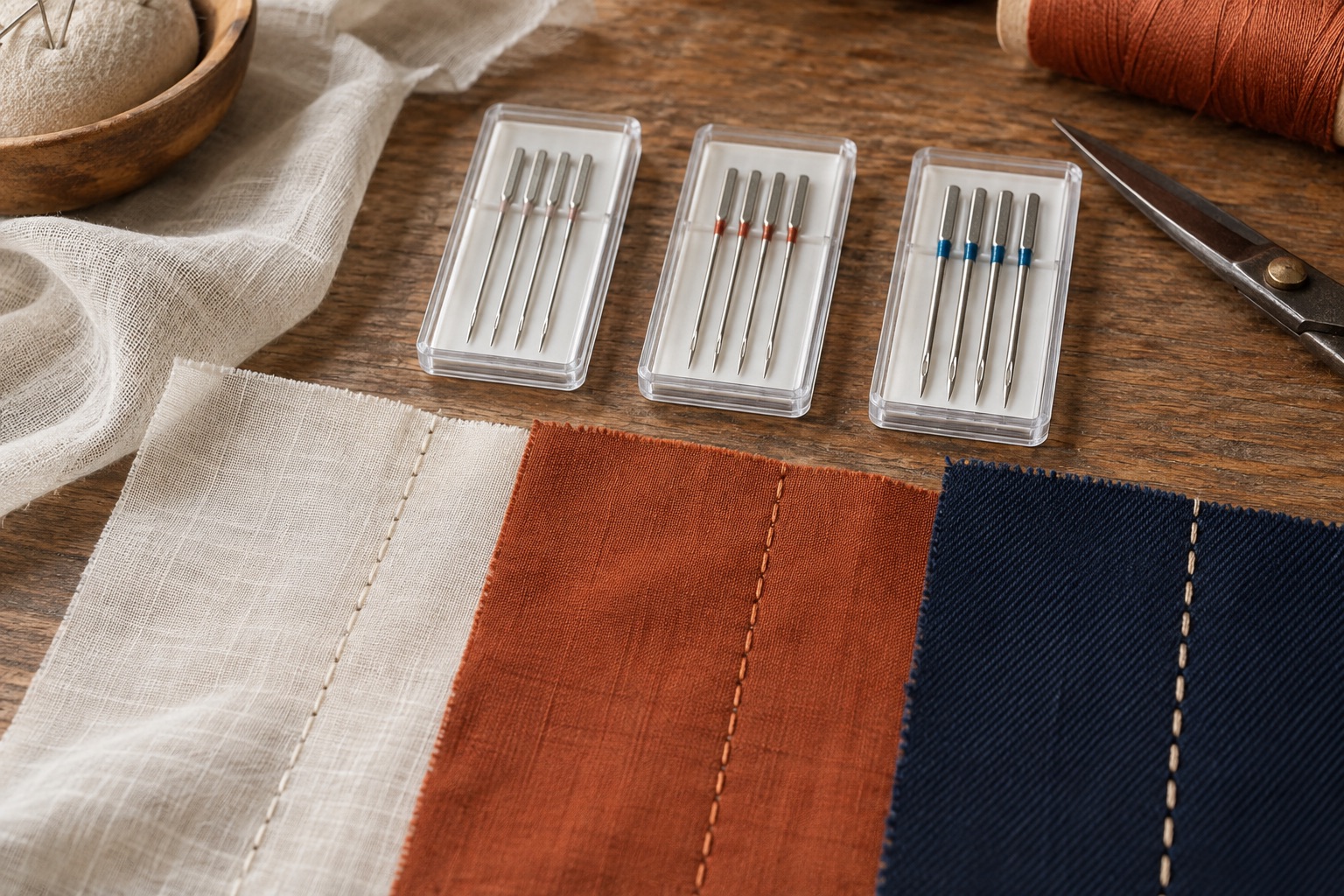
Needle size answers “how thick is the needle?”, not “what shape is its point?”. A 90/14 Jersey needle and a 90/14 Jeans needle have the same nominal size but different intended fabric behaviour. If you need to identify the point family first, use our needle-types guide.
What does 80/12 mean?
The NM number is based on needle-shaft diameter in hundredths of a millimetre: NM 80 corresponds nominally to 0.80 mm. The second number is the approximate US size. Thus 70/10 is finer than 80/12, which is finer than 90/14. The numbers are not stitch length, needle length or a fabric-weight rating. SCHMETZ packaging also identifies the needle system and needle type. Read all three pieces of information, not just the largest number.
The assortment below is useful for building your own evidence from woven-fabric scraps. It covers 70/10, 80/12, 90/14 and 100/16 Universal needles. It is for a machine that takes the 130/705 H flat-shank system; verify that in the manual.
SCHMETZ Universal needles, assorted sizes
A practical starting pack when the machine manual specifies the flat-shank 130/705 H system and your projects vary in fabric weight.
A ten-needle assortment spanning 70/10 to 100/16 for sampling fine-to-medium woven fabrics and ordinary sewing thread.
Keep in mind
- Universal point is not the first choice for very elastic knits.
- Check the needle system in your machine manual before buying.
A starting-size guide, not a prescription
- Fine voile, lawn or lightweight lining: sample 60/8–70/10 in the suitable type. Fine thread and visible needle holes favour a finer needle; dense cloth may call for a different point.
- Medium woven cotton, linen or poplin: sample 70/10–80/12 Universal. Weave density, interfacing and seam-layer count may justify 90/14.
- Stable cotton jersey: sample 70/10–80/12 Jersey. Elastane and skipped stitches may call for a Stretch type, not merely a larger number.
- Medium denim and twill: sample 90/14–100/16 Jeans at the actual seam crossing; lighter denim may take 80/12.
- Heavy denim stack: sample 100/16–110/18 Jeans only if the machine permits it. Thread, clearance and machine resistance set the limit.
These are starting tests, not promises about every fabric. SCHMETZ lists a range of sizes for each needle family; the right choice is the smallest compatible needle that passes cleanly, carries the thread and forms reliable stitches in the real stack.
For stable knits, the Jersey assortment below spans useful sizes without introducing an unnecessarily thick universal point. For highly elastic fabric, switch type as well as size if a fresh Jersey needle skips.
SCHMETZ Jersey needles, assorted sizes
Useful for cotton T-shirts and other stable jersey when a universal needle snags knit yarns or gives an untidy seam.
A medium-ballpoint 130/705 H SUK assortment for ordinary knitted fabrics, with sizes 70/10 to 90/14 to test against jersey weight.
Keep in mind
- For highly elastic fabric with skipped stitches, a Stretch needle may be better.
- A compatible machine and correct size still need checking.
Recognise a size mismatch
A needle that is too fine for thick thread or a dense seam may bend, shred thread, break or skip. A needle that is too thick can leave visible holes, damage delicate yarns, pucker fine fabric or make a coarse-looking stitch. Neither symptom proves size alone is at fault: a bent needle, wrong type, poor threading or a tilted foot can look similar. Change to a fresh needle before making multiple tension changes.
If denim is your repeat project, the SCHMETZ Jeans assortment makes a more useful progression than oversized Universal needles. It offers 90/14–110/18; start at the lighter end and inspect holes and needle deflection. See our denim-needle buying guide for the decision in context.
SCHMETZ Jeans needles, assorted sizes
Choose the smallest size that forms a clean stitch through the actual denim layers without deflection, starting with a fresh needle.
A five-needle 130/705 H-J assortment in 90/14–110/18 for testing denim, twill and canvas of differing weights.
Keep in mind
- A larger needle cannot give a domestic machine unlimited piercing or presser-foot clearance.
- 110/18 may leave excessive holes in lighter denim.
The eye must suit the thread
Heavy topstitch thread needs an eye and groove that do not abrade it. Moving up one size may help, but a purpose-designed Topstitch needle can be more appropriate than forcing a thick thread through a small Universal eye. Conversely, large needles with fine thread can leave obvious holes. Thread and needle should be tested together; polyester versus cotton thread helps with the fibre choice, which is separate from size.
Size is not compatibility
Most modern household machines use 130/705 H variants, but check the manual. An industrial round-shank 134 needle with “80/12” on the packet is not made compatible by the familiar size number. Turn the machine off to change needles, insert the flat side as directed, tighten the clamp and handwheel the first stitches. Replace needles after a strike, bend or persistent stitch deterioration.
Frequently asked questions
Is 90/14 stronger than 80/12?
It is thicker, but strength in the job also depends on needle design, the fabric stack and machine alignment. A 90/14 of the wrong type can perform worse than an 80/12 of the right type.
What size is best for a beginner?
An 80/12 Universal is a useful first test on medium woven cotton. Keep 70/10 and 90/14 available for lighter or heavier fabric, then choose a different needle type for knits or denim.
Can I use 110/18 in any domestic machine?
No. Check the manual's permitted system and size, and do not force a resistant stack. The larger hole can also damage lighter cloth.
Sources
Numbering, types and available ranges follow SCHMETZ's needle packaging guide, Universal, Jersey and Jeans specifications. Confirm the needle system and maximum size in your machine manual.