
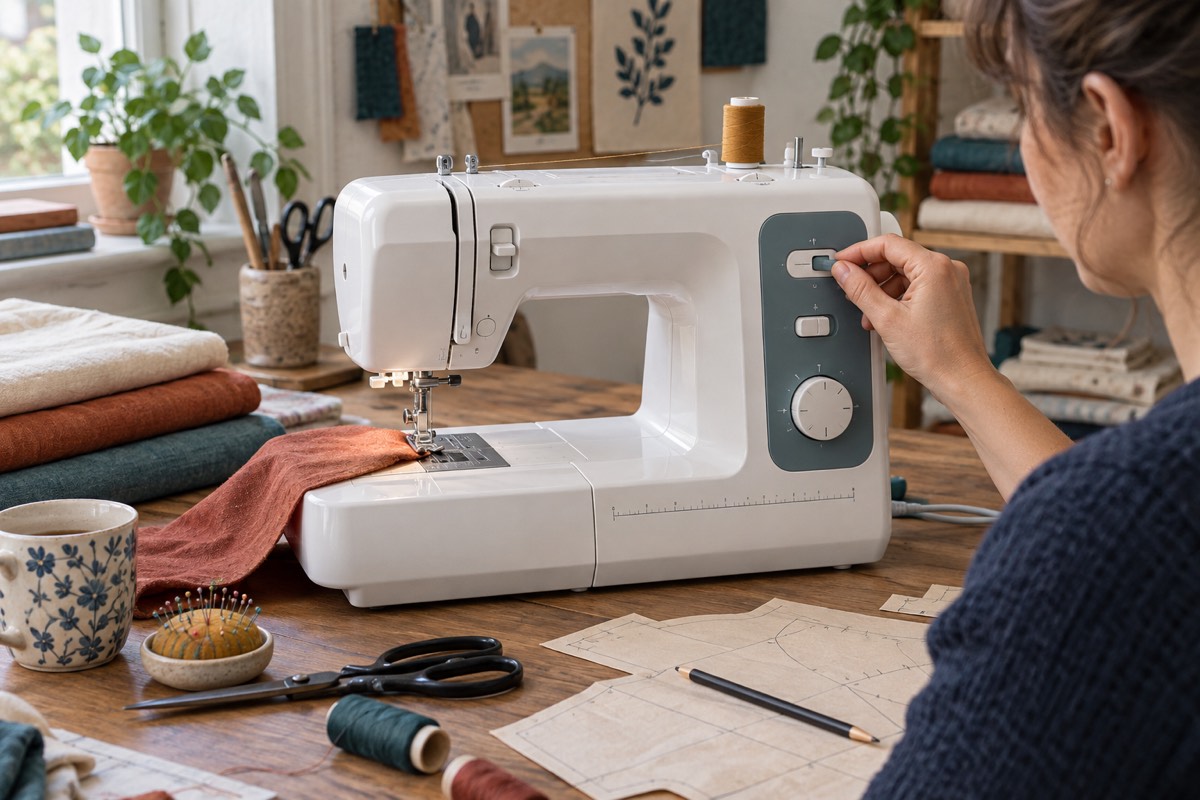
A feature is worth paying for when it removes a recurring frustration or makes a planned operation more controllable. It is not valuable merely because it raises the specification count. Start with the projects you will make, identify the awkward steps in them, then match those steps to controls.
A four-question value test
Before paying more, ask:
- Will I use it in my first ten projects? A garment maker may use a one-step buttonhole immediately; a repairs-only household may not.
- Does it change control or only convenience? A speed limiter can affect every curved seam. An extra decorative motif may affect none.
- Can I add it later? Feet and extension tables are often available separately. Needle up/down and electronic speed limiting normally cannot be added.
- Does the exact model implement it well? Try the control or read the manual. “Automatic” can mean different things across brands.
That last point matters. A built-in needle threader still needs the needle at the correct height. A one-step buttonhole still requires stabilised fabric and the correct foot. Features reduce steps; they do not remove sewing technique.
Control features with the widest benefit
A maximum-speed slider
A speed slider caps how fast the machine can run, even if the pedal is pressed further. It is particularly useful for a nervous beginner, children under close supervision, curves, appliqué and stop-start garment work. It does not replace a well-positioned pedal, but it separates “how firmly am I pressing?” from “how fast can this become?”
The Brother Innov-is A16 is a strong example of paying for control rather than a huge stitch count. It has only 16 stitches, but combines a speed slider, start/stop control and needle up/down with three one-step buttonholes.
Brother Innov-is A16
Best for garment sewing, careful learners and supervised teenagers who value slow-speed control more than a large decorative-stitch menu.
An electronic 16-stitch machine with a speed slider, needle up/down, three one-step buttonholes and a seven-point feed system.
Keep in mind
- It costs considerably more than a basic mechanical machine.
- At 6.6 kg it is class-portable rather than genuinely light.
Needle up/down
This control tells an electronic machine where to stop the needle. Needle-down is useful when pivoting a collar point, turning a corner or easing a curve because the needle holds the work while the presser foot is lifted. Needle-up is convenient for removal. It is a small feature that frequent garment and patchwork sewists may use on almost every seam.
Start/stop sewing
Start/stop lets a suitable electronic machine sew without the foot pedal. It may help a sewist who struggles to operate a pedal, but check the manual: restrictions can apply, and the machine must still be stopped safely before threading, changing a needle or working near moving parts. For most buyers it is an alternative control, not a reason on its own to upgrade.
A one-step buttonhole
A one-step system measures the button in its specialist foot and completes the sequence without the sewist manually moving through four stages. It is worth prioritising for shirts, dresses and childrenswear. Multiple buttonhole shapes are secondary; one reliable style that suits the button and fabric is more useful than ten you never sample.
Setup features that prevent small frustrations
A visible top-loading bobbin
A clear cover makes remaining bobbin thread easier to check and removes a separate removable case from normal insertion. This is convenient, not proof of better stitch quality. Front-loading systems remain perfectly valid and may suit a sewist who already understands them. Our top-loading versus front-loading bobbin guide explains the real trade-off.
A built-in needle threader
This can be valuable for eyesight or dexterity, but test the lever if possible. Threaders are usually designed for a specified range of needle sizes and must be used exactly as the manual shows. They are not universal across twin needles and very fine needles.
Clear markings and useful lighting
Readable seam guides, an obvious threading path and light that reaches both sides of the needle improve every setup. Look beyond the headline number of LEDs: shadows, colour temperature and the position of the casing affect visibility. A removable accessory tray should come away without a struggle if you regularly use the free arm for cuffs and trouser hems.
Fabric-handling features worth considering
Adjustable presser-foot pressure
Pressure adjustment changes how firmly the foot holds fabric against the feed dogs. Reducing it can help some fine or stretchy materials feed without distortion; increasing it can help maintain contact on some firm layers. The correct setting depends on fabric, stitch and machine, so use the manual and test scraps.
The Janome 230DC combines foot-pressure adjustment with electronic speed control, a top-loading bobbin and an extension table. That package has a clear purpose for dressmaking and light quilting; it is less compelling if your work is limited to occasional woven repairs.
Janome 230DC
Best for a committed beginner who expects to make garments or quilts regularly and would use speed control, foot-pressure adjustment and the larger work surface.
A computerised machine with 30 stitches, three one-step buttonholes, a speed controller, top-loading bobbin, adjustable foot pressure and an included extension table.
Keep in mind
- It is a substantial step up in cost from an entry mechanical model.
- Thirty stitches are useful only if the core controls and included table match the projects you will actually make.
Feed-dog control
Dropping or covering the feed dogs is useful for free-motion quilting, darning and some button-sewing methods. It is not essential for ordinary seams. If free-motion work is a stated goal, check how the control is reached and whether the appropriate foot is included or available.
Foot levelling and extra lift
A levelling button or height-compensation tool can help a foot cross a thick seam junction. Extra presser-foot lift creates clearance when positioning layers; it does not increase motor power or turn a domestic machine into an industrial one. For denim, bags or upholstery-weight projects, read our heavy-duty machine guide and test the actual folded seam.
Mechanical buyers do not have to give up fabric control. The Janome Sewist 725S offers adjustable foot pressure, a one-step buttonhole and a top-loading bobbin while retaining dial-led operation.
Janome Sewist 725S
Best for a dressmaker who wants tactile mechanical controls but also needs foot-pressure adjustment and a more convenient top-loading bobbin.
A 25-stitch mechanical machine with a top-loading bobbin, adjustable presser-foot pressure, one-step buttonhole and hard cover.
Keep in mind
- It has no speed limiter or needle up/down control.
- At 6.7 kg plus its hard cover it is portable, but not the lightest machine for weekly travel.
Workspace, tables and included feet
Measure the flat area to the right of the needle, not just the machine’s overall width. A larger harp supports rolled quilt sections and bulky garments, while an extension table supports fabric on the left and front. Neither substitutes for a stable, correctly sized table underneath.
Included accessories should be judged at replacement cost and likely use. A zipper foot, buttonhole foot and basic overcasting foot are broadly useful. A walking foot, quarter-inch foot, non-stick foot or wide table adds value only when it matches planned work. Confirm the exact UK box contents; bundles with similar model names can differ.
Local support is also a feature. A clear manual, accessible bobbins and feet, a traceable UK warranty and a service route can be worth more than another row of icons on the stitch panel.
Features you can usually deprioritise
- A three-digit stitch count: many totals include mirrored or slightly altered decorative patterns. Confirm the utility stitches you need.
- Built-in alphabets: useful for occasional labels, but the letter height and quality are constrained. They are not machine embroidery.
- Very high maximum speed: capacity is not the same as control, especially for a beginner.
- Large accessory bundles: unused feet are not savings.
- Automatic claims without detail: determine what is automated, what preparation remains and whether the feature works on your common materials.
The most sensible upgrade is usually the smallest one that solves a repeated problem. If two machines meet the same brief, choose on control clarity, fabric handling, support and fit in your sewing space—not on the longest feature list.
Frequently asked questions
Is automatic thread cutting worth paying for?
It can save time in repetitive sewing, quilting or embroidery, but it is a convenience rather than a core beginner need. A manual thread cutter on the casing is adequate for many home sewists.
Is adjustable presser-foot pressure essential for jersey?
No. It can help, but needle type, stitch choice, seam support and handling also matter. An overlocker with differential feed is a different tool again; see whether you need an overlocker.
Should I choose more stitches or better speed control?
For most beginners, reliable utility stitches and better control win. Our guide to how many stitches you actually need separates useful stitch families from marketing totals.
Sources
Feature definitions and model examples are grounded in the Brother sewing-machine buyer’s guide, official Brother Innov-is A16 specifications, Janome 230DC specifications and Janome Sewist 725S specifications.