
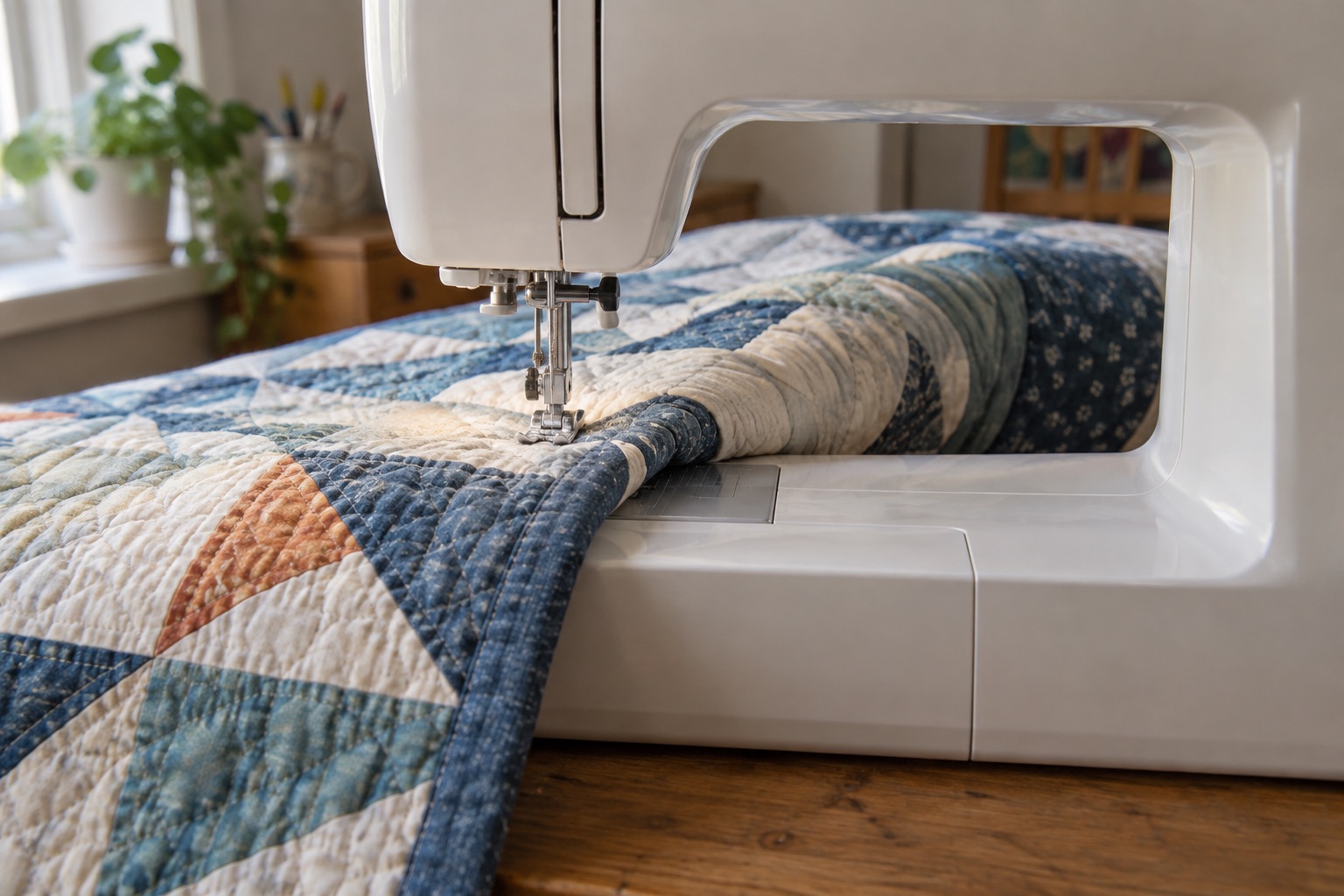
The throat is the opening between the needle and the machine's upright body. When you quilt, some of the fabric, wadding and backing must fit through it while the rest is supported around the bed. There is no single centimetre threshold at which a machine becomes “quilt-ready”: a straight-line baby quilt and dense quilting across a king-size top make very different demands.
Measure the opening you can actually use
Manufacturers may call it workspace, arm space, sewing space or distance to the right of the needle. Note the stated horizontal measurement, then look at height and the shape of the head. A tall rolled sandwich may meet a width figure but still rub hard against a low opening. The centre of the quilt is usually the most awkward part, because more material has to pass through the throat at once.
Do not confuse three separate areas:
- Throat space: where the quilt must pass between needle and upright body.
- Extension table: level support outside the opening, beside the needle.
- Room around the machine: table and floor area for the quilt's remaining weight.
A larger number in the first category is useful only if the second and third are workable too. A quilt hanging over the front edge can pull against the needle and make even a roomy machine difficult to control.
Decide by the quilts you repeat
For piecing, you are normally feeding small flat sections, not a full quilt sandwich. Accuracy, a suitable foot and steady fabric feed usually matter more than throat width. For runners, cushions and baby quilts, a regular domestic opening can be comfortable with a supported table and simple quilting plan. For bed quilts, more space can reduce constant rolling and rearranging, but basting quality and the chosen pattern still determine how manageable the work feels.
Free-motion quilting needs lateral movement and generous support all around the needle. Straight lines can be planned in sections with less manoeuvring. If your preferred design requires the whole quilt to pivot repeatedly in a small throat, change the design or consider a different machine/service rather than forcing it.
What current machines illustrate
The Janome 230DC includes an extension table and useful basic quilting controls, making it a sound compact option for piecing and smaller quilts. The table improves support; it is not an arm-space upgrade.
Janome 230DC
Best for a committed beginner who expects to make garments or quilts regularly and would use speed control, foot-pressure adjustment and the larger work surface.
A computerised machine with 30 stitches, three one-step buttonholes, a speed controller, top-loading bobbin, adjustable foot pressure and an included extension table.
Keep in mind
- It is a substantial step up in cost from an entry mechanical model.
- Thirty stitches are useful only if the core controls and included table match the projects you will actually make.
The Janome 5060QDC includes a larger accessory set for quilting—quarter-inch, even-feed and free-motion feet plus an extension table. Those improve several operations even though the table still cannot widen the opening. Choose it for the workflow, not on an assumption that accessories create a long arm.
Janome 5060QDC
Best for a home quilter who wants the useful feet and table in the standard UK package while retaining a versatile dressmaking machine.
A 60-stitch computerised machine supplied with an extension table, quarter-inch foot, open-toe even-feed foot and free-motion foot.
Keep in mind
- The extension table supports fabric but does not enlarge the opening to the right of the needle.
- Large quilts still demand a supported table and careful handling of the bulk.
Brother states 190 mm sewing workspace for the F580. That gives more room to handle quilt bulk than a compact chassis, and a walking foot is included. It is also an embroidery machine, so the investment makes most sense if that second function has real use.
Brother Innov-is F580
Best for a sewist who will use both functions regularly and needs more design room and sewing workspace than a compact combination machine provides.
A combined machine with a 180 × 130 mm embroidery field, 190 mm sewing workspace, wireless transfer, adjustable foot pressure and an included walking foot.
Keep in mind
- It is a substantial investment and takes more permanent table space than the M380D.
- One machine still cannot sew while embroidery is running; changing modes remains part of the workflow.
Give the quilt a flat route through the machine
Put the machine on a stable surface, ideally with an extension table or inset bed. Clear an area behind it so fabric can travel away from the needle without piling up against a wall. Support the remaining quilt on a table to the left; avoid letting it hang to the floor. Roll or accordion-fold only the portion entering the throat, leaving the area immediately around the needle flat enough to see and guide.
Baste the full sandwich before sewing. Poorly secured layers shift and pucker regardless of throat size. Test the intended stitch, foot, thread and needle on a layered offcut. For a large top, plan a route from the centre outward where appropriate to your pattern and basting method, then redistribute the bulk at each section. Our domestic-machine quilting guide works through that setup.
Know when the current machine is genuinely the limit
An upgrade is justified when the quilts you regularly finish cannot be manoeuvred without compressing the batting, distorting stitches or exhausting your hands despite good table support and a simpler design. Ask a dealer to let you move a rolled sample through the exact model, with a foot attached, rather than judging empty-machine photographs. Check the machine's footprint and carrying weight as well as its opening.
For a one-off oversized quilt, hiring long-arm quilting or simplifying the quilting design may be better value than replacing a capable sewing machine. A large throat does not eliminate basting, feeding control or the need to support the quilt's weight.
Frequently asked questions
Is 190 mm enough for a bed quilt?
It can be workable for many domestic quilting plans, but there is no guarantee from width alone. Quilt size, batting loft, opening height, table support and the amount of turning required all matter.
Does an extension table count as throat space?
No. It supports the fabric outside the arm opening. That support is valuable, but the space inside the machine remains unchanged.
Should I roll a quilt very tightly to fit it through?
Keep the section entering the throat compact enough to move but do not force or crush it. Hard compression can drag layers and make stitches irregular. Replan sections if the sandwich cannot move freely.
Sources
Workspace and package examples use Brother F580, Janome 230DC and Janome 5060QDC official specifications; machine-quilting setup is informed by Brother's quilting guide.