
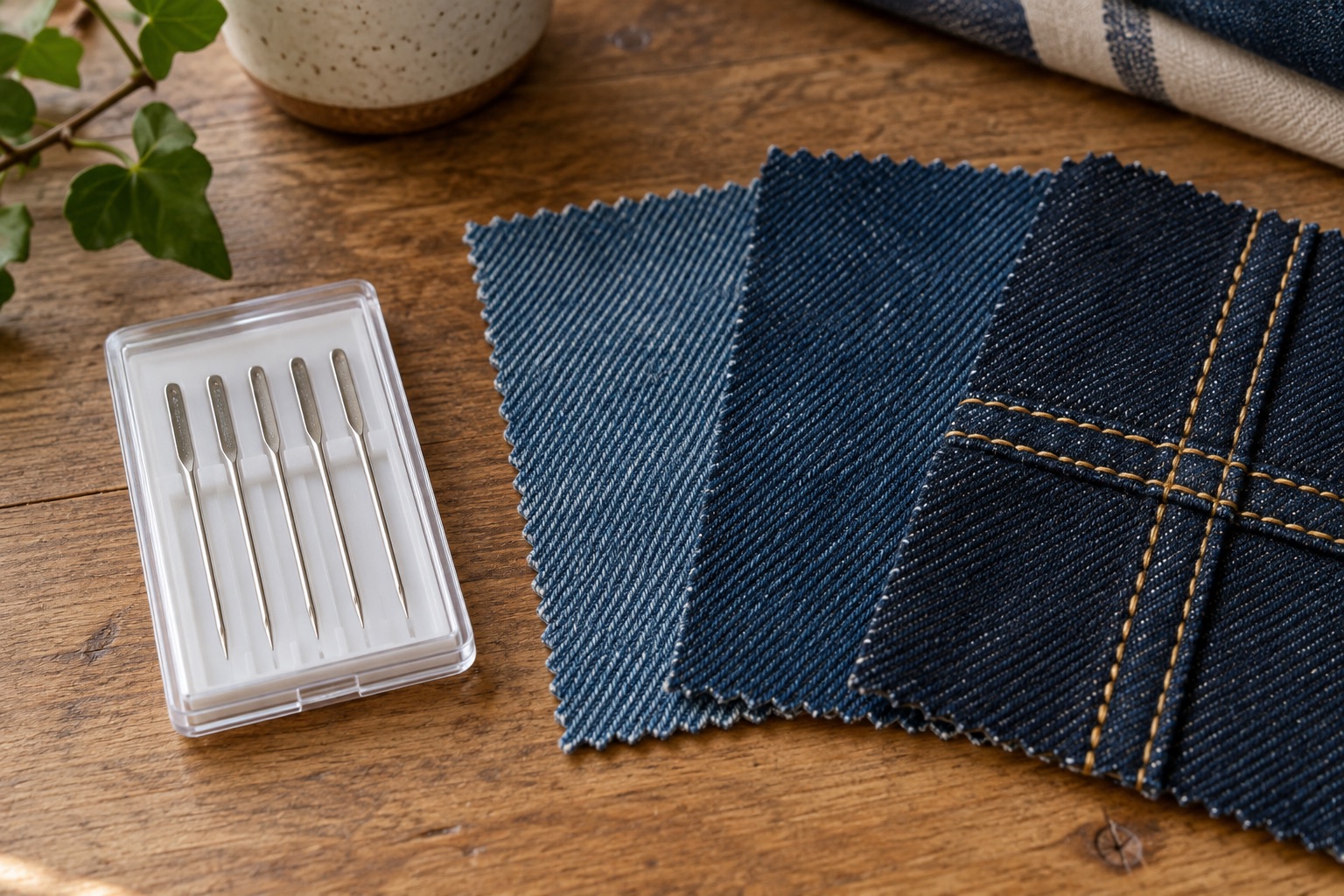
The best denim needle is not automatically the thickest needle on the shelf. It is a fresh, machine-compatible point that penetrates the thickest part of your particular job cleanly without bending, shredding thread or leaving excessive holes. This guide makes the small-accessory choice; our denim sewing guide covers the whole garment workflow.
Why choose a Jeans needle?
SCHMETZ lists its Jeans needle as 130/705 H-J for denim, twill, canvas and similar firm fabrics. Its specialised blade design is intended to resist deflection in dense layers. SCHMETZ describes the point as medium ballpoint; the often-repeated claim that all denim needles have a sharp cutting tip does not fit this manufacturer's specification. A correctly sized Universal needle may sew a light denim sample, but a Jeans needle is the more targeted choice when a seam stack gets dense.
Before ordering, confirm the machine takes the 130/705 H domestic system. A matching size number on another system is not enough. Overlockers, industrial machines and some specialist machines can need different needles.
90/14, 100/16 or 110/18?
Try 90/14 first on medium denim, a straightforward jeans repair or a few firm layers. Move to 100/16 when the actual crossing and thread show a need for a thicker needle. 110/18 is not the default: it can leave large holes in light denim, and the machine manual may not permit it. If the handwheel resists at a thick hem, moving from 100 to 110 is not a substitute for reducing bulk or levelling the foot.
The first number is the metric diameter code, so 100/16 has a nominally thicker shaft than 90/14. The second is the corresponding US size. For more on this distinction, see needle sizes explained.
A sensible small pack to test
The SCHMETZ Jeans assortment spans 90/14–110/18. That makes it useful for comparing a fine and thicker denim test on the same machine, rather than buying a large single-size pack before you know the result. It does not prove your machine can handle the thickest seam, and it does not include every specialist point. Check the live listing's pack contents before purchase.
SCHMETZ Jeans needles, assorted sizes
Choose the smallest size that forms a clean stitch through the actual denim layers without deflection, starting with a fresh needle.
A five-needle 130/705 H-J assortment in 90/14–110/18 for testing denim, twill and canvas of differing weights.
Keep in mind
- A larger needle cannot give a domestic machine unlimited piercing or presser-foot clearance.
- 110/18 may leave excessive holes in lighter denim.
If you mostly sew ordinary woven cotton and only occasionally hem light denim, an assorted Universal pack may be more versatile, but it is not the strongest recommendation for repeated heavy seam crossings. Buy for your real projects rather than an imagined maximum fabric thickness.
SCHMETZ Universal needles, assorted sizes
A practical starting pack when the machine manual specifies the flat-shank 130/705 H system and your projects vary in fabric weight.
A ten-needle assortment spanning 70/10 to 100/16 for sampling fine-to-medium woven fabrics and ordinary sewing thread.
Keep in mind
- Universal point is not the first choice for very elastic knits.
- Check the needle system in your machine manual before buying.
When another point or eye makes more sense
For decorative, heavy topstitch thread, a Topstitch needle's larger eye may reduce thread abrasion. That is a thread-management choice, not a guarantee of better penetration through a thick jeans hem. For a double row, a Jeans Twin may work on a compatible zigzag machine, but 4 mm twin spacing requires plate and foot clearance and can struggle at abrupt thickness changes. Two single-needle passes are often easier to control.
For stretch denim, test whether the elastane content causes skipped stitches with the Jeans needle. A Stretch needle may improve stitch formation on some elastic cloth, but its suitability at the actual layer count still needs testing. Never substitute a leather cutting-point needle for jeans merely because the denim is tough.
The four-part test that prevents wasted needles
Fold an offcut to the same number of layers as the finished hem or seam junction. Fit a new compatible Jeans needle, rethread and use a normal all-purpose thread before trying decorative topstitch thread. Turn the handwheel slowly with the foot down, then sew a short line at low speed. Examine holes, both thread faces, stitch length and needle straightness. Finally, level the foot at the crossing if it tilts. Change one thing at a time.
The Brother HF37 includes a levelling-button J foot that can help feed over a step, but purchasing a different machine is not the first response to one skipped stitch. Its specification is useful as a concrete example of what to look for if denim and bags become frequent projects.
Brother HF37
Best for bags, jeans alterations and mixed dressmaking where a mechanical control layout and help over bulky seam steps matter.
A 37-stitch mechanical machine with a top-loading bobbin, levelling-button foot, non-stick foot, adjustable stitch dimensions and a hard case.
Keep in mind
- There is no maximum-speed slider.
- Its domestic heavy-duty positioning does not make it an industrial or walking-foot machine.
Stop if a needle bends, contacts the plate, breaks or if the motor labours. Reduce the stack, revise the construction or use an alterations service rather than pushing the machine beyond its clearance.
Frequently asked questions
Is 100/16 the best size for every pair of jeans?
No. Light jeans may sew more cleanly with 90/14; a dense hem crossing may need 100/16. Test the actual layers and keep within the machine manual's limits.
Do Jeans needles work in all sewing machines?
No. Confirm the machine's needle system. The featured SCHMETZ pack is a domestic 130/705 H-J product, not an industrial or overlocker needle.
Will a Jeans needle fix skipped stitches by itself?
Sometimes, but threading, a tilted foot, unsuitable thread and excessive bulk can also cause skipping. Diagnose the crossing rather than repeatedly buying larger needles.
Sources
Needle design, point and sizes follow SCHMETZ's Jeans needle specification and needle packaging guide. The levelling-foot example follows Brother's HF37 specification.