
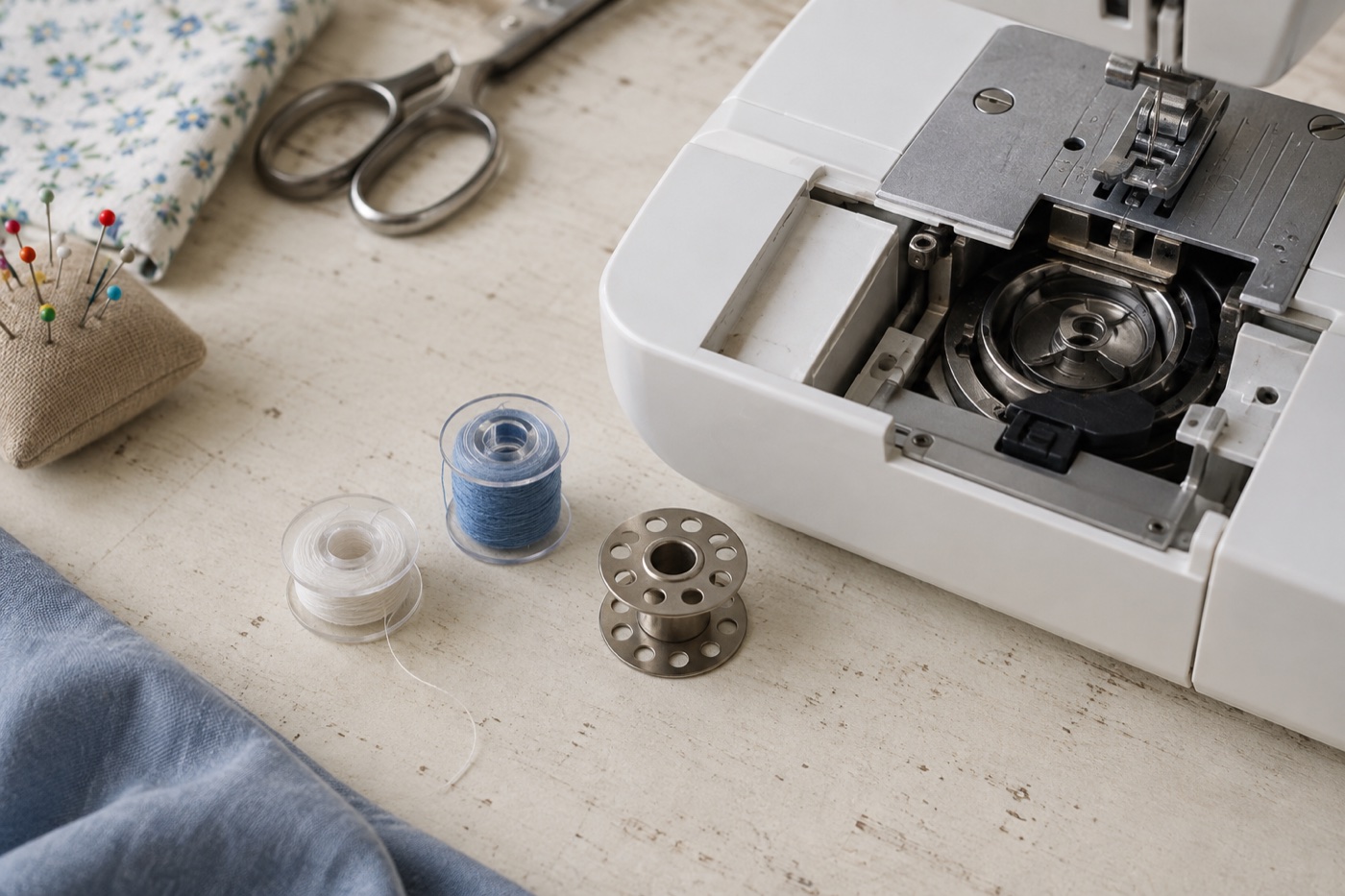
A bobbin carries the lower thread, but its size and shape are part of the machine's mechanism. Online listings often call a pack “universal” because it fits several popular families. That does not make it right for your machine. The safest search term is the manufacturer's exact bobbin code plus your model number.
How to identify the correct bobbin
Start with the model label on the machine, not its appearance. Locate the manual's bobbin-winding or accessories section and note the part number, height and specified material. If the manual is missing, use the manufacturer's support page for that exact model. Compare an original undamaged bobbin only as a secondary check: old machines often acquire a mixed drawer of unsuitable spares. A ruler may reveal an obvious mismatch but cannot prove that two similar rim profiles are equivalent.
For example, Brother documents an 11.5 mm plastic SFB/SA156 bobbin for specific models, and explicitly warns against bobbins from other models. The ten-pack below represents that family. It is useful only if the manual or support entry for your Brother machine specifies that code. It is not a recommendation for all Brother, Janome or Singer machines.
Brother 11.5 mm sewing-machine bobbins, pack of 10
A useful spare set after confirming the exact Brother model's bobbin part code in its manual or support page.
Ten 11.5 mm plastic bobbins for Brother machines whose manual explicitly specifies SFB or SA156; not a universal bobbin replacement.
Keep in mind
- Do not use if your machine specifies another bobbin height, shape or material.
- The Amazon title alone does not prove compatibility with every Brother machine.
Do not swap plastic for metal because the replacement feels sturdier. Material, weight and dimensions can be part of the designed bobbin system. Likewise, “Class 15” describes a family, not blanket permission to use any item carrying that phrase. Check the complete maker code.
Top-loading and front-loading describe access, not a universal size
A top-loading bobbin drops into a horizontal holder beneath a slide or clear cover. A front-loading system normally uses a removable case accessed from the front or free-arm area. Neither orientation tells you the correct bobbin dimensions. Our top-loading versus front-loading guide explains the workflow difference if you are comparing machines.
The Brother LX17 illustrates a modern top-loading domestic layout. The Janome 2200XT is a front-loading example. Their product cards are shown to clarify the distinction between systems—not to suggest that their bobbins can be exchanged. If you own either model, use its own manual for the exact spare part.
Brother LX17
Best for a new sewist who values an uncomplicated dial layout and wants to learn on a full-size machine without paying for electronic controls.
A straightforward mechanical machine with a top-loading bobbin, 17 stitches and the core feet needed for everyday repairs, simple garments and home projects.
Keep in mind
- Its four-step buttonhole takes more input than a one-step system.
- There is no speed-limiting slider or automatic needle threader.
Janome 2200XT
Best for a beginner who prefers simple controls but wants drop feed for free-motion work and a broader utility-stitch range than the most basic machines.
A six-kilogram mechanical all-rounder with 22 stitch options, adjustable stitch length, drop feed and a free arm, operated through two main dials.
Keep in mind
- The front-loading bobbin is less visible while sewing than a clear top-loading system.
- The buttonhole is a four-step design rather than a one-step automatic cycle.
What to check on a replacement listing
Match model, manufacturer part code, material and pack quantity. Read the current retailer listing for the actual item supplied; product titles can be broad or changed by sellers. Manufacturer-made parts are an easy benchmark when available, but compatibility still has to be checked. Avoid large assortments of pre-wound bobbins unless the exact compatible bobbin and thread specification are clear. Extra colours are no bargain if the spool rubs the case.
Wind one new bobbin following the machine's threading instructions before winding the entire pack. The thread should build evenly, without a cone at one edge or loose loops. Stop at the machine's full-bobbin position; do not overfill. Insert it in the direction shown by the actual bobbin-cover diagram or manual—clockwise and anticlockwise rules vary by design.
When a bobbin seems to fit but sewing goes wrong
Stop if the new bobbin clicks unevenly, stands proud, drags when the thread is pulled, or creates a new rattle. Switch off and unplug before opening the area. Compare against a known correct bobbin, inspect the rim for burrs or cracks, and clear accessible lint as the manual permits. If the problem appears only with the replacement, do not adjust the bobbin-case screw to compensate. Put the correct part back in and test on folded cotton with ordinary thread.
Thread nests beneath the fabric are often caused by the upper thread path, not the bobbin. Follow our thread-bunching checklist before buying spares or changing case tension. A jam that persists with the correct bobbin and clean accessible race needs a dealer rather than force.
Frequently asked questions
Are all 11.5 mm plastic bobbins interchangeable?
No. Height is only one dimension. Match the exact model-approved code and profile; Brother's SFB/SA156 advice applies to listed models, not all domestic machines.
Can I use metal bobbins instead of plastic?
Only where your machine's manual specifies or permits them. Do not substitute based on visual similarity.
Why does a new bobbin jam even though it fits?
It may be the wrong shape, damaged, overfilled or inserted in the wrong direction. Compare with the original approved bobbin, rethread and clean the accessible area before seeking service.
Sources
Brother's model-specific SFB/SA156 bobbin guidance documents the 11.5 mm type and warns against substituting other bobbins. The Brother machine setup guide describes following the machine's bobbin-direction diagram. Confirm the exact part in your own model manual.