
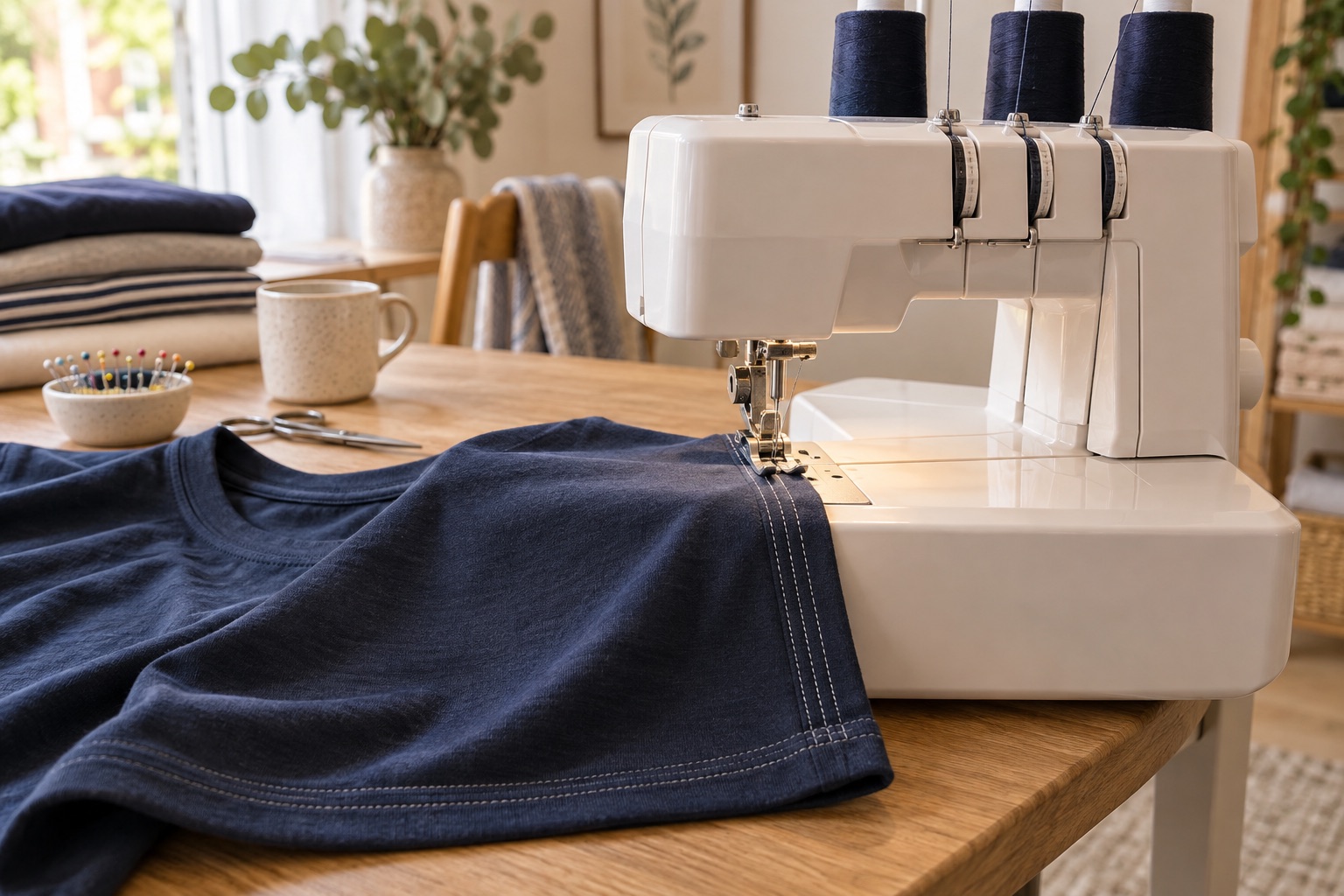
A coverstitch machine is a very good answer to a narrow, repeated problem: a knit hem that must stretch and still look tidy from the front. It is a poor answer to “I need a second sewing machine” if you mostly make woven clothes or repairs. It cannot replace the ordinary machine that inserts zips and buttonholes, and it cannot replace the overlocker that trims and wraps seam allowances. Read the machine-type comparison first if those jobs are still blurred.
Two sensible UK coverstitch choices
Brother CV3550: for top-cover options in a compact footprint
The CV3550 supports conventional narrow, wide and triple coverstitch, chain stitch and decorative top-cover variants. Brother lists 155 mm of working space, a free arm, differential feed, adjustable presser-foot pressure and automatic tension release. Those are useful when switching between a T-shirt hem, cuff and visible decorative finish. Its top-cover capability adds setup steps; it should not be treated as a magic fix for an unstable knit.
Choose it if you actually want the visible top-cover effect and can keep a dedicated machine threaded between projects. Skip it if your goal is simply to finish the raw seams of T-shirts; an overlocker serves that task better.
Brother CV3550
Best for a garment maker who already owns a sewing machine and needs shop-style knit hems often enough to justify a specialist second or third machine.
A dedicated coverstitch machine for flexible hems and decorative surface stitching, with two-sided top-cover capability and a 155 mm work area.
Keep in mind
- It does not trim raw edges, so it is not an overlocker substitute.
- It is specialised and hard to justify for occasional woven garments or simple repairs.
Janome CoverPro 3000 Professional: for a roomy flat-bed workflow
Janome lists 143 mm to the right of the needle, a convertible free arm, differential feed, adjustable foot pressure, a fine-mode lever for fine knits and a top-cover stitch. The clear-view foot is included. That wider-feeling flat-bed arrangement is attractive for repeated garment hems and visible topstitching, while the fine-mode control is a reason to test your actual lightweight jersey at a dealer.
Its strengths are not a claim that it will automatically make a cleaner hem than the Brother on every fabric. Both need the correct needle, thread, fold depth and differential setting. Janome's model is a substantial dedicated machine, not a compact accessory.
Janome CoverPro 3000 Professional
A strong comparison point for frequent knitwear makers who want a roomy flat bed and top-cover stitch, provided a specialist machine earns its space.
A dedicated two- to five-thread coverstitch machine with a top-cover stitch, 143 mm right-of-needle workspace, differential feed and a fine-mode lever.
Keep in mind
- It does not cut and overlock a raw edge.
- Top-cover setup and stitch choice have a learning curve; test the intended knit and hem before committing.
What changes the decision
- Standard hem or visible top-cover effect? A conventional cover hem is enough for many T-shirts; decorative top cover adds threading and setup.
- Do you need a free arm? It helps position narrow cuffs, though garment size and the machine's geometry still matter.
- What fabrics and cross-seams do you repeat? Test thin jersey, ribbing and bulky joins on the exact machine. Marketing stitch counts cannot predict handling.
- Where will it live? A permanently set-up specialist is more useful than one you must unpack and rethread for every hem.
The number of threads in a coverstitch specification is not comparable with an overlocker's three- or four-thread seam. Coverstitch configurations include needle threads and a looper, sometimes an additional top-cover thread. Check the stitch diagram, not just the number.
The five-minute dealer test
Bring your own jersey, ribbing and a folded cross-seam. Ask to thread the machine yourself, switch between the stitch you expect to use and a basic hem, and sew one swatch across a seam allowance. Stretch the finished sample gently, then examine the underside for skipped stitches and tunnelling. Ask which needles, binder accessories and service support are actually included in the UK package. An Amazon product image cannot answer those questions.
When to wait
For a handful of hems each year, try a correctly set twin needle or the stretch stitch on your domestic machine. If the problem is raw-edge finishing rather than hems, see do you need an overlocker?. If workspace is the limiting factor, a combination overlocker-coverstitch machine can save a footprint, but switching modes adds conversion time; the sensible purchase depends on which mode you will leave set up most often.
Frequently asked questions
Will a coverstitch machine sew a T-shirt from start to finish?
No. It makes hems and certain chain-stitch seams; construction details and raw-edge finishing usually require a sewing machine and perhaps an overlocker.
Is top-cover stitch essential?
No. It is a distinctive visible finish. A normal two-needle cover hem is sufficient for many garments.
Can I use ordinary sewing thread?
Follow the maker's thread and needle guidance, then test the planned fabric. Thread choice changes stretch, bulk and appearance; not every decorative thread belongs in every path.
Sources
Model features come from the official Brother CV3550 specifications and Janome CoverPro 3000 Professional specifications. The machine-role distinction is also explained in the Brother buyer's guide.