
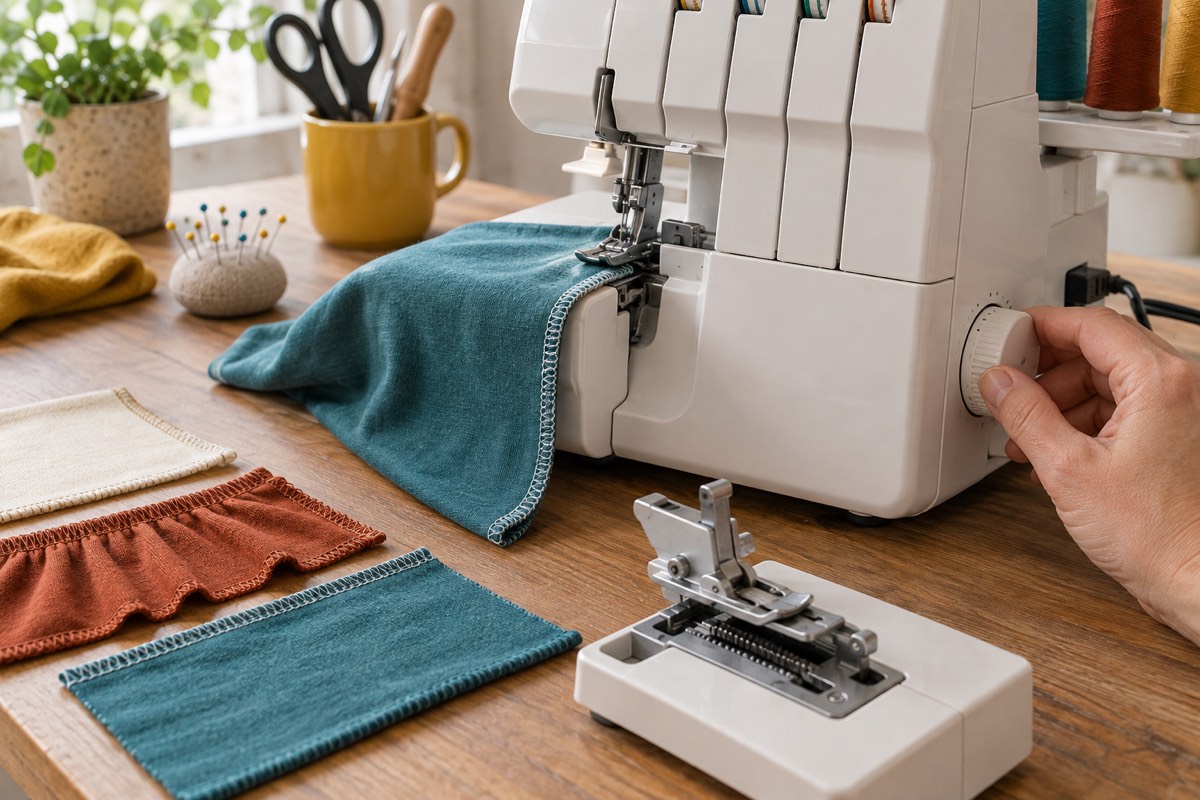
An overlocker has two feed-dog groups under the presser foot. At a neutral relationship they move fabric through at broadly the same rate. Differential feed alters one group relative to the other, changing whether the material is compressed or stretched as the stitch forms.
The dial is not a quality control and it does not simply make the machine feed “more strongly”. It changes a ratio. Numbering and direction vary, so use the symbols and examples in your own manual.
What differential feed can and cannot do
It can help control distortion created as fabric passes the needle and knife. Common uses are:
- preventing a knit edge from spreading into a lettuce-like wave;
- reducing seam puckering on some lightweight, tightly woven fabrics;
- intentionally gathering a woven or stable knit edge;
- supporting smooth feed across fabrics with different stretch behaviour.
It cannot correct incorrect threading, a damaged needle, unsuitable thread, excessive hand pulling or every fabric mismatch. Presser-foot pressure, stitch length, cutting width and tension also interact with the result.
The Brother 2104D provides differential feed in a straightforward 3/4-thread machine, making it a sensible platform for learning with labelled samples.
Brother 2104D
Best for a first-time overlocker owner who wants the core controls, useful threading assistance and a widely documented domestic model without paying for a large accessory bundle.
A compact 3/4-thread overlocker with colour-coded threading, a lower-looper threading aid, differential feed, a free arm and an instant rolled-hem changeover.
Keep in mind
- It is an overlocker, so it does not replace a sewing machine for buttonholes, topstitching or construction away from an edge.
- Threading is still a multi-step process and must follow the machine manual in the stated order.
How to flatten a wavy knit seam
A jersey edge may stretch as it passes the foot and emerge longer than it entered. On many machines, moving the differential control towards the setting that advances the front feed dogs more relative to the rear helps compress that edge back towards its original length.
Use this method:
- Cut four strips on the same grain, marking a 10 cm reference section on each.
- Return tension, stitch length and pressure to the manual’s starting values.
- Sew one strip at neutral without pulling or pushing.
- Move the differential setting one step in the corrective direction shown by the manual.
- Sew the next strip and compare the relaxed reference length and edge shape.
- Repeat in smaller increments, then press as the project will be pressed.
Do not stretch the fabric behind the presser foot to make it look flat. That can distort the sample and hide whether the feed relationship is correct.
How to address a puckered woven seam
On some fine or tightly woven materials, the stitch draws the edge shorter and produces puckers. The manual may direct the differential feed towards the opposite side of neutral so the material is presented with a slight stretch. Make a small change and inspect both the seam and the cut edge.
If that does not solve it, return to neutral and check other causes:
- reduce inappropriate needle or looper tension one control at a time;
- use a fresh needle of the specified type and size;
- lengthen an overly dense stitch;
- confirm cutting width gives the looper threads enough edge to wrap;
- support the fabric so its weight is not pulling before or after the foot.
The Janome 9300DX combines differential feed with adjustable stitch length and cutting width, giving the user the three main geometry controls needed for systematic tests.
Janome 9300DX
Best for a learner who wants clearly labelled mechanical controls, adjustable seam width and a relatively compact eight-kilogram machine.
A compact 3/4-thread overlocker with colour-coded threading, differential feed, adjustable cutting width and a retractable upper knife.
Keep in mind
- It does not include the broad table-and-feet bundle supplied with some rivals.
- As with every overlocker, stitch quality depends on correct threading, needle choice, tension and a fabric test.
Using differential feed to gather
Setting the feed relationship towards compression can deliberately gather a single layer. A longer stitch and increased needle tension may intensify gathering on some machines, but only use settings the manual permits. Leave long thread chains and avoid relying on the overlocked edge as the only structural attachment unless the pattern calls for it.
Differential gathering works most predictably on light to medium fabrics. The result depends on grain, stiffness and finish, so calculate the gathered ratio from a sample rather than a dial number. For example, if a marked 20 cm strip emerges at 14 cm, the practical result on that fabric is more informative than the machine scale.
The Brother 3034DWT includes a gathering foot as well as differential feed. The foot can help feed two layers for particular gathering operations; consult its instructions rather than assuming the dial alone controls both layers.
Brother 3034DWT
Best for a beginner who expects to sew garments regularly and will genuinely use the wider support surface and included specialist feet.
A 3/4-thread overlocker supplied with a wide table, trim trap and blind-stitch, gathering and piping feet, plus differential feed and adjustable presser-foot pressure.
Keep in mind
- The accessory bundle costs more and is poor value if you only need occasional seam finishing.
- Its maximum 1,300-stitch-per-minute speed is capacity, not a reason to rush while learning.
Build a reusable differential-feed record
For every unfamiliar fabric, staple or tape three offcuts to a card:
- neutral setting;
- one corrective setting;
- the chosen final setting.
Write the fabric, grain direction, stitch configuration, length, cutting width, pressure and threads beside them. This creates a far better starting library than a universal online chart because it reflects your machine and materials.
Judge the sample after it has relaxed. Check seam stretch, recovery, tunnelling, puckering and whether looper threads sit around—not beyond—the cut edge. Then repeat across a real seam crossing before sewing the garment.
Avoid changing differential feed and tension together. If the result improves, you will not know which adjustment mattered. A one-variable process is slower for five minutes and faster for every future project.
Frequently asked questions
What number should differential feed be for jersey?
There is no universal number. Start at the manual’s neutral mark and move incrementally in the direction it identifies for stretched edges. Different jerseys can need different settings on the same machine.
Is differential feed the same as presser-foot pressure?
No. Differential feed changes the relative movement of two feed-dog sets. Foot pressure changes how firmly the presser foot holds material against them. Both can affect feeding, but they are separate controls.
Why is the seam still wavy at the highest setting?
Check that you are moving in the correct direction, not pulling the fabric, and using an appropriate needle, stitch length, pressure and cutting width. Some very unstable fabrics need stabilisation or a different construction method.
Sources
The explanation and control boundaries use official documentation for the Brother 2104D, Brother 3034DWT, Janome 9300DX and the Janome overlocker guide.