
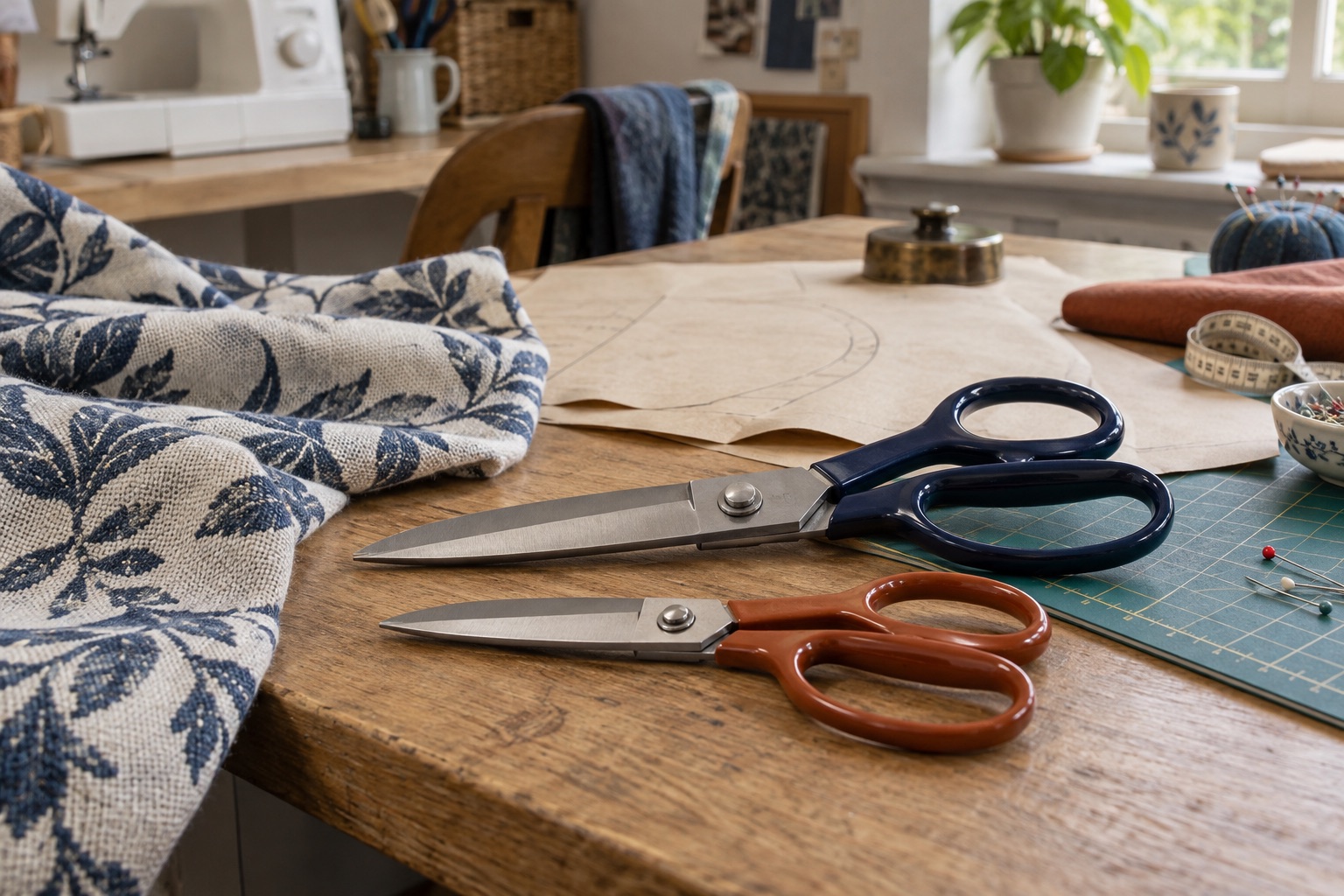
Dressmaking shears have long blades and angled handles that help keep fabric on the table while you cut. They are most valuable when cutting long pattern lines accurately, not because every project requires the heaviest pair. A comfortable, sharp, fabric-only pair is better than a large pair that strains the hand or lifts the cloth. This shortlist compares two identifiable UK-available Fiskars models, not a row of near-identical marketplace listings.
Judge fit before chasing blade length
Check whether the handle matches your dominant hand, and whether the thumb and finger openings feel comfortable. A right-handed design held in the left hand can push blades apart rather than together, leaving a ragged cut; “ambidextrous” claims should be checked carefully. The blades should open smoothly, close cleanly to the tip and cut the actual fabric without forcing the pivot. A longer blade may cover more fabric in each stroke but is harder to steer round tight curves and takes more space on a small table.
For a garment maker, 25 cm is a practical full-size starting point. For long straight cutting on medium or heavier cloth, 27 cm can be useful if the weight and grip are comfortable. Those are overall lengths, not the cutting length of the blade. Neither size guarantees success on a thick stack, coated fabric or leather; reduce layers and use the appropriate cutter and surface when needed.
Two named options with different trade-offs
Fiskars Classic Professional 1005151, 25 cm: the more manageable all-round choice here for a right-handed beginner or a mixed dressmaking setup. Fiskars specifies stainless-steel blades and a right-handed handle. It has enough length for many garment-panel cuts without dominating a compact home worktable. It may be less comfortable for very large hands or repeated long cutting runs, so handle fit still matters more than a universal “best” label.
Fiskars Classic Professional scissors 25 cm
A straightforward first dedicated fabric pair for a right-handed maker cutting garment pieces on a stable table.
A 25 cm right-handed pair with stainless-steel blades, suitable as a full-size fabric-cutting tool for a home dressmaking setup.
Keep in mind
- The handle is right-handed; left-handed sewists should select a genuinely left-handed model.
- Keep it for fabric and pattern work rather than blunting it on packaging or wire.
Fiskars Classic Tailor 1005145, 27 cm: the larger option, positioned by Fiskars for thicker fabric. Its extra length can make straighter continuous cuts on wide panels, but it can be cumbersome around necklines, pockets and other small curves. It is also right-handed. If you mainly make small projects, do not buy the longer pair just because it sounds more professional.
Fiskars Classic Tailor shears 27 cm
Worth the added length when cutting long garment lines or heavier fabric on a generous table, if the handle feels comfortable.
A larger 27 cm right-handed cutting pair positioned by Fiskars for fabric and thicker materials.
Keep in mind
- The longer blades can be awkward at tight curves or in a small cutting area.
- The handle is right-handed, and thick stacks still require controlled cutting rather than forcing the pivot.
These options are shortlisted from maker specifications and exact Amazon UK model matches; current offers can change. If you are left-handed, do not force either of these right-handed options—seek an explicitly left-handed maker model instead.
Technique changes the result as much as the tool
Pre-wash and press fabric according to the project before cutting. Lay it flat on a table large enough to support the entire pattern piece; fabric hanging over the edge can distort the shape. Pin or weight the pattern without stretching the cloth. Use long, smooth strokes on straight runs and shorter controlled strokes around curves, keeping the lower blade near the table. Do not lift the fabric to chase the blades. Trim notches carefully, often as small outward marks rather than deep cuts into a seam allowance.
Try a single layer for a slippery or uneven textile before cutting a doubled stack. If the blades snag or chew, check sharpness and pivot condition, not just technique. Fabric that is deliberately thick at a fold may be better cut in stages than crushed through closed shears. Keep fingers clear of the blade path, and close and store the shears safely between cuts.
Keep one pair for cloth
Paper patterns, tape, pins and packaging can dull or nick a fabric edge. Use separate paper scissors and small snips for threads. Wipe lint from the blades after use and follow the maker's care advice; do not oil or adjust a pivot without its instructions. If fabric begins to slide between blades despite clean alignment, seek appropriate sharpening or replacement rather than pressing harder. A rotary cutter is an alternative for long straight lines on a mat, but it adds its own safety, blade and mat requirements, so it is not the automatic first purchase.
Frequently asked questions
Are dressmaking shears different from ordinary scissors?
They usually have longer blades and an offset handle that helps fabric stay on the table. Comfort and blade condition still determine how well they cut.
Should a beginner choose 25 cm or 27 cm?
Start with the 25 cm style unless you have ample table space, larger hands or frequent long cuts through suitable heavier fabric. If possible, try the handle in person.
Can I use fabric shears for paper patterns?
You can, but keeping a separate paper pair helps preserve a clean fabric-cutting edge. Small paper scraps and pins can nick blades over time.
Sources
Fiskars' creating catalogue maps the older retail numbers 1005151 and 1005145 to its 25 cm and 27 cm Classic scissors, and describes their right-handed handles and cutting uses. You can reach the PDF from Fiskars' catalogue page. Match the actual pair to your hand and project before buying.