
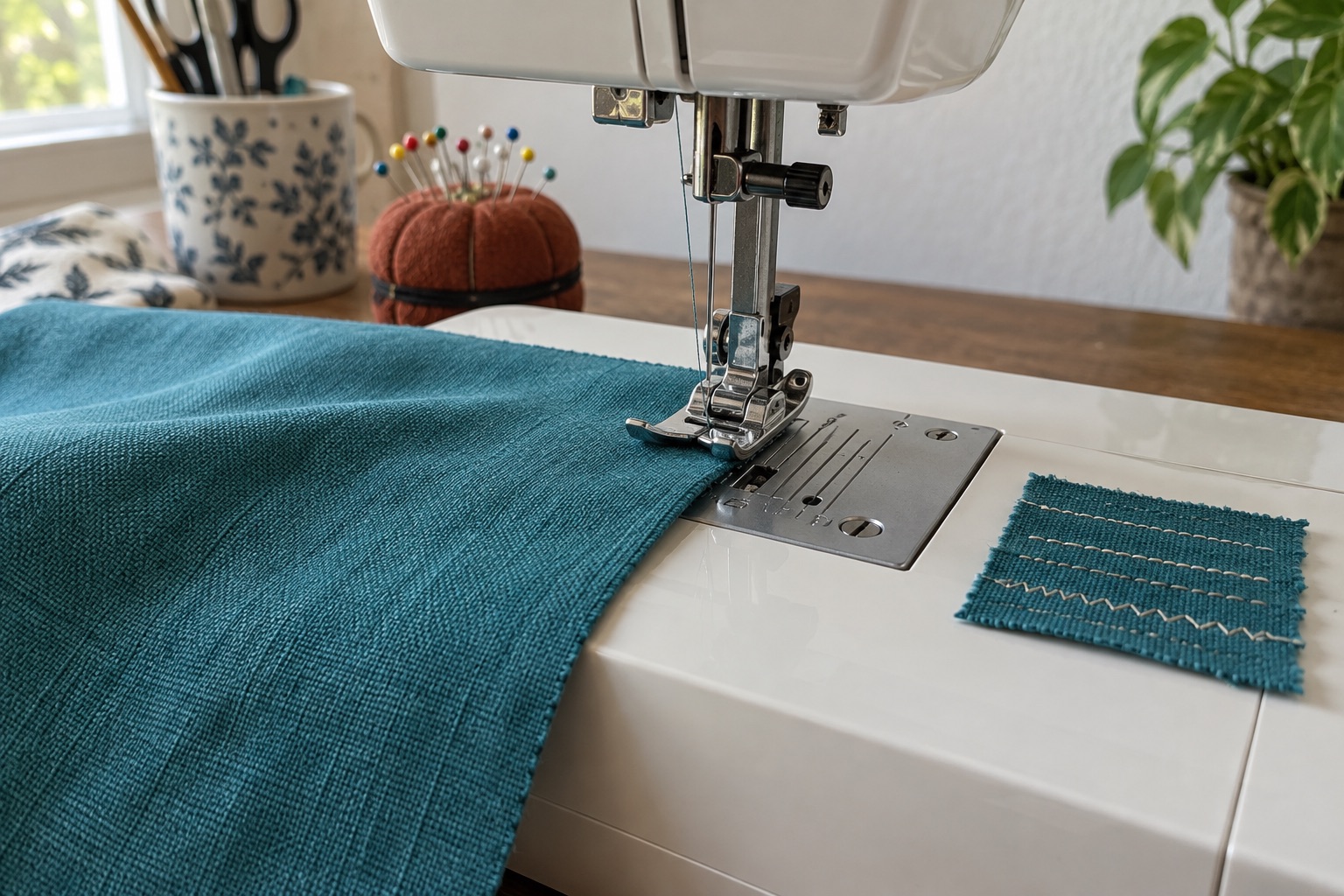
When the needle stitches repeatedly in one place, it is tempting to tug the cloth from behind. That can bend the needle, change the stitch length and turn a feeding fault into a strike against the presser foot. Stop first. A domestic machine's feed dogs—the toothed bars beneath the foot—should advance fabric while your hands guide its direction. The checks below separate a switched-off feed mechanism from a fabric-specific problem.
Is the needle moving, or has the whole machine stopped?
If the motor runs but the needle does not move, check whether the bobbin-winder spindle is still in winding position. Use the controls guide and your manual; a feed-dog adjustment will not fix a disengaged needle. If the handwheel itself will not turn freely, do not press the pedal. Unplug and follow the jam checklist.
If the needle cycles and stitches pile into one spot, the cloth is not travelling correctly. Switch off before reaching under the foot or cleaning the feed area. Remove the test cloth only once the needle is clear and the foot is raised as the model instructions require.
Check foot, feed dogs and stitch length—in that order
Presser foot. Lower the foot before sewing. A raised foot does not hold fabric against the feed teeth and often changes upper-thread tension as well. Confirm the correct foot is fitted securely and is not caught on a bulky seam edge.
Feed-dog position. Machines with a drop-feed lever can lower the teeth for free-motion work. Raise them for ordinary straight stitching according to your model manual. Some machines need one handwheel turn or a short powered cycle after the lever is moved before the teeth return fully; follow the maker's sequence, keeping fingers clear.
Stitch length. A near-zero length means little forward travel even when the teeth work. Restore an ordinary straight-stitch length from the manual for a cotton test. Do not turn random dials together, because that makes it hard to tell which change helped.
Accessible lint. Dust packed between the teeth can reduce their grip. Unplug and clean only the accessible feed and bobbin areas as the manual directs, using a suitable small brush. Do not remove internal covers or oil an unspecified mechanism.
Now test two layers of stable woven cotton with the standard presser foot. If the cloth advances normally, the issue may be a project material or seam-crossing problem rather than a broken feed system.
Why does one particular fabric refuse to move?
Very fine cloth may be drawn towards a wide needle-plate opening at the start. Begin slightly in from the edge on a supported scrap, use the correct needle and consider a manual-approved stabiliser or straight-stitch plate if your model supports one. Slippery or layered materials may shift because the upper and lower layers feed differently; pin or clip safely, support the fabric weight and test the appropriate foot on a scrap. Thick seam steps can tilt a standard foot and stall progress; our bulky-seam guide explains how to keep it level.
Do not solve a fabric-specific stall by forcing the cloth through. That risks needle deflection and a broken needle. If the underside forms a thread nest at the same point, follow thread-bunching diagnosis as a separate fault.
When is the feed mechanism itself suspect?
If clean, raised feed dogs do not move fabric on an ordinary two-layer cotton test, with the correct foot down and normal stitch length, stop. A feed-control linkage, foot mechanism or internal drive issue may require an authorised technician. A new foot or more pedal pressure is not a substitute for repair. See when to call a technician.
Frequently asked questions
Why does fabric move backwards instead?
Check whether the reverse control is engaged or a buttonhole lever is in the wrong position, using your model manual. Do not force the reverse control if it sticks.
Should I pull the fabric to help the machine?
No. Support its weight and guide the edge lightly; the feed dogs should provide the forward movement.
Can a very short stitch length make fabric seem stationary?
Yes. Return to an ordinary length for a test. If no movement follows, check foot, feed-dog position and accessible lint.
Sources
Brother's common sewing-machine problems guide names lowered feed dogs, a raised presser foot and very short stitch length as first checks. Janome UK's maintenance guide adds accessible lint and foot position. Your own manual controls the drop-feed reset and cleaning procedure.