
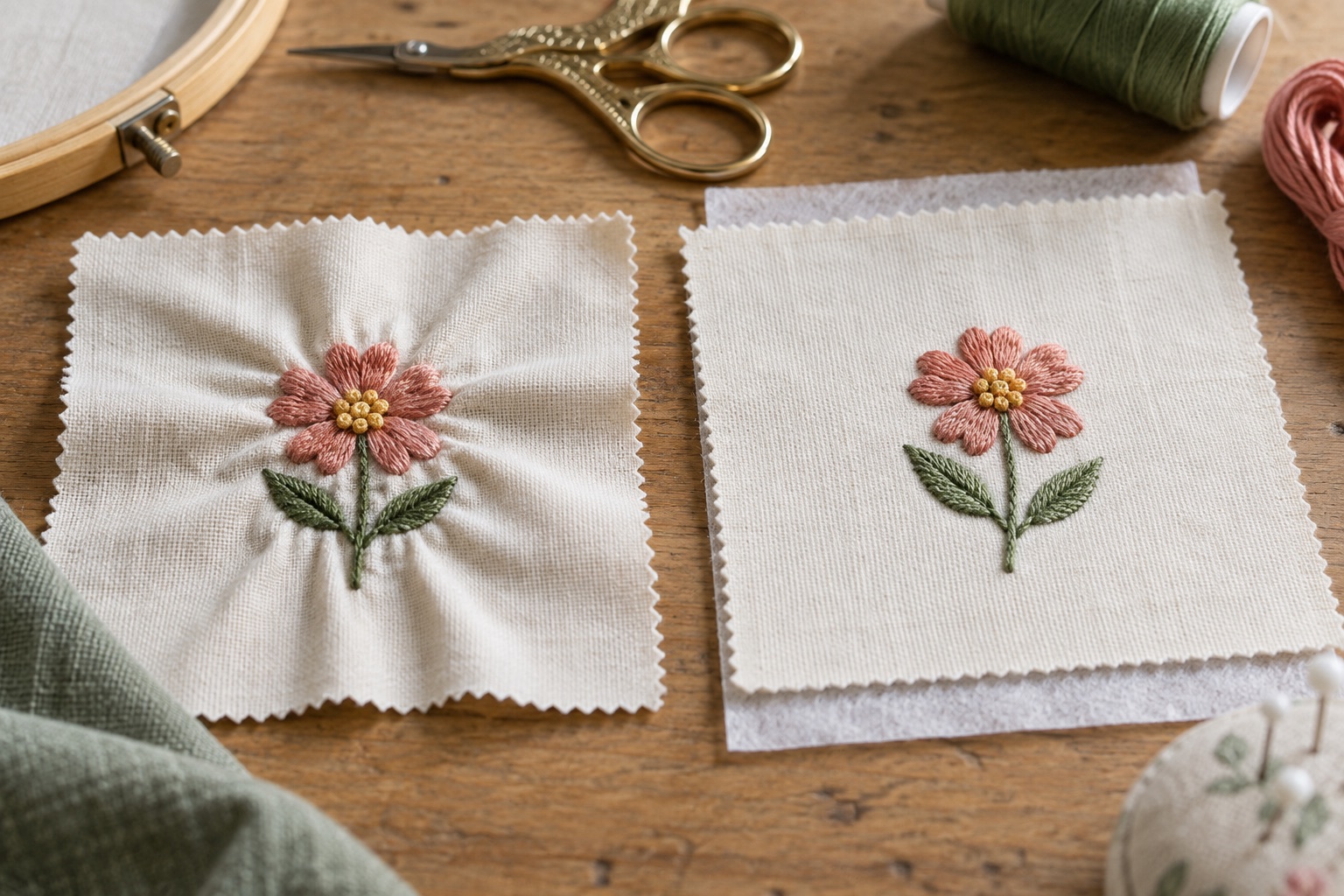
An embroidery motif pulls hundreds or thousands of stitches into a small area. If the cloth is unsupported, stretched in the hoop or asked to carry more stitch density than it can handle, it draws into wrinkles. “Turn down the tension” is tempting, but it can hide the real cause and produce loose stitching. The first question is when the fabric puckers.
During stitching, after unhooping or after washing?
If the fabric gathers while the machine is running, inspect hoop grip, backing and stitch density. If it looks flat in the hoop but wrinkles after removal, it may have been stretched into the frame and is relaxing back. If it changes only after washing, check thread and fabric care, residual stabiliser and whether the material shrank. Use a swatch from the same fabric and make only one change per test.
Four controlled checks, in order
1. Support the fabric appropriately
Read the stabiliser guide: a stable woven may suit tear-away for a light design, while a stretchy jersey often needs cut-away support that remains after stitching. Very dense fills can need more support than an outline motif. Do not assume “more layers” is always better; extra bulk may make hooping worse. Test the exact stabiliser weight and removal method.
2. Re-hoop without stretching
The fabric and backing need to be smooth and held firmly, not stretched to make wrinkles vanish temporarily. Check the underside for folded backing or a trapped garment layer. Use a hoop close to the design size when practical and approved. The hooping guide gives a repeatable sequence.
3. Check file and needle
Try a small built-in motif on the same fabric. If it stitches cleanly but a purchased dense design puckers, the design's density or underlay may be unsuitable. A damaged or wrong needle can drag fabric down into the needle plate; replace it with a type and size the manual permits for the thread and cloth. Check upper and bobbin threading before making tension adjustments.
4. Only then test tension and thread
Return to the maker's baseline. If a correctly supported sample still pulls hard around each stitch, follow the manual's embroidery-tension method, changing one step at a time. Use proper embroidery top thread and the specified bobbin thread. Madeira Polyneon 40 is one verified polyester top-thread assortment, but buying a new colour set will not remedy a mis-hooped shirt.
Madeira Polyneon 40 polyester embroidery thread set
A practical first colour range when laundering resistance matters and the machine manual permits standard 40-weight embroidery thread.
An 18-colour assortment of standard-weight Polyneon 40 polyester machine-embroidery thread in 400 m spools.
Keep in mind
- Not a bobbin-thread substitute; use the bobbin thread specified by the machine maker.
- Colour charts and screen previews are approximate; check the actual spool against fabric.
Fabric-specific differences
On jersey, avoid stretching the garment to fit the hoop and leave suitable cut-away backing in place. On thin woven cotton, test a lighter or denser design and a backing that supports it without showing through. On towels or pile, topping can keep the stitches above the surface, while backing stabilises from beneath. On a finished garment, support the free fabric so its weight cannot tug on the carriage. No single backing or tension number is right for all four cases.
When should you stop?
Stop if the needle hits the frame, thread repeatedly breaks after correct threading and fresh needles, the carriage sounds obstructed or a known-good design puckers on stable cotton with proper backing. Use the manufacturer's service channel rather than changing hook timing or internal settings. For a purely design-specific failure, ask the design supplier about its intended fabric and recommended stabiliser.
Frequently asked questions
Can ironing fix machine-embroidery puckering?
Careful pressing may soften a slight ripple on heat-safe fabric, but it does not correct severe distortion or replace a better test stitch-out.
Is my hoop too big?
A very large hoop can make a small design harder to support evenly. Use the smallest compatible frame that comfortably contains the design and allows safe carriage clearance.
Does polyester thread prevent puckering?
No. Thread quality matters, but fabric support, hooping and design density are usually more direct variables.
Sources
The diagnostic order is grounded in Brother's embroidery basics and backing guidance, Brother's puckering and feeding checks and its hoop-size and misalignment checklist. Follow the manual for your exact machine when its setup differs.