
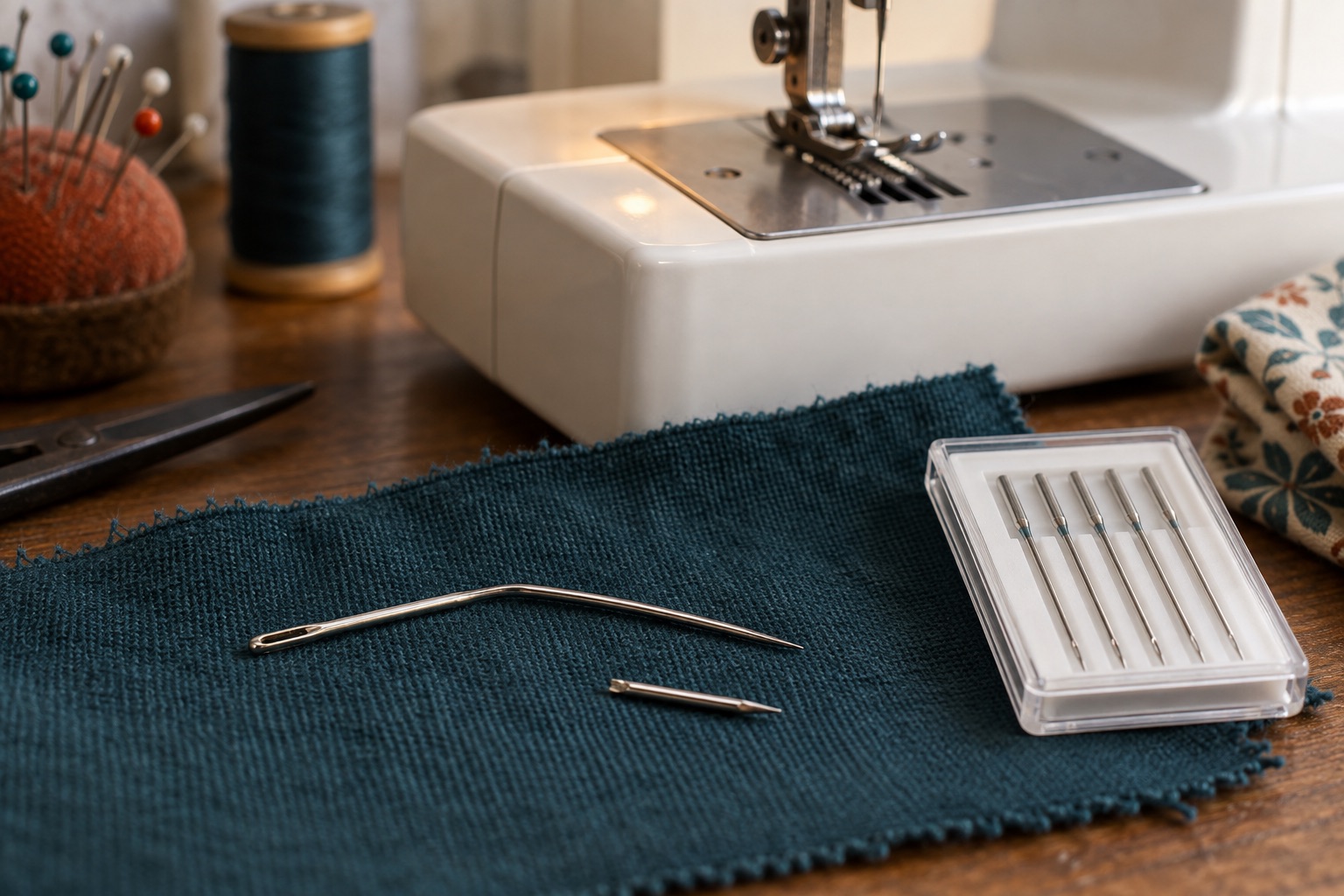
A needle that bends is being pushed off its intended path. If it breaks, the broken point can stay in the garment, bobbin area or machine. Do not sew another seam until you have found the piece and corrected the cause. A stronger needle may help with a genuinely heavier fabric, but it cannot cure a wrong foot, a mis-seated needle or a hand pulling the work sideways.
First, make the broken needle safe
Switch off and unplug. Keep feet clear of the pedal. Lift the presser foot and remove the fabric only if it moves freely; do not tug against a trapped needle. Find the shank, point and any splinters, checking the fabric and accessible bobbin area under good light. Follow your manual's procedure for opening the plate or bobbin cover. If a fragment is lodged where you cannot retrieve it without dismantling the machine, leave it for a technician. Never reach into the mechanism while power is connected.
Discard a bent needle even if it did not snap. Its tip may already be out of line and can damage the plate or hook on the next stroke. Record whether the break happened at start-up, on a wide zigzag, while reversing, or at a thick seam: that timing narrows the cause.
What made the needle move sideways?
Needle installation: A domestic needle fitted below the stop, facing the wrong way or held by a loose clamp can strike the plate. Use the needle system, orientation and insertion steps for your exact model. A newly fitted needle is not proof of a correct fit.
Foot or stitch collision: A narrow-opening straight-stitch foot paired with a wide zigzag, or a poorly attached foot, can put metal in the needle's path. With the power off, confirm the foot is seated and the stitch is compatible. If the manual allows a handwheel check, turn it slowly without fabric and stop at the first touch; do not force through a collision.
Fabric drag: Pulling from behind or pushing from the front deflects the needle. Let feed dogs transport the fabric and support its weight, especially a quilt or heavy garment. At a thick step, a presser foot tilted sharply up can bend the needle; use the bulky-seam technique and slow down rather than forcing the pedal.
Wrong needle for the job: An exhausted, fine or unsuitable point may struggle with denim or multiple layers. Our needle types and size guide explain the fabric/thread match. Not every machine is rated for every thickness, however, and a jeans needle does not increase motor or clearance capacity.
The SCHMETZ universal assortment below suits common woven-fabric testing only on machines specified for domestic 130/705 H needles. The jeans assortment is a considered option for denim on compatible machines. If you already have correctly sized, undamaged needles, use those; neither purchase solves a foot collision.
SCHMETZ Universal needles, assorted sizes
A practical starting pack when the machine manual specifies the flat-shank 130/705 H system and your projects vary in fabric weight.
A ten-needle assortment spanning 70/10 to 100/16 for sampling fine-to-medium woven fabrics and ordinary sewing thread.
Keep in mind
- Universal point is not the first choice for very elastic knits.
- Check the needle system in your machine manual before buying.
SCHMETZ Jeans needles, assorted sizes
Choose the smallest size that forms a clean stitch through the actual denim layers without deflection, starting with a fresh needle.
A five-needle 130/705 H-J assortment in 90/14–110/18 for testing denim, twill and canvas of differing weights.
Keep in mind
- A larger needle cannot give a domestic machine unlimited piercing or presser-foot clearance.
- 110/18 may leave excessive holes in lighter denim.
A controlled retest
Install a fresh appropriate needle and check foot clearance with the machine off. Restore a simple straight stitch, then sew two layers of ordinary woven cotton at moderate speed without steering against the feed. If that succeeds, try a scrap of the project fabric, flattening or grading a bulky intersection as appropriate. Change only one factor at a time. If a needle breaks specifically on a decorative stitch, recheck the needle/foot opening rather than treating it as a general fabric problem.
When should you stop?
Stop for a repeated plate or hook strike, a new mechanical knock, a needle that visibly leans despite correct fitting, a handwheel that binds, a damaged plate, or any missing fragment. Internal alignment and hook timing are technician work. Our service decision guide helps you describe the fault clearly.
Frequently asked questions
Why does the needle break on thick seams?
An abrupt height change can tilt the foot and deflect the needle, especially if you pull the fabric. Level the foot, support the fabric, slow down and check that the machine and needle are suited to the total thickness.
Can a wrong presser foot break a needle?
Yes. A stitch wider than the foot opening can cause a direct strike. Verify the foot and stitch pairing before restarting.
Can I straighten and reuse a bent needle?
No. Replace it and find out what bent it; a damaged tip may harm the fabric or machine.
Sources
Brother's needle-breakage guidance covers installation, damaged needles and fabric pulling. Its further troubleshooting includes presser-foot and heavy-fabric checks. Janome UK's maintenance guide also addresses needle breakage. Use your own manual for compatible needles, foot clearance and safe access.