
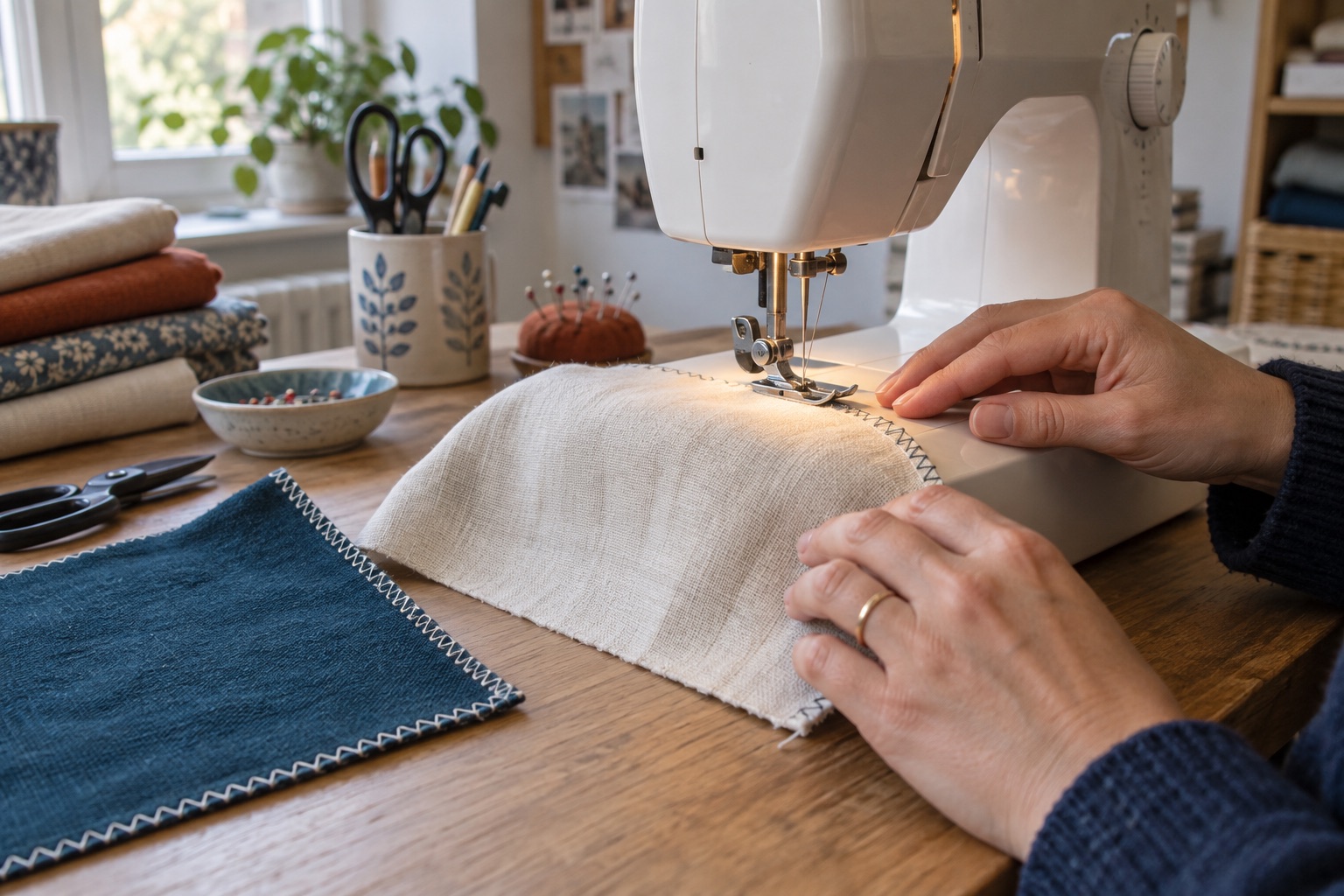
The name causes confusion: an overcasting foot fits an ordinary sewing machine; an overlocker is a separate machine with loopers and usually a knife. The foot's guide keeps the cut fabric edge consistently beside a compatible stitch. Some designs include a small stitch finger that supports the thread as it swings over the edge, reducing the tendency for the fabric to roll into a tight cord. Neither feature cuts the edge or joins four threads.
What result should you expect?
Use it mainly to tidy the raw seam allowance of a woven garment or homeware item that frays. A properly chosen zigzag or dedicated overcast stitch crosses the edge without tunnelling. The stitch may sit next to, or integrate with, a construction seam depending on the pattern and machine stitch. On very sheer fabric, a French seam can enclose the edge more attractively. On knit, an ordinary overcast stitch can be too rigid or wavy; test stretch-compatible stitches first. If you repeatedly sew knit garments and value speed, the overlocker decision guide explores the separate machine.
An “overlock foot” product name does not mean the foot turns your domestic machine into an overlocker. Avoid marketplace attachments promising a professional serged edge without checking what mechanism they actually provide.
How to test the foot on a raw edge
Cut a stable scrap from the project fabric. If the edge is already ragged, trim it neatly before sewing; the foot cannot correct a wildly uneven allowance. Switch off and attach the foot specified by the machine maker. Select the specific stitch recommended for that foot in the model's manual. Some overcast stitches move the needle in more than one position, and a narrow metal guide can be struck if the wrong width is chosen. Turn the handwheel through a complete stitch cycle with the foot down before using the pedal.
Place the raw edge against the foot guide, not underneath a metal finger unless the instructions say so. Feed at a moderate pace while allowing the feed dogs to move the material. Do not tug to keep the edge aligned. Press the finished allowance as the fabric permits and check that the stitch encloses the cut threads without drawing the fabric into a ridge. If it rolls, move to an approved wider stitch or change the edge position on a fresh scrap; do not keep increasing upper tension blindly.
Why does the finish look worse than a plain zigzag?
If the edge curls inward, the stitch may be too narrow or too dense for the fabric, or the guide may be carrying too much thread. If the edge remains frayed, the stitch is too far inside the fabric or the cut is uneven. If the machine skips stitches, check the needle type and size and thread path rather than blaming the foot immediately. A very soft knit may need a stretch needle, a different stitch and careful foot pressure. A tidy sample matters more than the accessory's name.
A precise product option, with a fit boundary
Brother lists the F015N as an overlock foot for overcast stitches and gives a model compatibility list. The exact F015N code appears in the Amazon UK listing below. It is a sensible example only for a machine Brother confirms is compatible. A Brother LX17 and many other models appear on the maker's page, but check your exact model and manual rather than assuming brand-wide fit. If your accessory drawer already holds an overcasting foot or the ordinary zigzag foot makes an acceptable sample, keep using it.
Brother overlock foot F015N
Useful when woven raw edges repeatedly curl or wander under an ordinary zigzag foot and the exact model lists F015N as compatible.
A guided overcasting foot for a compatible domestic Brother machine's overcast stitch; it does not cut the edge or replace an overlocker.
Keep in mind
- Use only permitted stitch patterns and widths; the needle must clear the guide.
- Overlocking is a separate machine process with loopers and often a cutting knife.
Frequently asked questions
Can an overcasting foot cut fabric?
No. It guides stitches; an overlocker generally has a cutting knife. A separate side-cutter attachment is yet another device and should not be confused with this foot.
Do I need a special overcast stitch?
Use whichever stitches your machine's manual explicitly permits with its foot. A zigzag may be enough, but the needle must clear the guide at the selected width.
Is this the best finish for every garment?
No. A French seam suits some light wovens, a bound seam may suit unlined jackets, and a stretch construction needs movement. Choose the finish for fabric and use.
Sources
Brother's F015N overlock-foot specification identifies its use and compatible machines. Janome UK's sewing how-to library demonstrates its overedge and overcast feet. Our seam-finish guide explains alternatives on the same domestic machine.