
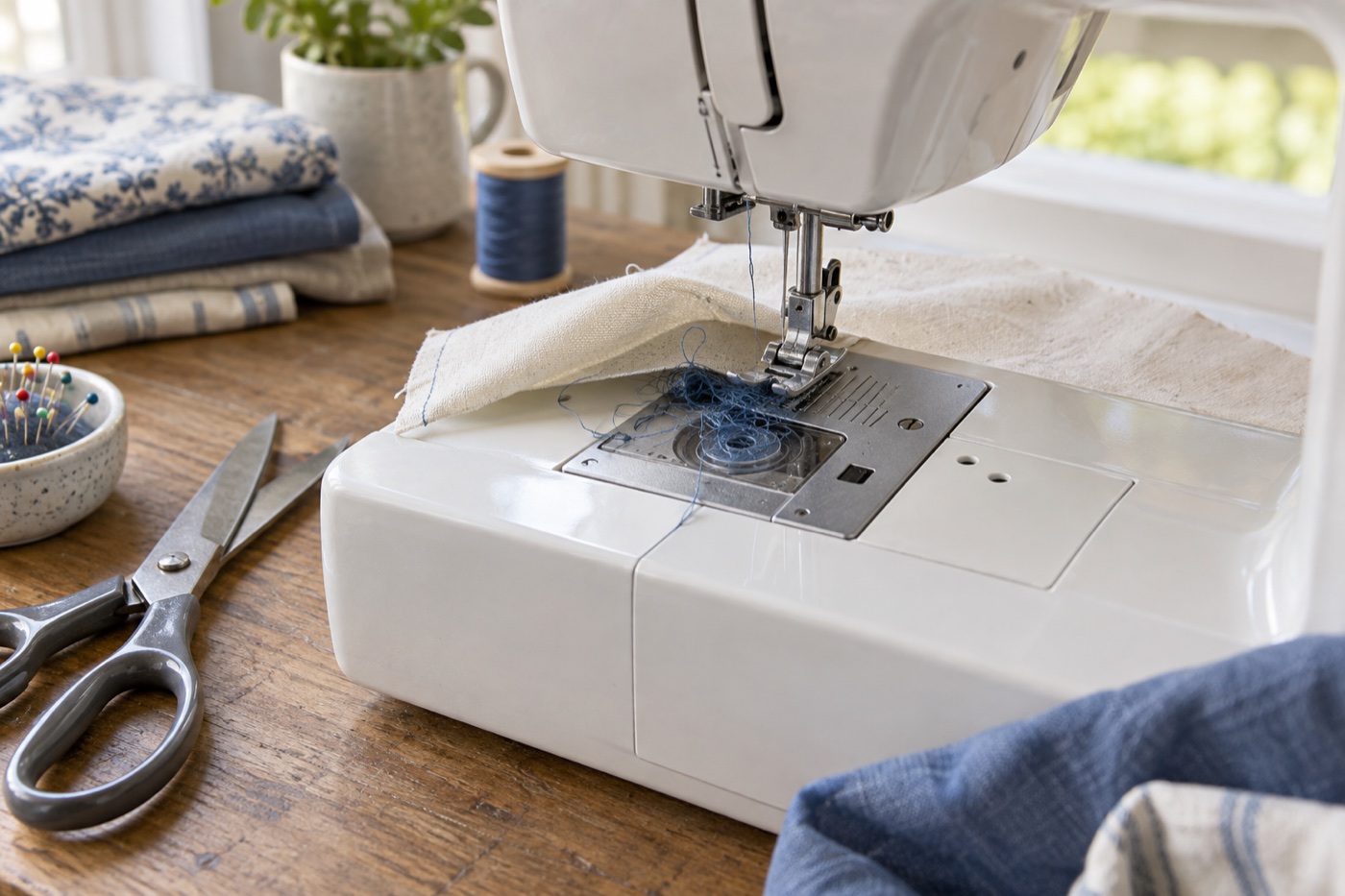
A tangle under a seam is often called a bobbin fault because that is where it appears. On a lockstitch machine, however, loose upper thread can be dragged below and build into a nest when it has missed the take-up lever or tension discs. Brother's fault guidance specifically begins with the upper path. Do not turn the bobbin-case screw before those reversible checks.
Stop and free the cloth without forcing the hook
Release the pedal or stop button as soon as the fabric stops advancing. Switch off and unplug before putting fingers under the foot or opening the bobbin area. Raise the needle only if the handwheel moves freely in the manual's direction. Lift the presser foot and gently remove the fabric; if threads trap it, snip the threads close to the fabric and the underside where you can reach them safely. Do not yank the project or lever a stuck needle sideways. If the handwheel is locked, follow the jam guide and stop if accessible clearing does not release it.
Remove all loose thread snippets from the needle-plate and bobbin area according to the manual. Check the needle for bending or a strike and replace it before sewing again. A scratch on the plate or bobbin case can keep catching thread and may need a technician.
Completely rethread the upper path
Raise the presser foot before removing and replacing upper thread so the tension path opens. Raise the needle and take-up lever. Trace the thread from spool through every numbered guide, between the tension discs, through the take-up lever, past the needle-bar guide and through the needle in the model's correct direction. If you cannot see the take-up lever, use the manual's diagram rather than guessing. Make sure the spool does not catch on its notch and the cap matches its size.
Test with quality machine-sewing thread if the existing spool is fuzzy, old or intended for hand sewing. The Gütermann Sew-All product below is a consistent control spool; the linked colour is white, so it may not match the finished garment.
Gütermann Sew-All polyester thread, white
A reliable general-purpose thread family for mixed garment fabrics; choose the shade that blends with your project rather than buying white by default.
A 100 m spool of 100% polyester Sew-All thread for everyday construction seams, repairs and machine sewing.
Keep in mind
- The linked listing is white; match colour locally if needed.
- It is not the same as a deliberately heavy decorative topstitch thread.
Check the bobbin without making a risky adjustment
Confirm the bobbin is wound evenly, undamaged, inserted in the direction shown on the cover or manual and pulled into its tension slot. A slightly different bobbin can sit in the case and still feed badly. The Brother SFB/SA156 pack below is suitable only for models that explicitly specify it; see bobbin compatibility. Do not mix an unknown bobbin into the test just to see if it fits.
Brother 11.5 mm sewing-machine bobbins, pack of 10
A useful spare set after confirming the exact Brother model's bobbin part code in its manual or support page.
Ten 11.5 mm plastic bobbins for Brother machines whose manual explicitly specifies SFB or SA156; not a universal bobbin replacement.
Keep in mind
- Do not use if your machine specifies another bobbin height, shape or material.
- The Amazon title alone does not prove compatibility with every Brother machine.
Start with a controlled seam
Replace covers, put two layers of plain cotton under the foot, lower the foot and hold or position the thread tails as your manual describes for the first stitches. Begin a short distance in from the raw edge so the fabric is supported by the feed dogs. Sew slowly, then inspect both sides. A clean control seam suggests the earlier threading, bobbin or start position caused the nest. If loops remain regular but not tangled, consult the tension guide and adjust only after documenting the default. If nests return immediately with a correct setup, seek service rather than forcing more seams.
Frequently asked questions
Is thread underneath always a bobbin problem?
No. A missed upper take-up lever or upper tension path commonly lets upper thread collect below the fabric.
Should I increase upper tension to remove the nest?
Not first. Rethread with the foot raised, check the bobbin and make a clean test. An extreme dial change can conceal rather than solve the error.
Why does nesting happen only at the start of a seam?
Check thread-tail length, whether the presser foot was lowered, and whether the first stitch is too close to an unsupported raw edge. Follow your manual's starting technique.
Sources
Brother's common-problems guidance names the raised-foot upper path, take-up lever, bobbin seating and normal tension as the first nesting checks. Follow your model manual for clearing trapped fabric and the bobbin direction.