
Stabiliser is a support layer that helps fabric resist the repeated needle penetrations of machine embroidery. The right type depends first on whether the fabric stretches, then on its surface texture and the density of the design. A poor choice can leave puckering, sagging stitches or a stiff patch even when the machine and file are sound.
Decide what remains and what disappears
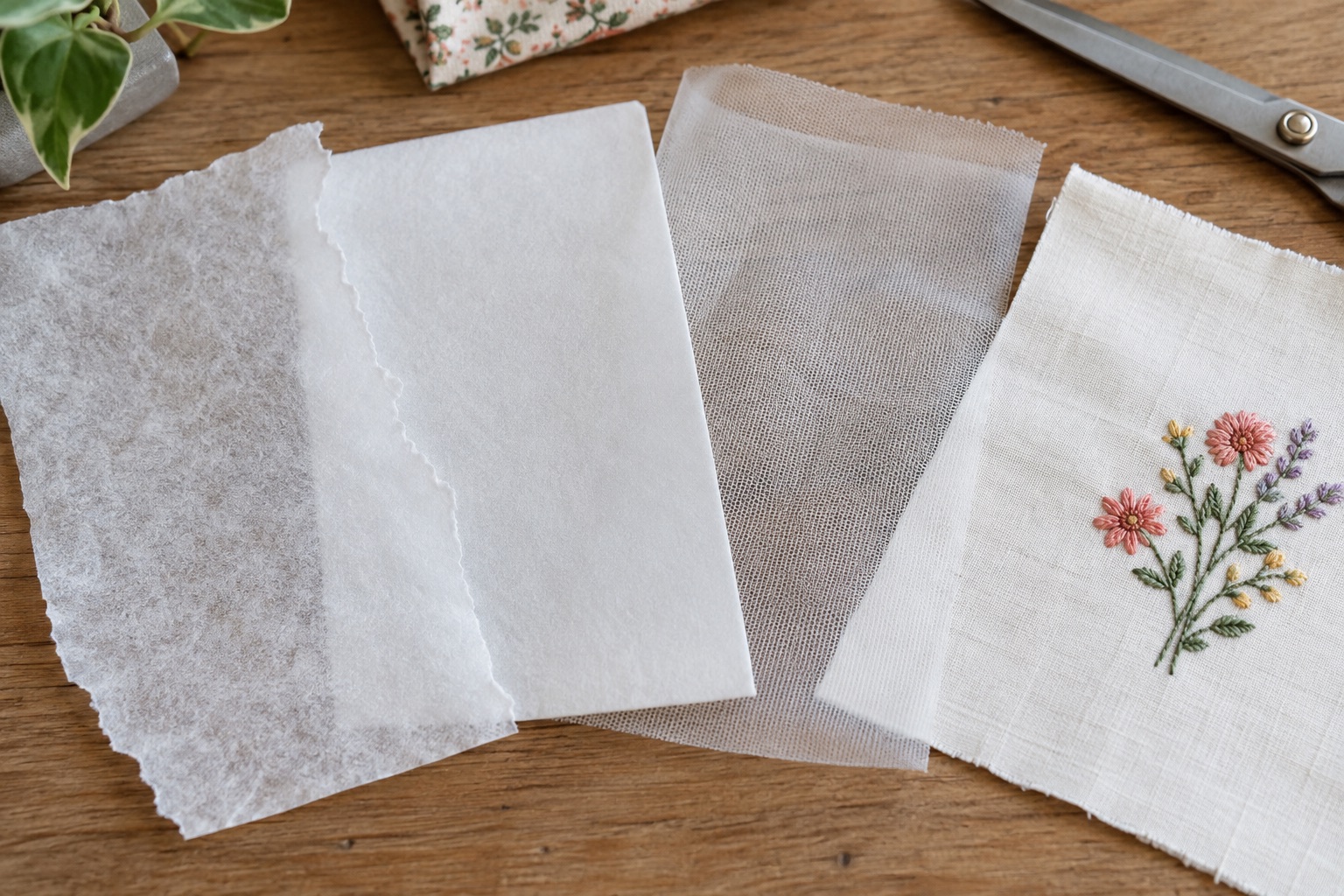
Backing sits behind the fabric during stitching. Topping sits on its face, mainly to prevent stitches sinking into pile. The terms describe position, not material: water-soluble stabiliser can be a thin film on top or a stronger non-woven backing underneath. Read the product's stated use and removal method before cutting it.
For a first test, choose a medium-density design on stable cotton. The Brother M330E is a compact machine for this kind of small motif; its 100 × 100 mm field is more than enough for a labelled stabiliser sampler. The stabiliser decision remains the same on a larger machine such as the Janome MC100E; extra field area does not correct unsuitable backing.
Brother Innov-is M330E
Best for a beginner who already owns a sewing machine and wants a guided, connected route into small motifs, names, labels and monograms.
A compact embroidery-only machine with a 100 × 100 mm field, colour touchscreen, 135 built-in designs, USB and wireless design transfer.
Keep in mind
- The 100 × 100 mm field limits large designs and does not describe the overall size of the project that can be hooped.
- Design files, stabiliser, embroidery needles and thread add to the working budget.
Tear-away: stable fabrics and craft projects
Tear-away is usually a non-woven sheet that perforates around the stitches and can be removed after the design is complete. It is a reasonable starting backing for stable woven cotton and projects where a slightly firm reverse is acceptable. It is less convincing on a T-shirt that must stretch repeatedly: removing support can allow the stitched area to distort in wear and washing.
Use enough material to be held securely in the hoop beyond the stitching field. After stitching, support the design with one hand and tear slowly with the other rather than pulling at delicate satin columns. Some material remains beneath dense stitches; do not dig it out and damage the thread. Adhesive-backed or iron-on variants have separate handling instructions, so check heat tolerance and residue on the project cloth.
Cut-away: jerseys, clothing and repeated washing
Cut-away does not tear out. It remains behind the motif to support stretch and repeated handling. Brother's stabiliser guidance favours cut-away for stretchy fabrics and garments that need continuing support. A soft or no-show mesh version can reduce a visible backing outline under light fabric, but the right weight still depends on stitch density and stretch.
Do not pull the jersey tight in the hoop; it should be held flat without pre-stretching. After stitching, trim the backing carefully outside the design, keeping scissors away from the garment. If the reverse touches skin, consider a suitable soft cover layer after the work is finished, following its care instructions. On very sheer fabric, visible cut-away may be unacceptable, so test a different design and stabiliser method rather than hiding the problem with more layers.
The Janome MC100E has a larger included 140 × 140 mm hoop, but larger designs can also carry more stitches and demand more stable backing. Plan stabiliser area for the whole hoop rather than the motif alone.
Janome Memory Craft 100E
Best for a beginner who values a larger square design field over wireless transfer and already has a separate machine for ordinary sewing.
An embroidery-only machine with a 140 × 140 mm included hoop, 274 built-in designs, colour screen, USB transfer and a swing-out embroidery arm.
Keep in mind
- It is heavier than the compact Brother options and needs clearance for the swing-out arm.
- USB transfer is practical but less seamless than a wireless app workflow.
Water-soluble: topper or complete removable backing
A thin soluble film placed on top of towels, fleece or other pile keeps stitches from disappearing between fibres. It supplements the backing; it is not automatically sufficient support underneath. A stronger water-soluble non-woven can support projects where the backing must disappear, such as freestanding lace or some sheer fabrics, but the design must be suitable for that construction.
Before wetting a finished item, check that the fabric, thread and any temporary marking can tolerate water. Remove excess film gently and follow the stabiliser maker's rinse instructions. Do not assume that every soluble product is interchangeable: a delicate topping film may break down too readily to act as a full backing.
Make one sample that answers the real question
Use an offcut from the actual project, with the same number of layers and the same laundering or pressing treatment. Stitch a small design at its intended density. Let it relax; then look at the face, reverse and fabric around the motif. Check for puckering, a visible backing halo, stiffness, buried stitches and whether the fabric can still drape or stretch as needed.
If it puckers, do not immediately add more top tension. Check whether the fabric was stretched in the hoop, whether backing is strong enough, whether the needle is suitable and whether the design is too dense for the cloth. Change one variable per sample. Keep labelled swatches for future projects: a generic chart is a starting point, but your fabric-and-design combination is the useful evidence.
Frequently asked questions
Can I use tear-away on a T-shirt?
For a garment that stretches and is washed repeatedly, cut-away is generally the safer first backing. A very light design may behave differently, so test the actual cloth and do not treat a successful first stitch-out as proof of long-term support.
Is water-soluble stabiliser always a topper?
No. Thin films are commonly used on pile; stronger soluble non-woven sheets can be used as backing in suitable designs, including freestanding work.
Why does my design sink into a towel?
Pile can rise around the thread. A water-soluble film on the surface helps keep stitches visible, while the backing underneath is chosen according to the towel and design.
Sources
The material and removal distinctions follow Brother's introduction to machine-embroidery stabilisers and its fabric-and-stabiliser lookup.