
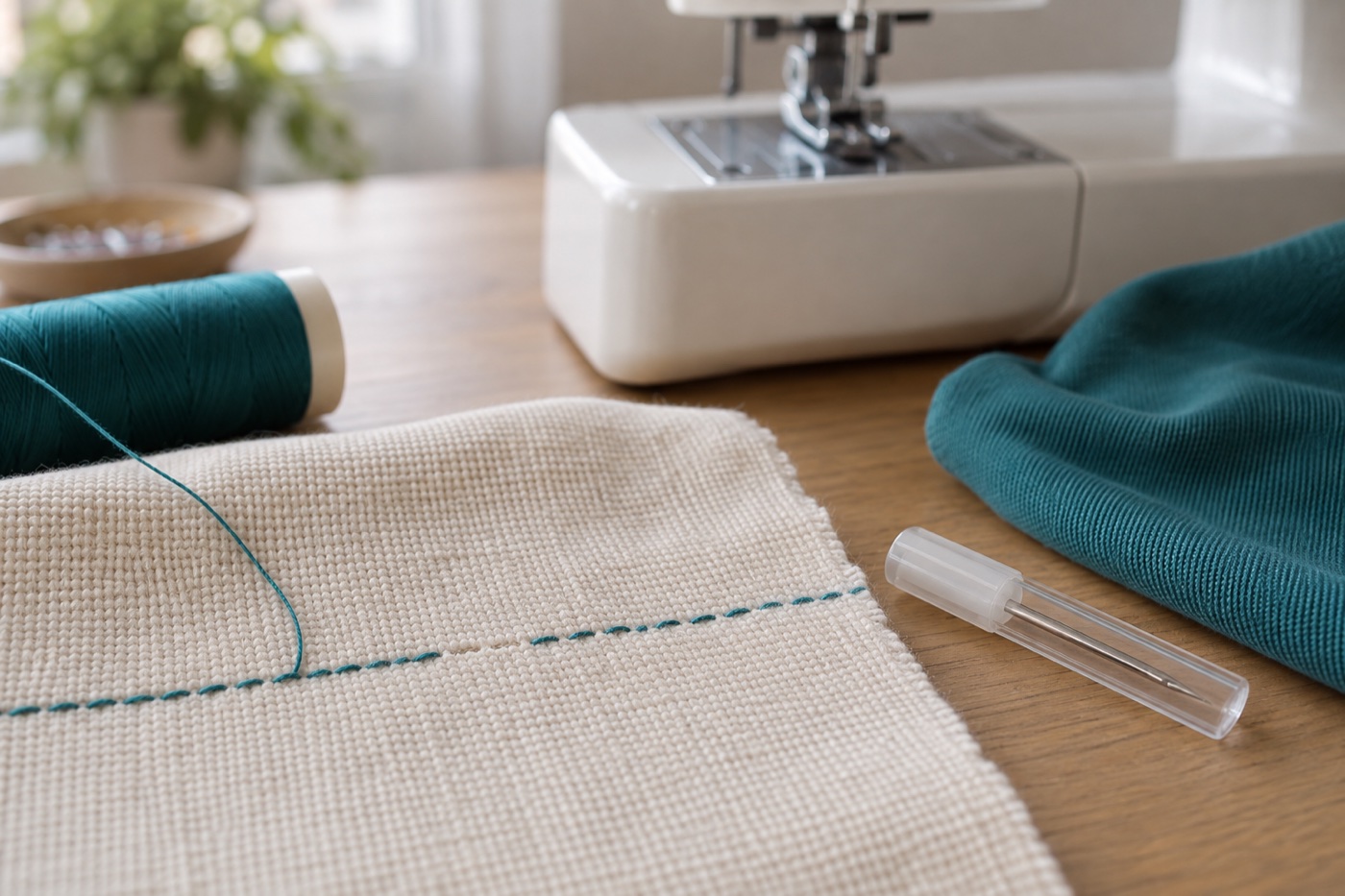
A skipped stitch is a gap where the needle penetrates but the upper and bobbin threads fail to lock together. One occasional miss and a repeating skip on every stitch are different symptoms. Note whether it happens on every fabric, only on elastic jersey, or only as the foot climbs a seam step. That pattern tells you more than a tension-dial number.
Make one fair control test
Switch off before changing the needle. Remove a suspect needle and fit a fresh needle in the exact household system and orientation stated in the manual, pushed fully up into the clamp. Check that the screw is secure. Rethread the upper path with the presser foot raised; inspect the bobbin insertion. Put two layers of stable woven cotton under the all-purpose foot, lower it and sew a medium-length straight stitch with ordinary machine thread. Do not pull the fabric from behind. If the control seam is clean, the machine can form a normal stitch and the original fabric or seam geometry needs attention.
A SCHMETZ Universal assortment is a practical control for common wovens if your machine takes 130/705 H needles. It supplies multiple sizes; choose one that carries the thread without punching excessive holes.
SCHMETZ Universal needles, assorted sizes
A practical starting pack when the machine manual specifies the flat-shank 130/705 H system and your projects vary in fabric weight.
A ten-needle assortment spanning 70/10 to 100/16 for sampling fine-to-medium woven fabrics and ordinary sewing thread.
Keep in mind
- Universal point is not the first choice for very elastic knits.
- Check the needle system in your machine manual before buying.
Choose point and size for the actual fabric
On stable jersey, try a Jersey ballpoint first. On highly elastic fabric with continued skips, SCHMETZ's Stretch geometry is a targeted option. It is not a cure for the wrong stitch type: a straight seam can still snap when stretched. The Stretch pack below is for compatible domestic machines and elastic fabrics, not an automatic upgrade for woven cotton.
SCHMETZ Stretch needles, assorted sizes
A targeted alternative when elastane-rich jersey, rib or activewear skips despite correct threading and a fresh Jersey needle.
A five-needle 130/705 H-S pack with stretch-needle scarf and eye geometry intended to reduce skipped stitches in elastic fabrics.
Keep in mind
- It does not replace a stitch that can stretch with the garment.
- Test size against the fabric and thread rather than assuming 90/14 is always safer.
On denim, a Jeans needle is reinforced for firm woven layers, but size must still suit thread and stack. A thick needle in thin cloth can leave holes; a fine needle at a bulky hem may deflect. Compare a 90/14 with a 100/16 on a true seam-crossing sample and stop if the needle bends or the handwheel binds. See our needle-size guide for the number system.
SCHMETZ Jeans needles, assorted sizes
Choose the smallest size that forms a clean stitch through the actual denim layers without deflection, starting with a fresh needle.
A five-needle 130/705 H-J assortment in 90/14–110/18 for testing denim, twill and canvas of differing weights.
Keep in mind
- A larger needle cannot give a domestic machine unlimited piercing or presser-foot clearance.
- 110/18 may leave excessive holes in lighter denim.
Support the fabric as the needle withdraws
Very elastic fabric can rise with the needle instead of remaining against the plate, disturbing loop formation. Support it on the table, avoid pulling, and consider the stabiliser or needle recommendation in the machine manual. At a thick folded seam the foot can tilt and feed unevenly; level the foot with a suitable tool or folded scrap behind it, then advance slowly. Our bulky-seam technique covers that separate problem.
Confirm the foot and stitch are compatible. A narrow-hole straight-stitch foot or plate must not be used with an offset or wide stitch. Rotate the handwheel to check clearance after any foot or needle-position change. A nicked needle plate can abrade thread; a bent needle must be replaced after a strike.
When the simple checks are exhausted
If a fresh correct needle, proper threading, clean accessible bobbin area and stable cotton control sample all still skip repeatedly, stop. Hook timing or a damaged hook may need an authorised technician. Do not adjust internal timing yourself from a general video; the procedure and tolerances vary by machine, and forcing it may worsen damage.
Frequently asked questions
Why does my machine skip only on jersey?
The fabric may move with the needle, or the point and scarf may not suit its elasticity. Try the appropriate Jersey or Stretch needle and test fabric support before assuming a timing fault.
Does a larger needle always stop skipped stitches?
No. Size must suit thread and fabric; type, correct insertion and fabric movement matter too.
Are skipped stitches a tension problem?
Not usually the first diagnosis. Rethread and replace the needle before changing tension. Persistent skips on plain woven control cloth justify service advice.
Sources
Brother's common machine problems guide prioritises needle, threading, fabric combination and service where those fail. SCHMETZ's Universal, Stretch and Jeans specifications underpin the material-specific options.